

A generation on hold: Education under strain in Lebanon
Between displacement, school closures, and widening inequality, Lebanese children are struggling to hold on to learning as crisis after crisis reshapes their classrooms—and their futures.



 Messenger
 Whatsapp
 Threads
 Email
Email
 Print
Print
 X
X
 Facebook
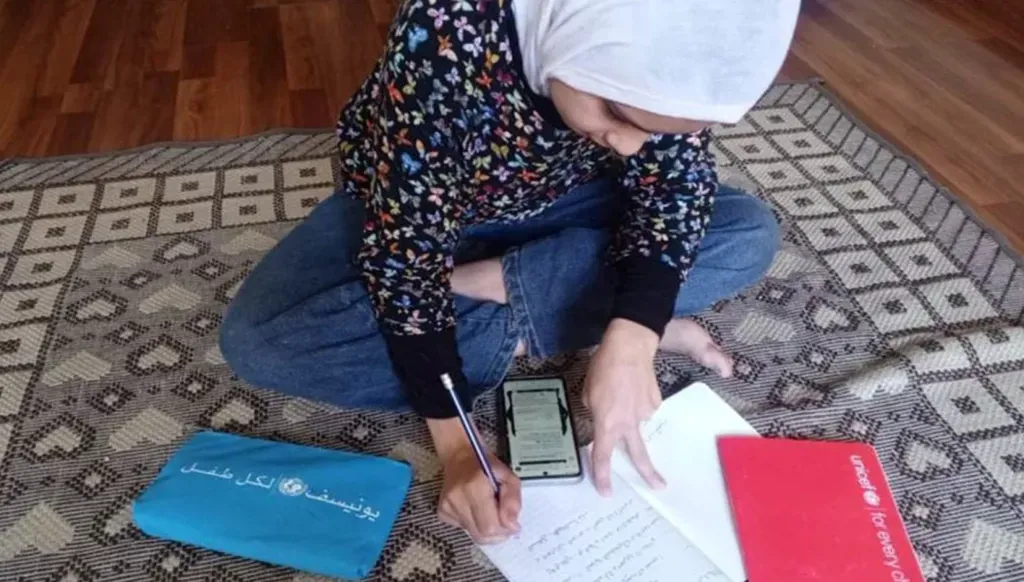


Nothing is more painful than when your “rights” turns into “dreams” you can only wish to achieve. There, in schools that once had classrooms guiding children toward a promising future, students are now taught only one lesson: how to adapt to displacement in Lebanon?
And while book boxes have turned into wardrobes and blackboards into silent walls, the destruction of war has not been limited to buildings alone. It has also destroyed dreams, to the point that some parents are now seriously considering withdrawing their children from school.
In shelter centers, students are almost cut off from the internet, which has become the only thread of hope for continuing their education. They have nothing but small screens, most of them broken, as if reflecting the image of their fractured dreams.
One mother speaks about her daughter who dreams of becoming an engineer, and her son who aspires to become an officer in the Lebanese army, but the war has stolen their focus and placed a heavy burden on their mental health.
A widening education gap in Lebanon
Meanwhile, a number of students are still receiving in-person education, which is deepening the divide among children in Lebanon. In this context, the Education Programme Manager at UNICEF in Lebanon, Atef Rafik, explains that the country has been going through a series of crises for years, starting with the COVID-19 pandemic, followed by the economic crisis, and then the war, making in-person education even more important.
He notes that around one thousand schools are still operating, either in person or online, with approximately 180,000 students continuing their education in person or through a blended system, compared to about 147,000 children learning remotely after their schools were turned into shelters or closed.
To ensure the continuity of education, Rafik explains that the Ministry of Education has adopted three strategies supported by UNICEF: online learning through the platforms Microsoft Teams and Madrasati, in addition to low-tech solutions such as the “Call and Learn” line in partnership with Teach for Lebanon, along with the distribution of printed materials in the most affected areas. Around 40,000 teachers have also been enabled to use Microsoft Teams, with students provided with dedicated accounts, which has allowed for remote educational interaction.
What about the other students?
However, the greater concern remains for children who cannot access the internet or a teacher, especially in shelter centers. From this perspective, Rafik says that “the focus is currently on psychological support and recreational activities, as a step toward gradually reintegrating these students into education, with plans to allocate learning spaces inside shelter centers.”
As the school year approaches its end, he notes that the Ministry of Education is “trying to ensure a minimum level of education, particularly for students in official exams.
However, the biggest challenge is learning loss, as estimates indicate that about half of the students are below the required level, especially in reading and math skills. This calls for a national plan to make up for this decline, at a time when the risks of school dropout, child labor, and early marriage are increasing.”
Between small screens in shelter centers and interrupted lessons, education is no longer a basic right, but a daily burden carried by an entire generation under catastrophic circumstances. And how long will children continue to bear the cost of a crisis they never chose to live through?