

War in the age of algorithms: How data and AI are rewriting the rules of conflict
From withheld satellite images to AI-driven strikes, the new battlefield is no longer defined by weapons alone—but by who controls information, algorithms, and the power to decide life and death.



 Messenger
 Whatsapp
 Threads
 Email
Email
 Print
Print
 X
X
 Facebook
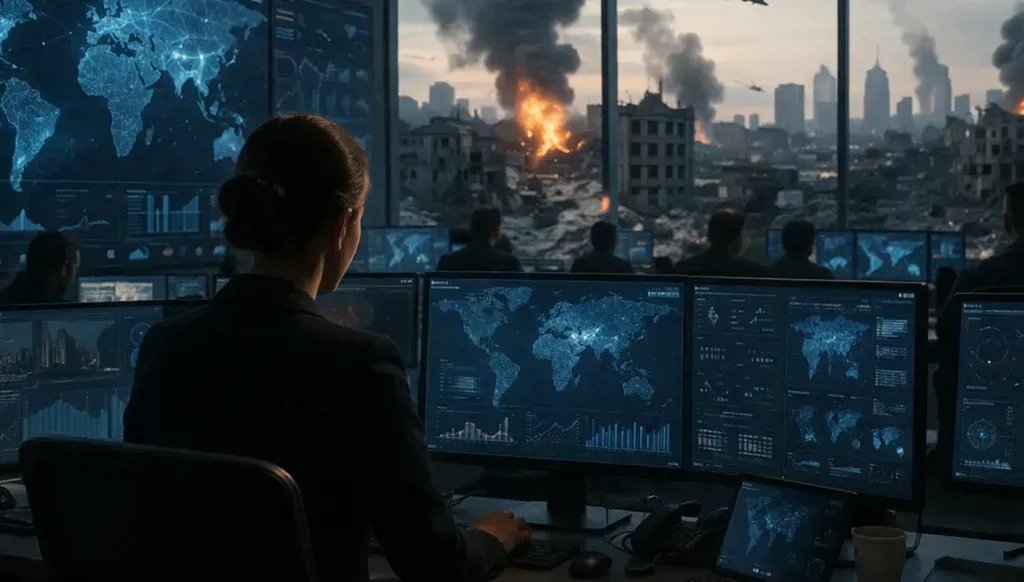


The decision to withhold satellite images of areas in the Middle East was not a mere technical detail, nor was the expansion of artificial intelligence in "Project Maven" just a natural military development. What we witness today is a deeper transformation: the shift in war control from traditional military domains to a space governed by data, managed by algorithms, and shaped by private corporations.
In the former case, it’s not just about preventing the publication of images, but about redefining who holds the "right to see." When a private company decides when images are released and when they are withheld, it is not only managing the flow of information but also shaping the perception of reality itself. Here, the image is no longer a mere reflection of an event; it has become part of the power equation. Whoever sees first, decides first.
In the latter case, with the development of "Project Maven," artificial intelligence is no longer just an aid to analysts but has become a central component of what is known as the "kill chain," moving from surveillance to targeting. This shortens the interval between information and strike to unprecedented levels, making the decision depend more on algorithmic processing speed than on human deliberation.
"Distributed Sovereignty"
This shift raises an even more dangerous issue: the state is no longer the sole entity monopolizing the decision to use force. Technology companies have become genuine partners, either by controlling data (as with satellite images) or by analyzing and directing its use (as in artificial intelligence systems). We are now facing a new form of "distributed sovereignty," where state authority intersects with corporate influence, yet no clear framework for accountability exists.

More dangerously, accelerating the "kill chain" does not merely increase efficiency; it also reduces the margin for human hesitation. The shorter the interval between surveillance and decision, the lower the possibility for review—heightening the risk of error and expanding the scope of "automated" killing. Here, the question is no longer technical but ethical: who bears responsibility? Is it the state employing the system, the company that developed it, or the algorithm that "suggested" the target?
"Community of Shared Destiny"
In this context, there is a growing international debate about the need to establish rules governing the use of artificial intelligence in military applications. Chinese President Xi Jinping has repeatedly called for strengthening AI governance, emphasizing that its development should serve humanity within the framework of what is known as the "community of shared destiny for mankind." These calls do not arise from a vacuum but reflect an early recognition of the dangers posed when technology escapes ethical constraints.
Conversely, the prevailing trajectory of some Western models appears to be moving toward deeper integration of AI in military operations, not merely as a support tool but as an active part of the decision-making process itself. Between these two paths emerges a pressing global question: are we heading toward a digital arms race without rules, or toward an opportunity to establish an international charter regulating the relationship between technology and war?
What is happening today confirms that the danger is no longer merely in possessing the weapon, but in owning the algorithm that decides when it is used—and who is killed. In a world where images are withheld and strikes are accelerated, the truth may not be the first casualty; humanity itself risks becoming just a variable in a digital equation.
Disclaimer: The opinions expressed by the writers are their own and do not necessarily represent the views of Annahar.