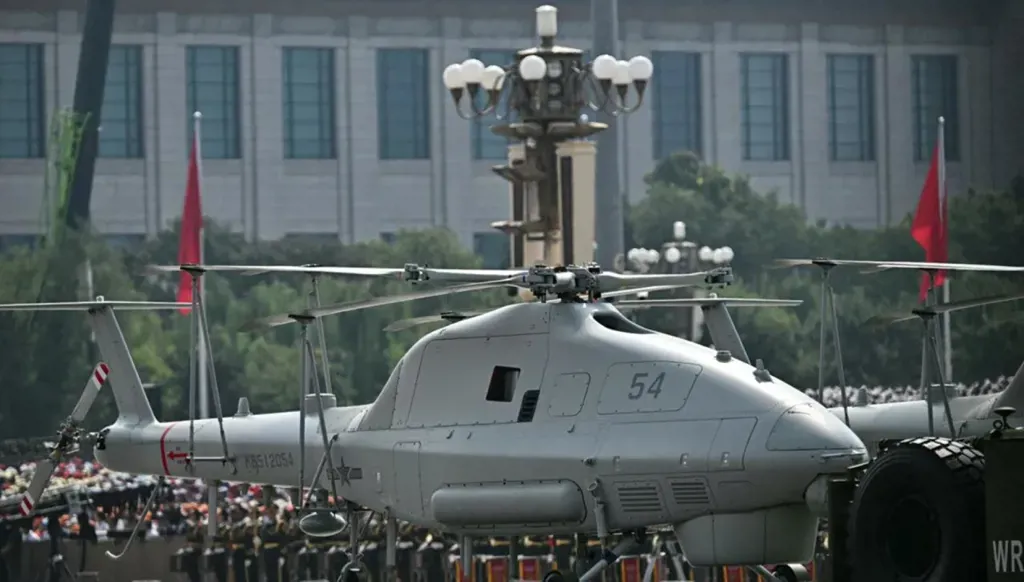
A few days ago, Katrina Manson's book, "Project Maven: A Marine Colonel, His Team, and the Dawn of AI Warfare," was released. It is the result of an investigation involving more than 200 interviews, narrating how algorithmic warfare was pushed forward by a small group of people against Pentagon inertia, to the point that it has now become a reality, used in Iran.
Since 2017, U.S. military leadership has acknowledged that the management of warfare can be entrusted to machines. At the same time, they have grown concerned about the Chinese rival’s approach to this perilous level of warfare management.
Transition to smart forces
Parallel to the release of "Project Maven," the RAND Corporation—an influential body within American power—released its report on "The Chinese People's Liberation Army's Vision of Artificial Intelligence," describing it as a central pillar of the "transition to smart forces" phase. This is the third phase in military modernization, following "mechanization" and "informatization," which Xi Jinping identified as the path to building a world-class army by mid-century.
The report concludes, based on analysis of more than 100 articles in Chinese military and academic journals and statements from military leaders, that Beijing views AI integration as a direct path to matching or surpassing U.S. military capabilities, with a particular emphasis on enhancing "killing chains" and logistics.
Three major axes
The Chinese leadership has made AI integration a high-level priority, linking it to the concept of a "new-type combat force" designed to rely on big data and cloud computing to create a generational advantage for China over other advanced armies. RAND's analysis highlights three major axes in Chinese military thought: integrating AI into combat "killing chains," leveraging AI for military logistics, and acknowledging certain gaps and deficiencies in its approach, while largely ignoring known risks identified in Western literature regarding autonomous weapons and military AI.
Through this framework, researchers aim to provide a comprehensive picture of an army advancing toward automation and smart systems across all aspects of warfare, while operating under significant political and strategic pressure and demonstrating a willingness to accept considerable risk and doctrinaire lapses in technically immature areas.
Yet, a significant portion of the intellectual and scientific output associated with the Chinese army since 2024 has focused on using AI to enhance the effectiveness of "killing chains," the series of phases that begin with detection and reconnaissance and conclude with target destruction.
The literature produced by the army systematically addresses the integration of AI into every facet of this chain. The stated goal is to accelerate strike tempo, expand operational reach, and reduce human and material costs through greater reliance on unmanned systems and advanced algorithms.
The development of Chinese killing chains rests on four fundamental pillars: integration among chain components, informational fusion across different domains, cooperation between multiple agents, and the enhancement of real-time data transfer and processing.
Even more noteworthy in the RAND report is the suggestion of a radical transformation in employing AI not only for execution but also in decision-making. For example, the Chinese army may use AI to address what it identifies as "weakness points in commanders' capabilities," develop advanced decision-support tools that could reshape command and control, and potentially expand AI applications into "cognitive warfare" and cyber operations, surpassing its current use in killing chains and logistics.
One notable observation is the absence of discussion in China on critical issues that concern the West, such as the risks of nuclear escalation linked to AI, the uncontrolled autonomy of lethal weapons, or the dangers of proliferating weapons of mass destruction.
Disclaimer: The opinions expressed by the writers are their own and do not necessarily represent the views of Annahar.





 Messenger
 Whatsapp
 Threads
 Email
Email
 Print
Print
 X
X
 Facebook