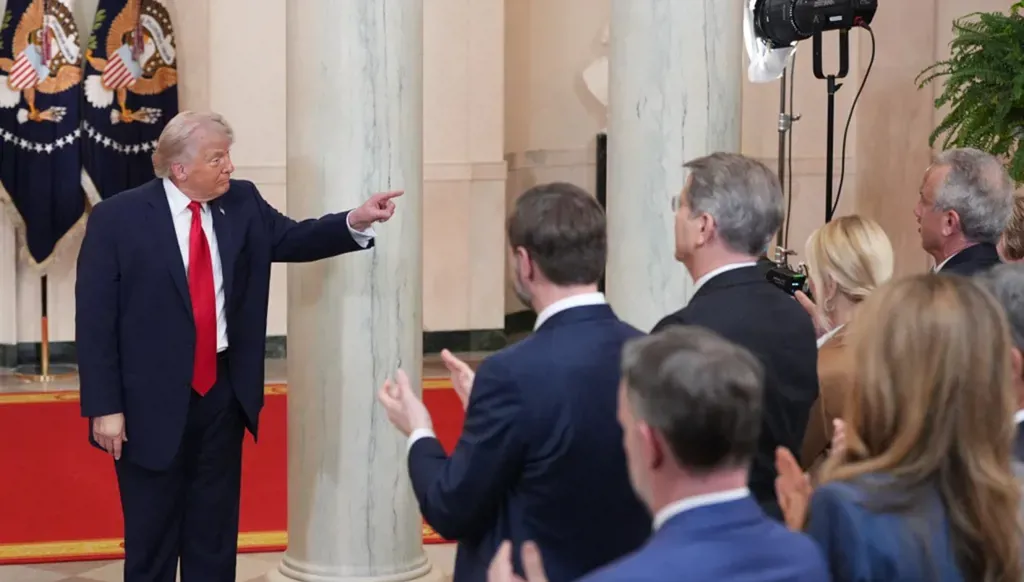
This week, the esteemed British magazine "The Economist" features on its cover an image of U.S. President Donald Trump with Chinese President Xi Jinping in the background, accompanied by the well-known saying: "Never interrupt your enemy when he is making a mistake."
Of course, this is not the magazine's first cover criticizing Trump's war against the Iranian regime, nor will it be the last in the wide-scale media campaign carried out by the European press, which increasingly leans toward the social-democratic left. A large portion of it is fundamentally media representing a capitalist orientation, defending markets and their principles. The "Financial Times" is also moving in this direction, as are other outlets in France, Germany, and Spain.
"Oxygen" for the Iranians
In practice, it is Western Europe that has positioned itself strongly against Trump, which is its natural right. At the same time, however, it ends up supplying "oxygen" to the Iranian regime.
This paradox prompts us to ask which is less dangerous to international relations—and to Arabs in general: Is it Trump, who disregards the traditional frameworks recognized in the West for many decades? Or the Iranian regime, which poses an existential threat to its nearest Arab neighbors and to Israel, and soon to Europe, unless it is stopped now—or even overthrown, given the impossibility of rehabilitating it?
In this sense, it is the right of the Arab East—which has been the first to suffer from the aggressive policies of the Iranian regime for more than four decades—to raise serious questions about the policies of Western Europe, most of whose members are in NATO. These European policies speak of a war that violates the law, all the while fully aware that the current Iranian regime embodies lawlessness both domestically and internationally.
The peak of alignment
These are countries that merely condemn Iranian attacks on the Arabian Gulf countries and Jordan, while simultaneously promoting the Iranian regime’s interests by attempting to encircle the American military campaign, such as by closing their airspace to U.S. aircraft headed to the region to combat Iran.
This represents the height of alignment with the idea of preserving the Iranian regime, which today bombards the Arabian Gulf countries without restraint and forcibly closes the Strait of Hormuz in violation of international law. In any case, Western Europe, led by left- or center-left governments, offers no viable plan for the region.
These governments are, in many ways, biased toward the Iranian regime, cloaking their positions in broad international law rhetoric, fully aware that the Iranian regime—which did not hesitate to kill more than 30,000 of its citizens in the streets earlier this year—is the antithesis of all the principles on which major European countries rely. Yet they act to protect the Iranian regime from potential collapse by the U.S., thereby squandering a historic opportunity to free millions of Iranians from the vast prison into which they have been confined since 1979.
What has been said is not a defense of Trump or Israel, but an expression of the sentiments of millions of Arabs who, during this war, have come to understand many facts about the Iranian strategy—a strategy long prepared to defend the regime by blackmailing the Arab neighborhood through aggression and attempting to destroy Arab developmental paths, thereby plunging the entire region into poverty, backwardness, and chaos.
Therefore, we do not exaggerate in saying that the stance of several European governments, as reflected in some venerable media outlets, is viewed very negatively by millions of Arab citizens—especially in such harsh times, when the Iranian regime poses an existential threat to their security and safety. Consequently, we cannot rule out that European leaders will hear different voices after the war, leading to a deep reconsideration of relations on multiple levels, particularly in economic and financial strategy.
The continuation of the military campaign against the Iranian regime represents a vital interest for the Iranian people, as well as a political and defensive necessity for neighboring countries, including Israel. It is also a major interest for Western Europe and the United States in the global strategic competition with the Chinese giant, which, as "The Economist" notes, watches with delight as the United States makes mistakes. What the renowned British magazine does not mention, however, is China’s pleasure in Europe’s complicity in supporting the Iranian regime—whose survival fuels the rise of the ambitious Chinese giant, poised to challenge the West, including Europe itself.
Disclaimer: The opinions expressed by the writers are their own and do not necessarily represent the views of Annahar.





 Messenger
 Whatsapp
 Threads
 Email
Email
 Print
Print
 X
X
 Facebook