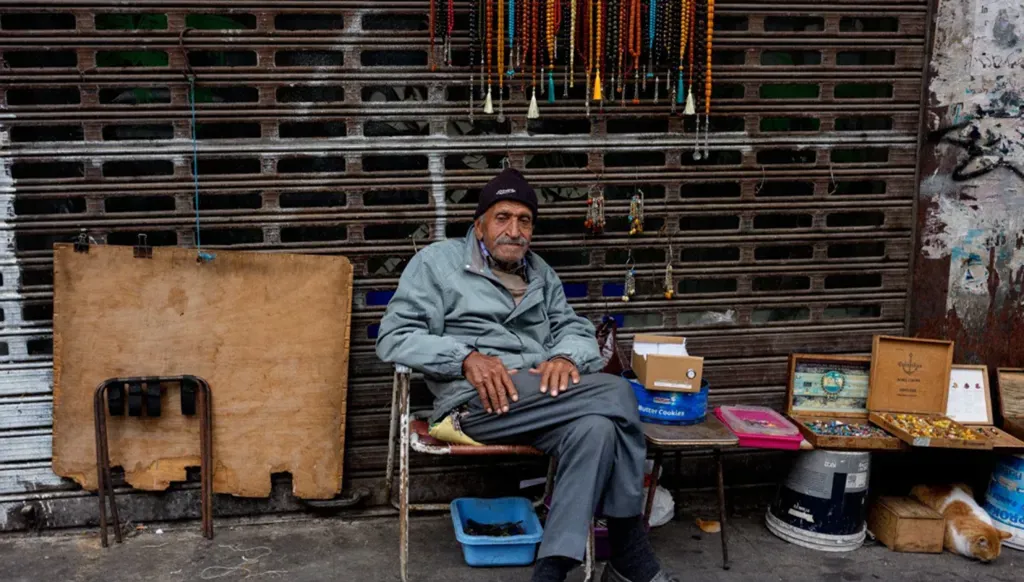
Lebanese memory can no longer hold the ominous numbers. Photo taken on a Beirut street, April 1, 2026 (AFP).
The expressive vocabulary in Lebanon related to wars, circulated by traditional media and more recently by digital media and social platforms, has risen to the level of comprehensive documentation of the Lebanese plight—spanning at least six decades. The truly tragic paradox, lived by the generation that experienced the conditions leading up to Lebanon’s explosion in 1975 and then witnessed a succession of wars, invasions, guardianships, and ongoing disturbances up to the current war between Israel and Hezbollah, reaches its dramatic peak in a discourse whose associations of words almost precisely mirror this reality. This reflects the fatal destiny of the Lebanese, as people of a country seemingly bound to wars with no turning back from that fate.
A shocking reality
This shocking reality is powerfully present today, as one month of the ongoing war ends and a second begins, coinciding with the approaching anniversary of the outbreak of the “War of Others on Lebanon’s Ground,” or the “Civil War,” on April 13—a date never forgotten, etched into Lebanese memory as the fateful day in 1975 when the Lebanese-Palestinian war ignited, giving rise to successive wars, occupations, and more, which only came to an end with the Taif Agreement after 15 years.
But this April places the Lebanese scene, perhaps, in its most painful context of the past six decades: first, because it starkly reinforces a reality many refuse to accept—that among the Lebanese there are still those dangerously intent on dragging the country back into the past; and second, because the images and memories of wars return incessantly, carrying with them bloodshed, destruction, ruin, migration, and displacement. A fundamental truth now weighs more heavily than ever on the Lebanese: that the first and last condition for protecting Lebanon from reclaiming a fateful, war-bound destiny seems almost impossible—namely, the establishment of a state with the full capacity and safeguards needed to alter this ominous course.
Destroying Lebanon
Recent months have offered a dangerous model in which an adventurist faction tied to a regional power prevails over the state while simultaneously destroying Lebanon. Great and far-reaching hopes were initially placed in a state that took extraordinary historic decisions to monopolize arms and put an end to reckless adventures with the country. Yet once again, recklessness has triumphed over the state, exposing a catastrophic inability to confront Hezbollah’s monopoly over the decision of war, and binding Lebanon’s fate to the Iranian regime—either killing or being killed.
The current war has set the clock back beyond the past six decades, as Lebanon has lost what remained of its resilience in the face of immense losses. A catastrophic scenario is gradually unfolding, marked by a “disastrous modernization” imposed by Israel through a severe strategic shift in its approach—one that has led to the large-scale emptying of populations from vast areas in the south, the western Bekaa, and the southern suburbs, while displacing residents into other regions and shaking internal stability. This dynamic risks leaving half the country consumed by fire and war, and the other half threatened by strife and unrest. This terrifying trajectory appears increasingly irreversible so long as the Lebanese state finds no effective support from the international community capable of halting this upheaval, after Lebanon has been left to its fate amid a crushing Israeli-Iranian war on its soil.
Six generations or more will mark the April 13 anniversary in two weeks to the refrain of recalling a war without a number, as Lebanese memory has become too overwhelmed to retain ominous numbers.
Disclaimer: The opinions expressed by the writers are their own and do not necessarily represent the views of Annahar.






 Messenger
 Whatsapp
 Threads
 Email
Email
 Print
Print
 X
X
 Facebook

