U.S.-Iran tensions: Pathways to war or negotiation
Trump’s speech signals multiple scenarios for the region, from a pressured deal with Iran to strikes on energy assets, leaving markets and governments anxious.



 Messenger
 Whatsapp
 Threads
 Email
Email
 Print
Print
 X
X
 Facebook
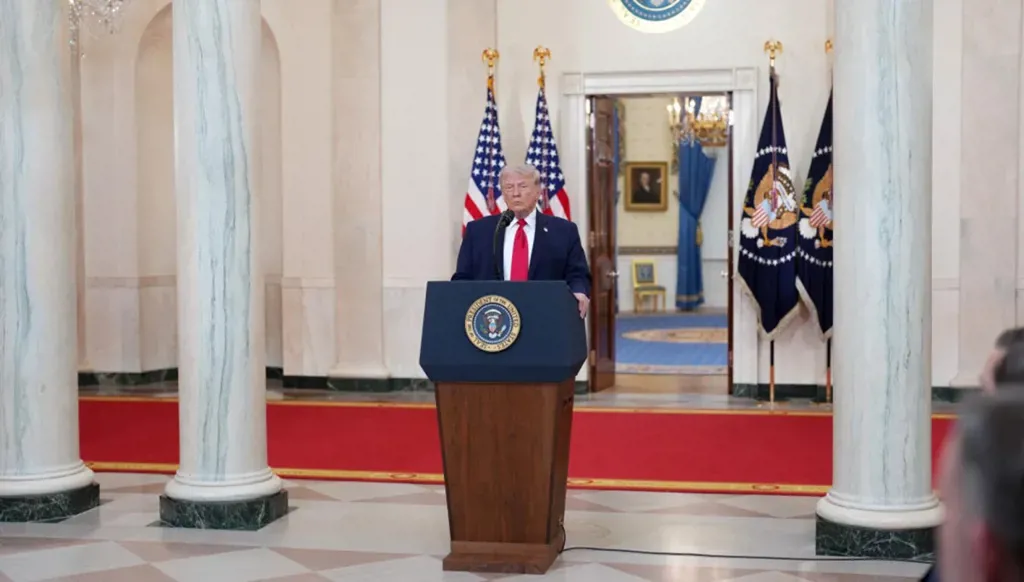


Although it lacks a clear strategy for exiting the war with Iran, President Donald Trump’s speech undoubtedly provided a clear guiding framework for the next phase. Indicators following the speech in energy markets and global stock exchanges revealed a deep sense of concern, reflecting widespread fear that the war might continue or escalate into what is known as an “energy war” by targeting and destroying Iran’s strategic energy assets.
At the political level, the speech opened the door to several scenarios ranging from reaching an agreement with Iran under pressure, to delivering a strong strike on its energy infrastructure, or exiting the war without an agreement while maintaining American deterrence in the region.
Undoubtedly, reaching a political agreement with Iran is the most favorable scenario, as it could provide relative stability in the region, even if only in the medium term. However, this scenario clashes with the limits of settlement that Trump is willing to accept, and with the rejection maintained by the Revolutionary Guard, which effectively holds the keys to war and peace in Iran. The Guard is betting that economic pressure might push Trump to end the war without achieving political gains that would translate into military victories. The settlement scenario also faces opposition from Israeli Prime Minister Benjamin Netanyahu, who favors striking Iran’s energy facilities and reducing the country to a state incapable of securing the basic necessities for survival.
Conversely, the scenario of destroying Iran’s energy assets and exiting the war without an agreement remains possible, although its likelihood is difficult to estimate. If it does occur, it would have profound implications at multiple levels. While the war would formally end, the situation would remain unresolved, potentially evolving into a long-term conflict with serious regional, international, and economic consequences.
Such a scenario would increase economic costs for the world, paralyze the Iranian economy, render the state unable to pay salaries, and deprive it of strategic resources. Iran would shift from a regional power to a state that disrupts stability within the region. It is also likely that the Revolutionary Guard’s desire for revenge would escalate, targeting energy assets in the Gulf countries and mobilizing hidden networks across several countries in the region.
As a result, this scenario could turn the region into a theater of indirect wars, with Lebanon potentially at the forefront of countries becoming an open battleground between Iranians and Israelis. The questions remain: will the Revolutionary Guard in Iran continue walking the edge of the abyss, or will it recognize that the cost of refusal is higher than the cost of accepting Trump’s terms to end the war? Or is it betting on a Chinese guarantee that could stop the war, prevent its renewal, and secure the conditions necessary for the survival of the regime?
Political science professor at the Lebanese University.
Disclaimer: The opinions expressed by the writers are their own and do not necessarily represent the views of Annahar