The Lebanese army between internal criticism and international pressure

Opinion 14-03-2026 | 11:41

The Lebanese army between internal criticism and international pressure


Growing criticism in Washington and Beirut raises questions about the army’s role, its ability to confront Hezbollah, and whether international pressure is paving the way for a wider Israeli military campaign in Lebanon.
The Lebanese army between internal criticism and international pressure
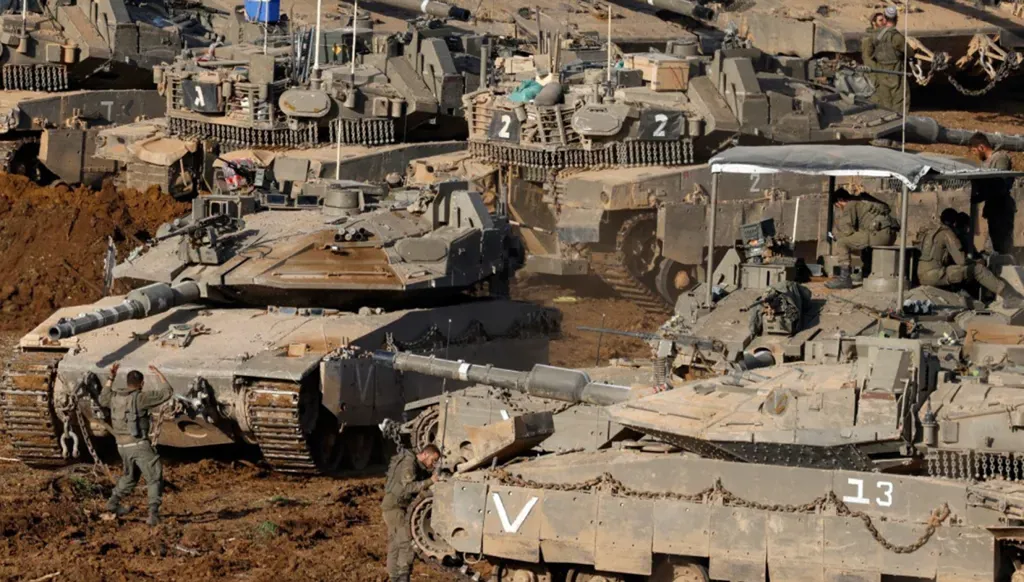
Israeli army tanks deploy at a position in the Upper Galilee in northern Israel near the border with Lebanon on March 12, 2026. (AFP)
Smaller Bigger


At this stage, the issue of the Lebanese Army occupies a prominent place in discussions within Lebanon and in international decision making circles, and the approaches toward it vary to the point that they often conflict with one another.


Supporters of Hezbollah as well as its opponents criticize the Lebanese Army for its lack of effectiveness. The first group criticizes its refusal to engage in a military confrontation with Israel, which carries out extensive attacks on Lebanon and occupies territory within it. The second group, meanwhile, considers the army to be reluctant to confront Hezbollah, disarm it, and take away from it the authority to decide on war.


While refuting the criticisms of Hezbollah supporters is relatively simple, based on the fact that engaging in a confrontation with Israel requires a clear decision from the political authorities that takes into account military, financial, economic, and social capabilities, as well as the risks and potential gains, the current problem facing the Lebanese Army lies in the issue of disarming Hezbollah. This comes after clear decisions issued by the Lebanese Council of Ministers to that effect, which stripped Hezbollah’s weapons of all legitimacy and legality and tasked the Lebanese Army with working to ensure that weapons are held exclusively by the state.


The most serious criticisms directed at the Lebanese Army are those coming from the current US administration, which believes that Lebanon’s senior military leadership is not prepared in any way to confront Hezbollah and put an end to its activities.


The major concern is that the public criticisms previously directed by Republican Senator Lindsey Graham at Army Commander General Rodolphe Haykal, following their “bad” meeting in Washington, have begun to occupy a prominent place in the thinking of decision makers in the United States, including the State Department. As a result, some are now promoting the idea of cutting off all US cooperation with General Haykal if he does not change his behavior as quickly as possible.


Senior Lebanese sources have confirmed that the negative US stance toward the Lebanese Army has begun, to the same extent, to reflect on the President of the Republic, General Joseph Aoun.


What some circles in the US State Department describe as the “straw that broke the camel’s back” is the belief that the quantity of weapons, launch platforms, shells, and rockets that Hezbollah possessed south of the Litani River, since the party decided to open the Lebanese front by a decision from the Quds Force, demonstrated that the measures taken by the Lebanese Army in the area described as the “first phase of the plan to place weapons exclusively under state control” had failed. This failure is attributed to the leadership’s refusal to search houses whose infrastructure conceals weapons depots.


Fearing that the Lebanese authorities, which are aware of Washington’s influence, might try to repair this dispute with the US administration by pushing the Lebanese Army to act more decisively in dealing with Hezbollah’s weapons, especially after unprecedented statements against the group by President Joseph Aoun and Prime Minister Nawaf Salam and their translation into a strong government decision, Hezbollah has begun, through its propaganda outlets, to promote the idea of a real division within the Lebanese Army. This was done by circulating what was described as a “draft statement” issued by those referred to as the “nationalist officers.”


This promotion of a possible division within the Lebanese Army has had negative effects on many opponents of Hezbollah, to the point that some of them have expressed “despair” toward the military institution and have begun questioning its usefulness. One observer even went so far as to say:

“Our situation with the army is like someone who hires a guard, but soon begins worrying about the guard being exposed to cold or heat and insists on keeping him in safe places so he does not get sick. In the end, the employer is forced to dismiss the guard because he has become useless.”


However, those concerned with the Lebanese Army believe that the situation is more complicated than it appears. The issue is different from what is being discussed in Washington, Beirut, or any other capital. The military institution, regardless of the many vital roles it plays inside Lebanon, from protecting internal stability to combating organized and cross border crime and cracking down on drug trafficking with unprecedented intensity, needs genuine support and real armament in order to carry out what is required of it on the military level.


What is demanded of it is decisiveness and the ability to impose its will, something that cannot be achieved without providing the capabilities that enable it to do so in a way that spares Lebanon from new disasters.


According to some observers, the raising of criticism against the leadership of the Lebanese Army, particularly in Washington, serves objectives that go beyond the content of the negative messages. It is intended to justify granting Israel a green light from the White House to implement a major plan to eliminate Hezbollah militarily throughout Lebanon.


For these observers, developments on the ground indicate that the issue is not limited to the Lebanese Army but rather concerns opening the door wide to an Israeli offensive against Lebanon.


Disclaimer: The opinions expressed by the writers are their own and do not necessarily represent the views of Annahar