

War pressure in the Gulf: Iran’s energy strikes and Washington’s calculations
The Gulf states were very clear in the past weeks that led to the outbreak of the blazing conflict. They strongly emphasized that they did not want to see a clash, let alone a military war.



 Messenger
 Whatsapp
 Threads
 Email
Email
 Print
Print
 X
X
 Facebook
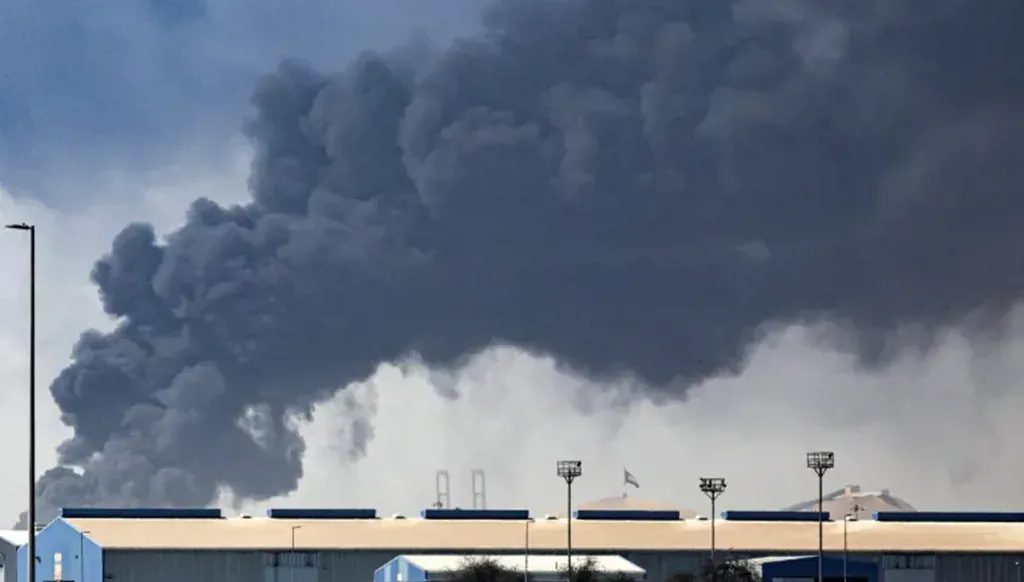


Why is the Islamic Republic targeting energy facilities in the Arab Gulf, even though they are not American military bases? What happened in the first phase of the Iranian response to the American Israeli military attack was intended to demonstrate to the Gulf states that the American military bases established on their territory were unable to protect them from any attack. In fact, these bases are a reason that makes them vulnerable to being attacked. What is being seen today in the second phase of the war is the targeting of energy infrastructure in Qatar and Saudi Arabia. This strikes at the heart of the Gulf economies and worries the international community. Everyone saw Qatar announce the suspension of liquefied gas production and its related products. This is a major development that will certainly affect the global economy, and that may well be the objective behind it.
Could this push the United States’ allies in the Gulf who are involved in the war to pick up the phone, speak with Washington, and demand an end to the war or at least a ceasefire? The leaders of the Arab Gulf states were on the phone with Trump not only since the start of the Israeli and American military strikes on Iran, but for quite some time before that as well. They did not want this to happen and went to great lengths to pressure the United States and its president to convince him not to attack Iran. Clearly, their pressure did not achieve what they had hoped for. What the Iranian attacks on the Gulf states, particularly on energy facilities, are doing is increasing the pressure not only on the Gulf states but also, through them, on Donald Trump.
What will the Gulf states do now? They certainly have influence over the United States, but something must be done to stop what is happening. They do have influence, that is true, answers a non Arab Asian researcher. But we see that this influence is limited. The Gulf states were very clear in the past weeks that led to the outbreak of the blazing conflict. They strongly emphasized that they did not want to see a clash, let alone a military war, and they were very clear in calling for engagement in diplomacy instead of war. Everyone saw the Omanis step in as a mediator in this matter. That was their position from the beginning. It has become even stronger now after the American Israeli attack and the Iranian response to it. All of this pushed the Gulf states to close ranks. On the one hand, they have no one to turn to except Washington, especially when it comes to security and related matters.
“In that case,” the same Asian researcher replies, “in whatever way it happens, it will increase the impact of the Iranian strikes on energy infrastructure in the Gulf.” In other words, if we see the Strait of Hormuz closed, along with the damage inflicted on energy facilities such as the suspension of production, then twenty percent of the world’s energy supplies that pass through the Strait of Hormuz will stop. Asia will be the most affected by this. Therefore, the Iranians want to increase the pain for the Gulf by striking major towers and large complexes in its countries. This reflects a decision to push the United States back to the negotiating table, but in a way that is fair to everyone.
In short, part of the problem is that Western countries view Iran as an autocracy and avoid acknowledging that there are democratic elements within its system. Iran has multiple centers of power, something that also exists in Washington and in a number of other Western capitals. This raises a question: how can harmony and chaos exist at the same time? I think some in Iran look at Washington and see chaos in its system.
What is the way that enables the Iranians to determine what they will face next, especially in light of the divisions within their internal opposition? This is a key point. If you look at popular revolutions, including the Iranian Islamic Revolution in 1979, the Philippines revolution in 1998, and the Arab revolutions in 2011, what you see are massive popular gatherings against governments. If they succeed, they prepare the ground for splits within the political elite, particularly within the army and the security forces. If you take Iran in 1979, it was a revolution that emerged from within the army and the security forces, especially among mid ranking officers in the air force and the navy. Compare that with what is happening today. There is widespread dissatisfaction and strong anti government sentiment, but the protesters do not have a coherent and unified structure, nor the mechanism that would allow them to achieve a transition to another system.
In 1979, Khomeini had a network of mosques across the country. He had a network of charitable and welfare activities and benefited from all the enemies of the Shah, including secular groups and ethnic minorities. In the current protest movement, however, the opposition does not possess all of that, or even much of it, and no one has seen cracks within the political elite or within the army and the Revolutionary Guard.
Disclaimer: The opinions expressed by the writers are their own and do not necessarily represent the views of Annahar