The end of an era? Hezbollah’s role in Lebanon under strain

Opinion 08-03-2026 | 12:21

The end of an era? Hezbollah’s role in Lebanon under strain

As Iranian support wanes and military setbacks mount, Lebanon faces the cost of rebuilding while the party navigates a new reality.

The end of an era? Hezbollah’s role in Lebanon under strain
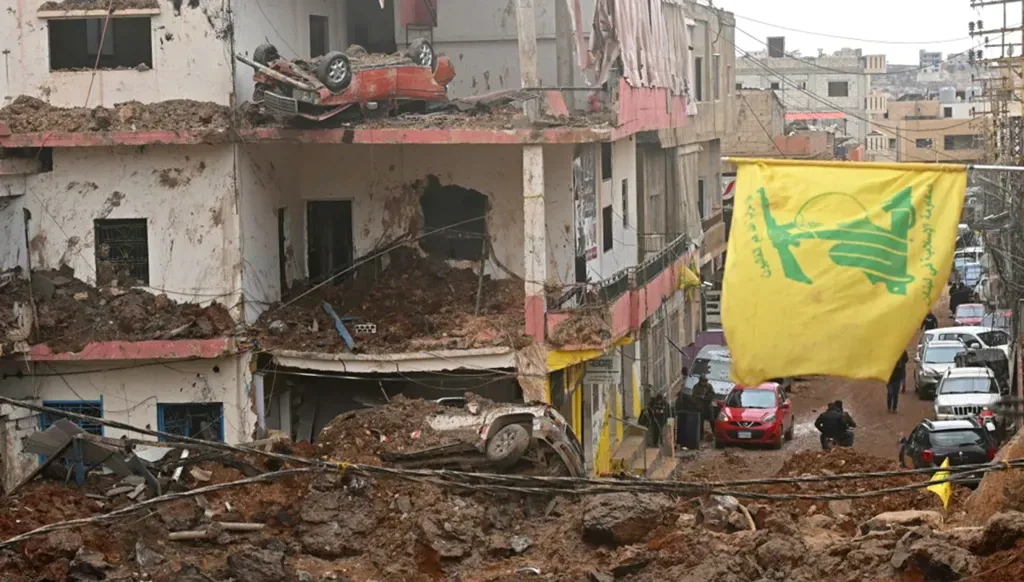
Raising the Hezbollah flag amid heavy Israeli airstrikes on the town of Nabi Chit in eastern Lebanon (AFP).
Smaller Bigger


Diplomatic observers attached great importance to the alignment of Hezbollah’s key Shiite partner with the Lebanese government’s decision earlier this month to ban the military and security activities of the party. They see it as indicative of several factors, most notably Berri’s reading of the major regional transformations that have occurred and will result from the American-Israeli war on Iran, allowing him some leeway to shield the Shiite community from the repercussions of these regional shifts without fully committing it to the potential losses for Iran, as pursued and implemented by the party.


The party may have been preoccupied with the war it initiated against Israel, which prevented it from engaging in an internal dispute that could expose contradictions within the Shiite community. However, it may have coordinated this move with Berri within the political framework he envisions, aiming to safeguard the future of the sect and its position in Lebanon. This largely reflects Berri’s approach, at least on major issues, such as refraining from participating in the war alongside Bashar al-Assad’s regime in Syria—unlike the party—an involvement that had extremely costly consequences for Lebanon and, subsequently, for Berri’s sphere.


However, Berri’s role in supporting the decision to ban the party’s military and security activities—which was significant for the government and provided Shiite backing—was also understood as a way to isolate the party and tighten pressure on it, cutting off its support from internal allies, including within the Shiite duo. Many saw Berri’s stance as a form of compensation for his silence when the party launched the Gaza support war, a conflict the Speaker viewed as entangling Lebanon and undoing decades of his achievements in the south during nearly forty years as head of the House of Representatives. This alignment gives Berri the ability to act as leverage for the Shiite community in the aftermath of the disaster the party inflicted on Shiite areas specifically, without attributing responsibility for Lebanon’s broader destruction to the sect as a whole.


And although political and sectarian consensus alone—as developments after the Gaza war showed—may not be enough to exert convincing pressure on the party to change its course, its close ties to Iran and its declaration of involvement in the recent “revenge” war for Iranian leader Ali Khamenei mean that the conflict with Iran will have significant repercussions on it. Iran itself, despite the uncertain outcomes of the war so far, faces major changes, beginning with the loss of capabilities that once allowed it to extend its influence and dominance across regional countries. Its regional extensions, foremost among them the party, will be among the most prominent to bear the cost.


In the end, the party—which has repeatedly stated, according to its former Secretary-General Hassan Nasrallah, that it has received “moral, political, and material support in all its possible and available forms from the Islamic Republic of Iran since 1982”—is likely to lose most, if not all, forms of Iranian backing in the next phase, as a consequence of the war on Iran and the reassessments it will be compelled to undertake. Just as the party’s strength and boldness were derived from Iran’s power and assertiveness, its own weakening and decline will mirror Iran’s diminishing influence.


The final days of this war clearly revealed the scale and condition of the party’s remaining arsenal after the 2024 conflict, as well as the repercussions of losing Syria as a rear supply source. On the ground, the party’s attacks and limited defensive clashes failed to deter Israel or inflict any significant losses, while Israel caused far greater damage to Lebanon and the party’s surrounding areas than it had during the nearly two-year Gaza support war. Furthermore, the reduction of the party’s presence south of the Litani River, due to the Lebanese army’s control, severely limited its capacity—already modest—to launch cross-border attacks against Israel, since its operations largely depend on direct fire or short-range indirect systems like rockets or mortars. As a result, while reaffirming the “resistance” principle, the party focused on targeting Israeli positions at points it occupies in southern Lebanon.


The party will face not only a military challenge but also a severe limitation in its ability to resupply and provide for itself. In addition to its responsibility for dragging its environment and Lebanon’s infrastructure into destruction—leaving it unable to access Iranian or other external resources to support its areas or reconstruction—it will inevitably confront an even greater challenge in the coming phase. This will make it reliant on the Lebanese state, whose support it will need for reconstruction after the devastation caused during the Gaza support conflict.


Many consider that the end of the party’s previous era began with these signs, along with other internal and external indicators that will become clearer once the war concludes. The outcome of the conflict will play a major role in determining the party’s position and nature in the coming phase, particularly in relation to what Lebanon will have to bear to restore stability and recover.