

Tripoli on the edge: When cities stop renewing themselves
Crumbling buildings and economic decline reveal deeper institutional failures—revitalizing Lebanon’s cities requires bold municipal reform.



 Messenger
 Whatsapp
 Threads
 Email
Email
 Print
Print
 X
X
 Facebook


According to Jane Jacobs, the city, not the state, is the fundamental unit of analysis for understanding global economic growth. In her books The Economy of Cities (1969) and Cities and the Wealth of Nations (1984), she showed that wealth is generated within cities through innovation, the diversity of activities, and the creation of “new work” that later develops into exports. From this perspective, national economies succeed or falter depending on their cities’ ability to continuously renew themselves.
Jacobs also formulated the principle of import replacement, where cities initially import goods and services and then gradually develop local capacities to produce alternatives. As experience accumulates and links between sectors intensify, productive adjacencies expand the skills base and create new products ready for export. The prosperity of cities, therefore, is not merely a matter of size or population density, but of institutional and networked capacity to turn density and diversity into sustainable innovation.
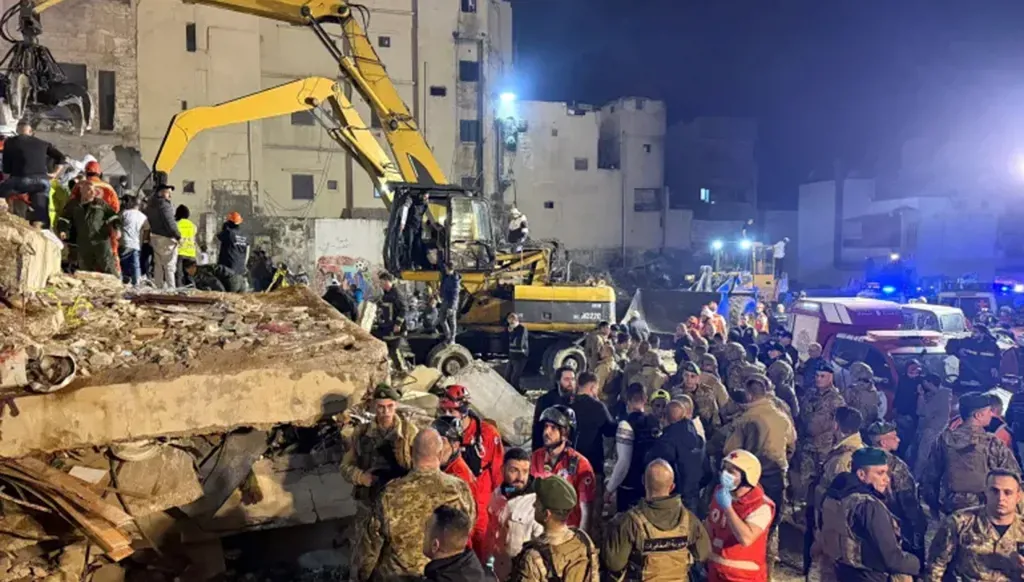
Tripoli has failed to renew itself. The collapse of its buildings, which has killed and displaced dozens of families, is a sign of its struggling economy. The city was unable to keep up with modern transformations after losing its comparative advantages during the first industrial revolution and the establishment of Greater Lebanon. It failed to capitalize on its geographic location due to security, political, and economic shocks, weak local governance, declining investment in infrastructure and urban services, and the contraction of industry and modernizable activities—forcing capital and skills to emigrate. In this way, the city sank into a cycle of poverty, innovation stagnation, and low productivity. And now, the revolutions in artificial intelligence and biotechnology are arriving!
What has happened goes beyond merely maintaining crumbling buildings, drawing up emergency plans, or assigning responsibilities; it exposes structural failures in institutions and legal frameworks. Rent laws produce building collapses, and municipal laws create marginal authorities. Municipalities have become sources of crises rather than their solution. What is needed is the creation of an institutional environment that produces capable municipalities, allowing our cities to regain the ability to renew themselves. Our major cities are engines of growth; therefore, reviving the Lebanese economy necessarily requires deep municipal reform that activates real administrative, financial, and political decentralization, giving Tripoli, Beirut, Sidon, Tyre, and other cities the space to become platforms for innovation and vibrant living, rather than remaining spaces of housing, poverty, and death.
Disclaimer: The opinions expressed by the writers are their own and do not necessarily represent the views of Annahar