

Hezbollah's resistance strategy according to its Secretary General
Hezbollah seeks to retrench as global interests converge on disarmament. President and Prime Minister stand resolute that disarmament move north from stage one which cleared the area south of the Litani river.



 Messenger
 Whatsapp
 Threads
 Email
Email
 Print
Print
 X
X
 Facebook
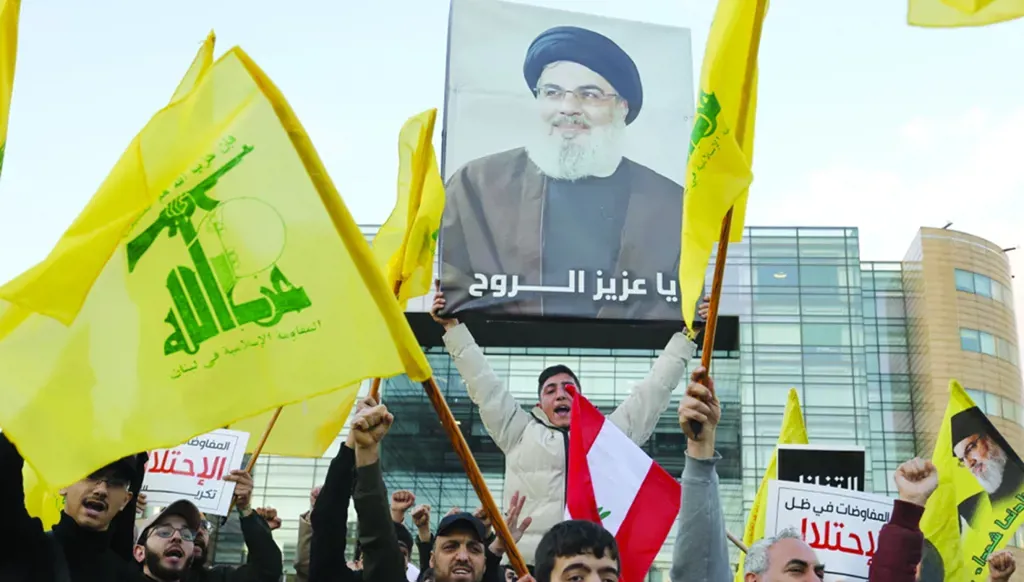


Hezbollah does not try to obscure the threats arrayed against it, aware that its circle of opponents has expanded. They have never concealed the stakes that would accompany an attempt at complete disarmament. Consequently, it is not surprising that they have raised concerns, following the announcement of an end to the first phase of disarmament south of the Litani river. In Hezbollah's eyes, this step should mark the end of disarmament efforts.
In the biggest public forum since, the parliamentary sessions to approve the general budget, their concerns bubbled into open confrontation. Prime Minister Nawaf Salam emphasized at a conference in Dubai that his government is moving forward to complete what it began in the weapon exclusivity plan. The President of the Republic has also restated his conviction in the move in what appears to be a coordinated public effort.
Hezbollah is constantly reminded that its circle of opponents will not allow the matter to rest south of the Litani. Searching unsuccessfully for space to maneuver, the party is unlikely to strike any partial deal with the government that allows it to retain a part of its arsenal.
The question remains: What options does the party have left to face the increasing pressures from inside and outside?
Although one of its deputies, Hassan Fadlallah, acknowledged the difficulty of the situation in which the party operates, Secretary-General Sheikh Naim Qassem affirmed in his most recent appearance that the party is not in a position to surrender and must continue devising methods of confrontation to defend its presence and role.
Notably, Qassem chose to appear on the 33rd anniversary of the founding of the Islamic Educational and Schools of Imam Mahdi. It was no mere coincidence that he indirectly responded to the party’s opponents, who had called for the closure of this institution because it trains fighters and educates students under a specialized curriculum. He explicitly affirmed that these schools are among the supportive and nurturing environments for the party.
Qassem emphasized that, despite the difficulties of the current phase, the party continues to work toward building the state, having participated in the election of the President of the Republic and the formation of the government.
Without publicly reiterating the party’s refusal to hand over its weapons, Qassem deliberately raised the stakes, openly referring to a long battle ahead. He noted that the resistance force would be limited to the Amal movement and national and Islamic parties and forces—the first nucleus of the resistance that emerged in the field after the Israeli invasion in 1982—emphasizing that this core is “capable of harming the enemy.”
Consequently, some have raised the question of whether the party is focusing its rhetoric on rebuilding the state in preparation for engaging in it, as its opponents demand.
However, none of the observers can yet conclude that the party has adopted this conviction in its calculations and actions, particularly as its opponents have begun working on its dismantling in preparation for its complete eradication. The party still retains dynamics and capabilities that allow it to recover some of what it has lost.
In this context, the party, through an authorized source, outlined some of the broad contours of its future roadmap, noting that its parliamentary bloc’s approval of the budget passed by Nawaf Salam’s government was based on a vision that this participation contributes to strengthening the option of internal stability.
The source added: “Our primary motivation for approving the budget is that it endorsed the principle of structural repair, preparing for the rebuilding of what was destroyed or damaged during the war. It also reflects our commitment to maintaining unity within the Shiite duo ahead of the parliamentary elections, which we insist on holding on time. We launched the participation workshop for these elections as further evidence of our significant popular presence.”
The party says it knows what lies ahead but asserts that it has set a future roadmap that accounts for all possibilities. “What is certain,” it added, “is that we are not in a position to retreat from the national security strategy that was promised to us in the inaugural speech, and we await the fulfillment of that promise.”
Disclaimer: The opinions expressed by the writers are their own and do not necessarily represent the views of Annahar.