

Crossroads for Lebanon: Can sovereignty survive Hezbollah and regional turmoil?
Fragmented alliances, regional conflicts, and internal complacency threaten to define Lebanon’s future unless urgent action is taken.




 Messenger
 Whatsapp
 Threads
 Email
Email
 Print
Print
 X
X
 Facebook
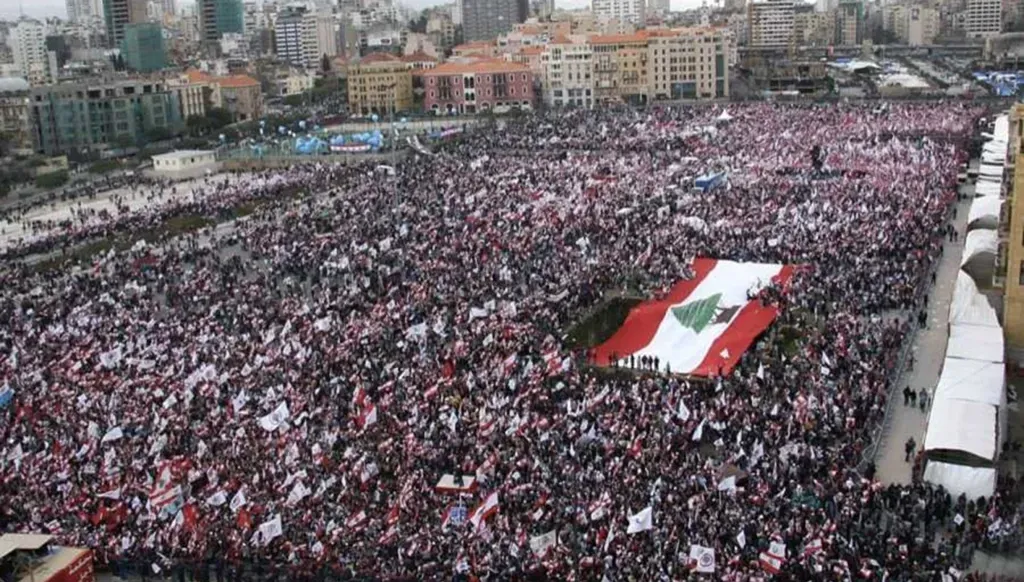


Since the beginning of President Joseph Aoun’s term, a reality that had already taken shape during the presidential vacuum preceding his election has become more firmly established, though still not with full clarity. This reality is the fragmentation of the sovereign forces whose alliance once played a historic role in the aftermath of the March 14 Revolution.
This fragmentation erased any remaining trace of that alliance, creating a catastrophic imbalance in internal power in favor of the so-called axis of resistance, which itself now appears to be nearing its end. This reality would not have reemerged were it not for the fact that Lebanon has reached a critical crossroads—one that may soon require developments similar to those that led to the disintegration and collapse of the resistance axis and its primary arm in Lebanon, Hezbollah. Meanwhile, other Lebanese forces remain absorbed in their own worlds, engaging in highly peculiar calculations that fail to account for the day after—when Lebanon may face a situation whose consequences it will be unable to control.
Herein lies the central question: where do the sovereignists stand in the face of the projects that may be taking shape for Lebanon—whether in the aftermath of a sweeping Israeli military operation against the party and its remaining arsenal and sites, through settlements quietly prepared behind the scenes, or as a result of the repercussions of an American war on Iran or an American deal with the mullahs’ regime? Today, the sovereignists, both old and new, appear to have been reduced to conventional political forces, aligning to varying degrees with the current presidency and government, or distancing themselves from it in isolation. There is little sign of awareness of the gravity of the complacency that has overtaken them, even as the country moves through a perilous phase toward inevitable transformations in the coming months of this year.
However, the troubling fluctuations in the state’s capacity and decision-making—coupled with the major developments and transformations unfolding around Lebanon—underscore the growing need to restore a modern sovereign framework, lest uncalculated developments impose an irreversible reality on the country at the dawn of a “lightless” morning.
Lebanon’s original sovereignists should not content themselves with merely confronting Hezbollah, nor rely solely on dreams of irreversible regional change, nor fully immerse themselves in the narrow calculations of neighborhoods, villages, and electoral districts at a time when sweeping transformations are pressing in from all sides.
As February and March approach—the months that have embodied Lebanon’s sovereign pulse for two decades—this year’s defining addition may well be the anticipation of looming dangers, rather than a repetition of the familiar, monotonous anthems of rhetoric.
Disclaimer: The opinions expressed by the writers are their own and do not necessarily represent the views of Annahar.