

The empire that never learned to lose



 Messenger
 Whatsapp
 Threads
 Email
Email
 Print
Print
 X
X
 Facebook


The American Empire has become a unique phenomenon in human history; present on every continent and inserted into every country. These are conditions that invite concern, because the world has never before known a state so deeply involved to this extent in the life and future of other states.
Decades ago, the historian Jean Lacouture quoted the French leader Charles de Gaulle as saying that America is an incomprehensible country and therefore difficult to deal with. De Gaulle said: "I can understand England, China, and Germany, but I cannot understand America; it has no keys in history that allow for that." Hence, attempting to understand America becomes a "necessity" in order to deal with it without fear produced by ignorance and without lightness produced by illusion.
The United States did not emerge as a homeland, but as a place of settlement, and did not begin as a state, but as a refuge. Meaning that it emerged as an open space for anyone able to cross the ocean, for various reasons ranging from seeking wide horizons in all fields to piracy.
Capital in the European experience used to follow the empire, picking up the scraps of its conquests. In the American experience, however, capital became ahead of the imperial path. In this way, America took from the Old World everything it wanted without suffering or pain and without rights or fees.
With the succession of days and its pivotal events, the American experience expanded its influence, through sales and purchases, or by discount and installment. It became the global superpower, a military power without constraints, devoid of the restraints of principles and culture. Consequently, the first word in any meeting is "point the gun." Power itself becomes a source of legitimacy and possession, turning possession into ownership, and laws of dominance and control are established.
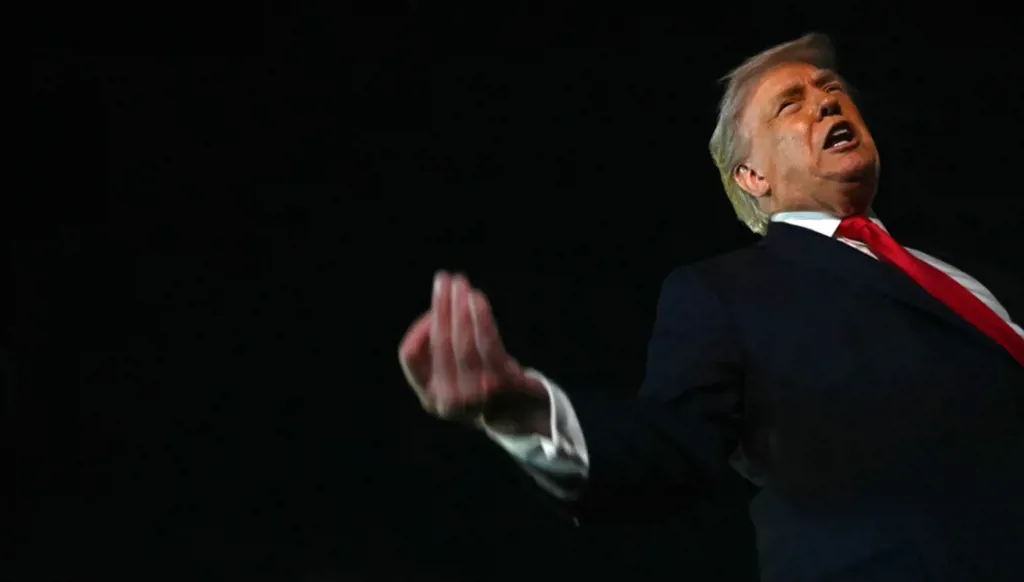
This may be what is going through the mind of U.S. President Donald Trump and his administration, in light of his "daily" decisions that surprise both domestic and foreign audiences, from arresting the Venezuelan president to wanting to seize Greenland by force, to annexing Canada and Mexico, and reactivating the Monroe Doctrine in the Western Hemisphere, etc. Trump believes it is necessary to restore America’s greatness, or its "golden age", because the cost of losing American influence would be enormous.
He believes that the United States’ military power and the appeal of the American market are enough to force countries to submit to his will. He imposes tariffs on countries that do not comply with his demands, in a step toward a new yet old era of trade protectionism.
Trump adopts a vision based on mercantilism (trade protectionism) and narrow self-interest, in order to reshape the American economy and the world order.
Although force often succeeds in getting what it wants from others, it sometimes fails, because even those who seem weaker have strengths and a will of their own that can make the tables turn. This is the lesson of history: how many empires began their decline from the very peak, when their people were intoxicated by their power and expanded excessively at the expense of other nations. It is impossible to predict the economic impact of Trump’s policies or how countries will respond, but what is certain is that his policies will unleash a sequence of retaliation and counter-retaliation. Each state pursues its interests alone and follows a “beggar-thy-neighbor” policy, as happened during the Great Depression in the 1930s, leading to a contraction in international trade, slower growth, and possibly recession or worse, meaning an explosion of the global system.
Over the past seven decades, American leadership globally has led to the prosperity of free trade and the dominance of international law and its institutions. But this era is now ending. The trust of partners in America has declined. They have become targets of its ambitions. A “fragmented” global trading system is taking shape. Alliances emerge wherever interests meet, within an organizational structure still in its formative stage.
And while Trump builds his new world, there is no American “golden age” on the horizon. Each day, he hammers another nail into the coffin of Western dominance. He is on the verge of breaking the bonds of the American-European alliance. Trump’s overwhelming desire to seize Greenland, even by force, was the final straw for Europeans, who responded by threatening counter-measures against the United States.
European powers imagined they were still as formidable as before, rather than an inheritance being appraised in preparation for a transfer of ownership to America. The Financial Times reported that the Greenland crisis would have profound geopolitical consequences: NATO could split and dissolve forever, Europe could move closer to China, and drift away from Washington. In turn, a new map of global alliances would take shape, opening the way for a new world order. The Economist noted that much now depends on “Europe’s courage.”
For any state, being hostile to America is a mistake whose risks cannot be tolerated, and falling in love with it is a mistake whose losses cannot be tolerated — yet the burdens of empire grow heavier by the day. The real danger for the world is the moment the empire feels compelled to retreat in the face of a power that could overtake it or an alliance capable of confronting it. At that point, international politics will become extremely rough and intensely violent, because American power has learned how to win, but has not learned how to lose.
Disclaimer: The opinions expressed by the writers are their own and do not necessarily represent the views of Annahar