Arab political slogans and their unfulfilled promises
In a situation where most Arab countries struggle to build a state based on institutions, law, and citizenship, and where people are preoccupied with the demands of daily life, these countries often lack significant, realistic, and effective political movements.



شارك على
 مسنجر
مسنجر
 واتساب
 ثريدز
ثريدز
 بريد إلكتروني
 الطباعة
شارك على


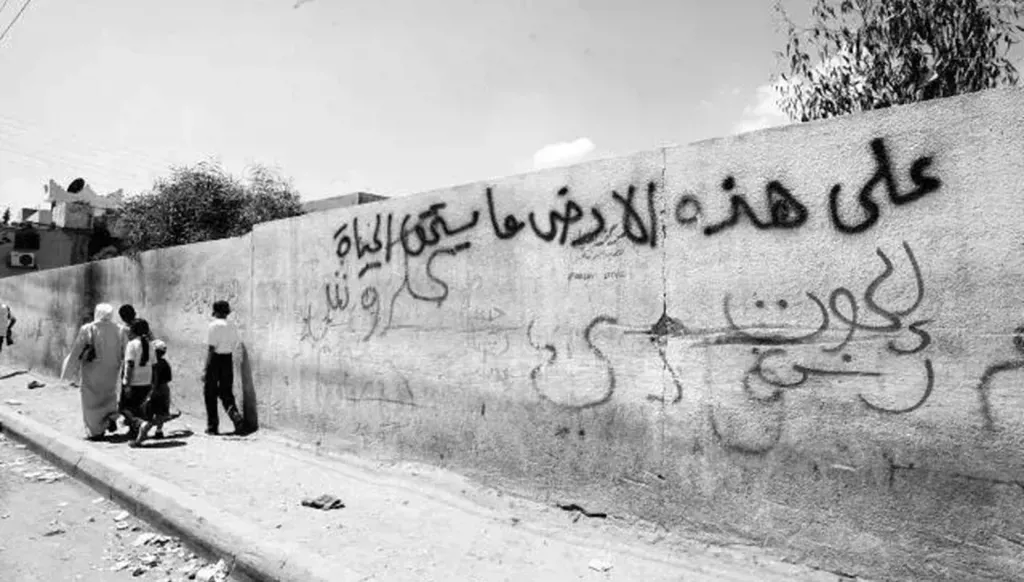


Throughout the past century, political movements in the Arab world have relied on emotional and highly charged slogans, often driven more by passion and wishful thinking than by realism, especially in Syria, Lebanon, Palestine, Jordan, Iraq, and Egypt. This was particularly evident in the decades following independence, which saw the rise of nationalist, leftist, and Islamist ideological currents.
The overall outcome of this historical experience shows that these slogans, which once filled the region with noise and excitement, did little to help people understand the Arab reality or the reasons behind its decline. Beyond their shortcomings, they also spread a high level of frustration, confusion, uncertainty, and a split in public consciousness.
Moreover, they failed to grasp the reasons behind the persistence of the structures, relationships, and concepts that continue to reproduce deteriorating conditions in most Arab countries. On top of that, they attributed weakness and backwardness to external factors, attempting to conceal or obscure the internal causes.
As a result, Arab political thought throughout the past century became immersed in ready made slogans and formulas, without seriously examining whether they could truly be applied in practice at the level of political systems and societies. In many cases, this political thinking maneuvered around the existing reality, justifying it or escaping forward instead of confronting it, thereby entering into an indirect, even if unintended, complicity with ruling authorities.
For example, over the past era, there has been repeated insistence on the need for economic integration and Arab unity in order to confront Israel, oppose Middle Eastern regional projects, or even resist globalization. This was often done without making clear political and historical distinctions between these concepts. In most cases, such projects were rejected and condemned as externally imposed schemes designed to dominate and subordinate the Arab world politically and economically, in the service of Zionist and imperial hegemony.
The purpose here is not to argue against integration at any level, nor to abandon criticism of external projects. The world is moving toward stronger large scale blocs and toward greater integration and interdependence. Rather, the question being raised is why Arab countries have been unable to achieve even the most basic forms of unity or economic integration, and whether the ruling governments have truly wanted that in the first place.
The second problem is that these slogans called for economic integration among Arab countries only as a necessity of conflict and confrontation, mainly against Israel and Western dominance. Yet such projects are valuable in themselves, for citizens and for states alike. They are essential for launching processes of modernization and economic, social, and cultural development, whether there is a conflict with Israel or not, and whether in the context of globalization or outside it.
In the sphere of conflict with Israel, Arab discourse has often been filled with passionate and rhetorical language. Historical experience, however, has shown that Arab states and societies possess little more than expressions of anger and the repetition of slogans when facing their adversary. For example, they recognize their inability to wage war against Israel for several reasons, yet they are unwilling to bear the consequences of making peace with it. Or they may seek peace in order to avoid the costs of hostility, but they are unable to impose peace on Israel or even persuade it to accept peace with them, as happened with the Arab Peace Initiative of 2002, and earlier with the negotiations that emerged from the Madrid Peace Conference of 1991 and the Palestinian Israeli Oslo Accords of 1993.
The discourse on democracy is no better, as it has often focused on rejecting it on the grounds that the appropriate conditions for it have not yet matured in Arab societies, or on the claim that it represents a foreign import or external interference. Meanwhile, internal authoritarianism has been met with silence or indifference, despite the fact that Arab societies are in urgent need of an environment in which they can learn and practice democracy and develop their own democratic experience. This is especially true when emphasizing the concept of citizenship, which was largely absent from the slogans of nationalist, leftist, and Islamist ideological movements. The establishment of a state of equal and free citizens is the fundamental condition for democracy.
Of course, the situation was not entirely devoid of serious political slogans, ideas, or concepts aimed at addressing Arab reality in terms of its internal structures, relationships, and underlying assumptions. Unfortunately, however, these remained isolated and individual efforts and did not evolve into a broader societal force.
Thus, in a context where most Arab countries suffer from obstacles to establishing a true state built on institutions, law, and citizenship, and where people have turned away from public affairs because they are consumed by the pressures of daily life, amid rising poverty rates and declining basic services ranging from education and healthcare to housing and infrastructure, and as external challenges continue to accumulate, Arab countries have largely lacked substantial, realistic, influential, and effective political movements.
Disclaimer: The opinions expressed by the writers are their own and do not necessarily represent the views of Annahar

العلامات الدالة
الأكثر قراءة


لا شك أن ثمة تغيراً وتطوراً حصل في سوريا بعد إسقاط النظام البائد، لكن يبقى السؤال هل الصورة وردية كما طرحها الشيباني في كلمته؟