Kurdish struggles and state integration: Lessons from Iraq 1970 and Syria 2025
Despite historic agreements granting limited rights, Kurdish self-administration in Iraq and Syria was dismantled, highlighting how regional power dynamics and geopolitics continue to shape the fate of the Kurds in the Middle East.
Despite the temporal and geographical distance, both agreements stem from military power dynamics that pressured the ruling regimes in Baghdad and Damascus to accept significant concessions, ultimately leading to outcomes that caused major strategic and demographic losses for the Kurdish people.
The Historical Context and Strategic Motives of the March 11, 1970 Agreement in Iraq
The March 11, 1970 statement was issued in direct response to a decade of armed struggle led by the Kurdish movement under Mullah Mustafa Al-Barzani against successive Baghdad regimes since 1961. By the time the Iraqi Ba’ath regime came to power in July 1968, it faced existential challenges: internal legitimacy instability, escalating border disputes with Iran, and a draining guerrilla war in the mountains with no clear military end in sight.
At the time, the Ba’ath Party, led by Ahmed Hassan al-Bakr and his deputy Saddam Hussein, viewed the promise of Kurdish autonomy as a way to neutralize internal unrest, enabling the regime to focus on suppressing political opponents and strengthening its military against external threats. For the Kurdish movement, the agreement represented a historic victory, granting legal recognition that Iraq was composed of two main nationalities and marking a fundamental transformation in the structure of the Iraqi state since its founding.
Collapse of the Iraqi Experience: From Procrastination to the 1975 Algiers Agreement
Despite the momentum generated by the agreement, the four-year implementation period saw a gradual retreat from its key commitments. The main point of contention was the boundaries of the autonomous region, particularly the status of the oil-rich city of Kirkuk. The Iraqi regime refused to include Kirkuk in the Kurdish region and carried out extensive Arabization campaigns and systematic demographic changes, renaming the province “At-Ta'mim.”
In 1974, the Iraqi government unilaterally issued an autonomy law, disregarding prior agreements with the Kurdish leadership, which sparked renewed fighting. However, the decisive factor in the Kurdish movement’s collapse was not merely internal but geopolitical. On March 6, 1975, Iraq and Iran signed the Algiers Agreement under the auspices of President Houari Boumediene, in which Saddam Hussein ceded Iraq’s claims to the Shatt al-Arab in exchange for Iran ending its military and logistical support for the Kurds.
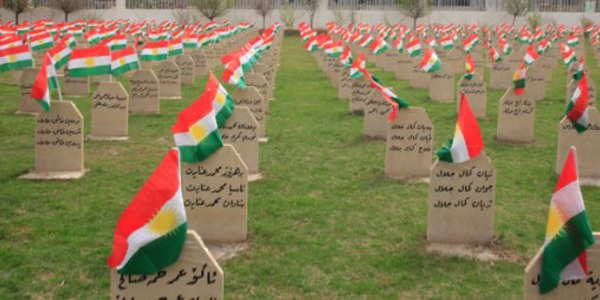
Graves of Iraqi Kurdish victims in Halabja. (Reuters)
The Syrian Context 2025: The March 10 Agreement and the Rise of the New Syria
A similar scenario unfolded in Syria decades later, amid the broader collapse of the Syrian state. Following the fall of Bashar al-Assad’s regime on December 8, 2024, a transitional government led by Ahmed Al-Sharaa took office. This government confronted a challenging reality: the Syrian Democratic Forces (SDF) controlled roughly a third of the country, including key oil and gas fields and strategically important border crossings.
On March 10, 2025, Ahmed Al-Sharaa and SDF leader Mazloum Abdi signed an agreement under U.S. auspices aimed at ending the dual military and administrative authority. The deal was significant as an effort to integrate the Kurds into the “new” state structure as national partners, while reaffirming a commitment to the principle of Syrian territorial unity.
The agreement encompassed commitments to Syria’s sovereignty and territorial integrity under a single flag and capital, the integration of the SDF into the Syrian Ministry of Defense and national civil institutions by the end of 2025, the protection of the Kurds’ constitutional, cultural, and linguistic rights as an indigenous component, equitable management of natural resources (oil and gas) under central state control, and the recognition of some form of administrative decentralization in Kurdish-majority areas.
As in Iraq, the March 10, 2025 agreement encountered structural obstacles over the interpretation of “integration.” The Kurdish leadership insisted on preserving the SDF’s organizational structure and military units within the Syrian army, while seeking full recognition of the “self-administration” as a permanent administrative model. In contrast, Al-Sharaa’s government, supported by Turkey, viewed these demands as “separatist tendencies” that threatened the unification of Syria’s sovereign institutions.
By August 2025, the truce began to unravel amid mutual accusations of violating the agreement. The SDF accused the government of attacking Deir ez-Zor and attempting to advance toward oil fields, while Damascus accused the Kurds of holding “separatist” conferences in Al-Hasakah aimed at internationalizing the issue and triggering renewed sanctions. The crisis reached its peak in December 2025, when violent clashes erupted in the Sheikh Maksoud and Ashrafiyah neighborhoods of Aleppo, leading to their siege and the displacement of thousands of Kurdish residents.
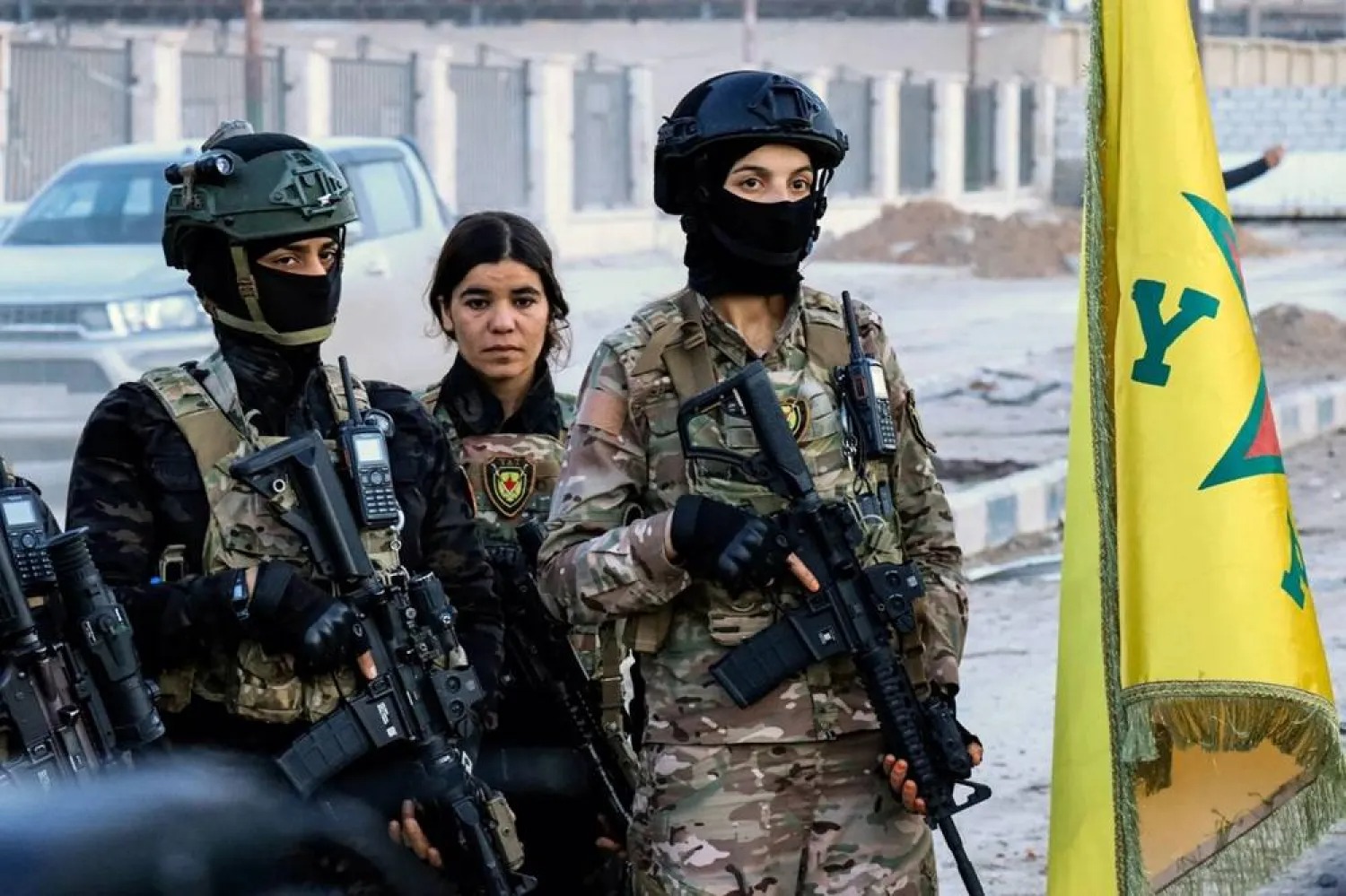
Female fighters of the Syrian Democratic Forces positioned in Al-Hasakah city, northeastern Syria. (AFP)
The January 18, 2026 Agreement: Forced Integration and the Dismantling of the SDF
Successive military defeats and the loss of control over oil fields in Deir ez-Zor and Tabqa severely weakened the Kurdish negotiating position. Facing pressure from the Syrian military and coordinated American-regional diplomacy, Mazloum Abdi signed a new 14-article agreement on January 18, 2026, effectively conceding to the central state’s demands in exchange for limited cultural and civil guarantees.
This agreement imposed a new reality, effectively ending the “self-administration” experiment in its previous form. Its provisions included:
The “individual” integration of SDF members into the Ministries of Defense and Interior, effectively dismantling independent Kurdish military units.
The complete handover of civil and military administration in Deir ez-Zor and Raqqa to the Syrian state.
Restoration of government control over oil and gas fields and border crossings, securing them with regular forces.
The removal of all non-Syrian PKK fighters, a fundamental Turkish demand included in the agreement to ensure regional stability.
In return, Al-Sharaa issued Decree No. 13 of 2026, granting the Kurds rights long denied under the Ba’ath regime: citizenship for stateless individuals, recognition of the Kurdish language as a national language, and designating Nowruz as a public holiday. Despite the significance of these measures, Kurdish circles criticized them as a “cheap price” for the loss of an independent political and military entity.
Ideology, Geography, and International Intervention
The comparison between the 1970 and 2025 experiences reveals a striking similarity in the conflict dynamics between the Kurds and the central regimes across the Arab East.
The conflict over resources and geography-
In Iraq, Kirkuk was considered “the Kurds’ Jerusalem” and the key stumbling block that derailed the agreement, as Baghdad refused to grant Kurdish control over its oil. Similarly, in Syria, the Al-Omar and Conoco fields, along with control over the Euphrates Valley, were central to the Syrian army’s offensive, as Al-Sharaa argued that continued Kurdish control of these resources obstructed the formation of a united and economically stable Syrian state.
The ideological shift of ruling regimes-
The Ba’ath regime in Iraq saw Kurdish distinctiveness as a threat to the goals of the “Arab nation.” In contrast, the new Syrian regime blends “moderate” Islamic orientations with political pragmatism, seeking to forge a unified national Syrian identity that includes Kurds as citizens while firmly rejecting any federal or confederal arrangements.
The role of superpowers and the Kurdish gamble-
In 1975, U.S. Secretary of State Henry Kissinger abandoned the Kurds once the Shah and Saddam reached an agreement, leaving the Kurdish movement exposed to annihilation. Similarly, in 2026, despite prolonged U.S. military support for the SDF in the fight against ISIS, President Donald Trump’s administration and envoy Tom Barrack ultimately prioritized a “security agreement” aligning U.S. interests with Turkey and Israel, compelling the Kurds to accept harsh terms of integration.
Human and Demographic Losses
The failure of the agreements in both cases fundamentally reshaped the Kurdish presence and influence in the region.
Losses in the Iraqi experience (1975 and beyond)
Complete military collapse: the Peshmerga lost their combat capability, and the Kurdish leadership was forced into exile.
Demographic change: the displacement of hundreds of thousands from border villages and the creation of “Arabization belts” in Kirkuk and Khanaqin.
Loss of resources: full central control over oil wealth and the long-term economic marginalization of Kurdistan.
Losses in the Syrian experience (2025-2026)
Loss of land: Kurds lost control over roughly 70% of their previously held territories, including key strategic areas such as Raqqa, Deir ez-Zor, and Tabqa.
Forced displacement: over 150,000 Kurds displaced from Aleppo alone, with further potential displacement from areas such as Kobani (Ayn al-Arab), now under siege by government forces.
Dismantling of military identity: the SDF was transformed from an organized army governing a vast area into individuals integrated into a national army controlled by a centralist mindset.
The common thread is that the Kurdish issue remains hostage to “cursed geopolitics.” In both cases, the Kurds were an undeniable force during periods of central weakness, yet once the state regained strength or regional powers reached agreements, Kurdish gains were sacrificed in the name of “national sovereignty” and “regional stability.”
Although the 2026 agreement in Syria granted the Kurds certain cultural and civil rights long denied—such as language recognition and citizenship—the cost was the dismantling of their “self-administration” project and acceptance of integration into a central state whose democratic credentials remain uncertain. The 1975 experience in Iraq serves as a historical reminder that, without binding international guarantees, political agreements can become “mere paper” when power dynamics shift—a lesson Syrian Kurds are confronting today. The Kurdish issue in the Middle East remains one of the most complex in modern history, where aspirations for national identity intersect with regional and international power struggles. Both the March 11, 1970 agreement in Iraq and the March 10, 2025 agreement in Syria stand as historical milestones in which Kurdish actors sought to secure political and administrative rights within the structures of the central state.
Disclaimer: The opinions expressed by the writers are their own and do not necessarily represent the views of Annahar.
في أجواء عائلية دافئة، شارك كريم محمود عبدالعزيز وروجينا وإلهام شاهين جمهورهم فرحة تخرج أبنائهم، مبرزين الجانب الإنساني والأسري بعيداً من أضواء الشهرة.






 مسنجر
مسنجر
 واتساب
 ثريدز
ثريدز
 بريد إلكتروني
 الطباعة