Trump re-enters the Nile dam dispute as Egypt and Sudan welcome U.S. mediation



شارك على
 مسنجر
مسنجر
 واتساب
 ثريدز
ثريدز
 بريد إلكتروني
 الطباعة
شارك على


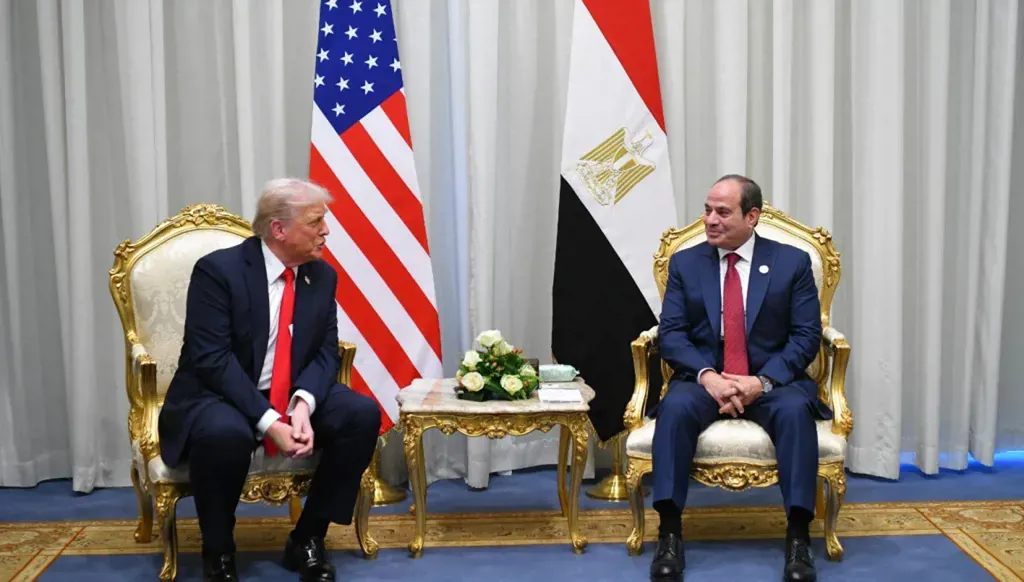


The commitment of U.S. President Donald Trump to reaching a lasting solution to the Ethiopian Grand Renaissance Dam crisis was welcomed officially by Egypt and Sudan. It also opened the door to broad discussions within political, parliamentary, and media circles, extending into the public sphere.
The spokesperson for the Egyptian Presidency, Ambassador Mohamed El-Shenawy, announced on Tuesday evening that Egyptian President Abdel Fattah El-Sisi will meet U.S. President Donald Trump on the sidelines of the World Economic Forum in Davos.
Shenawy said the meeting will be to "discuss the latest regional and international developments of mutual interest, and explore ways to strengthen cooperation and coordination between Egypt and the United States in a way that serves the interests of both countries and reinforces regional and international stability."
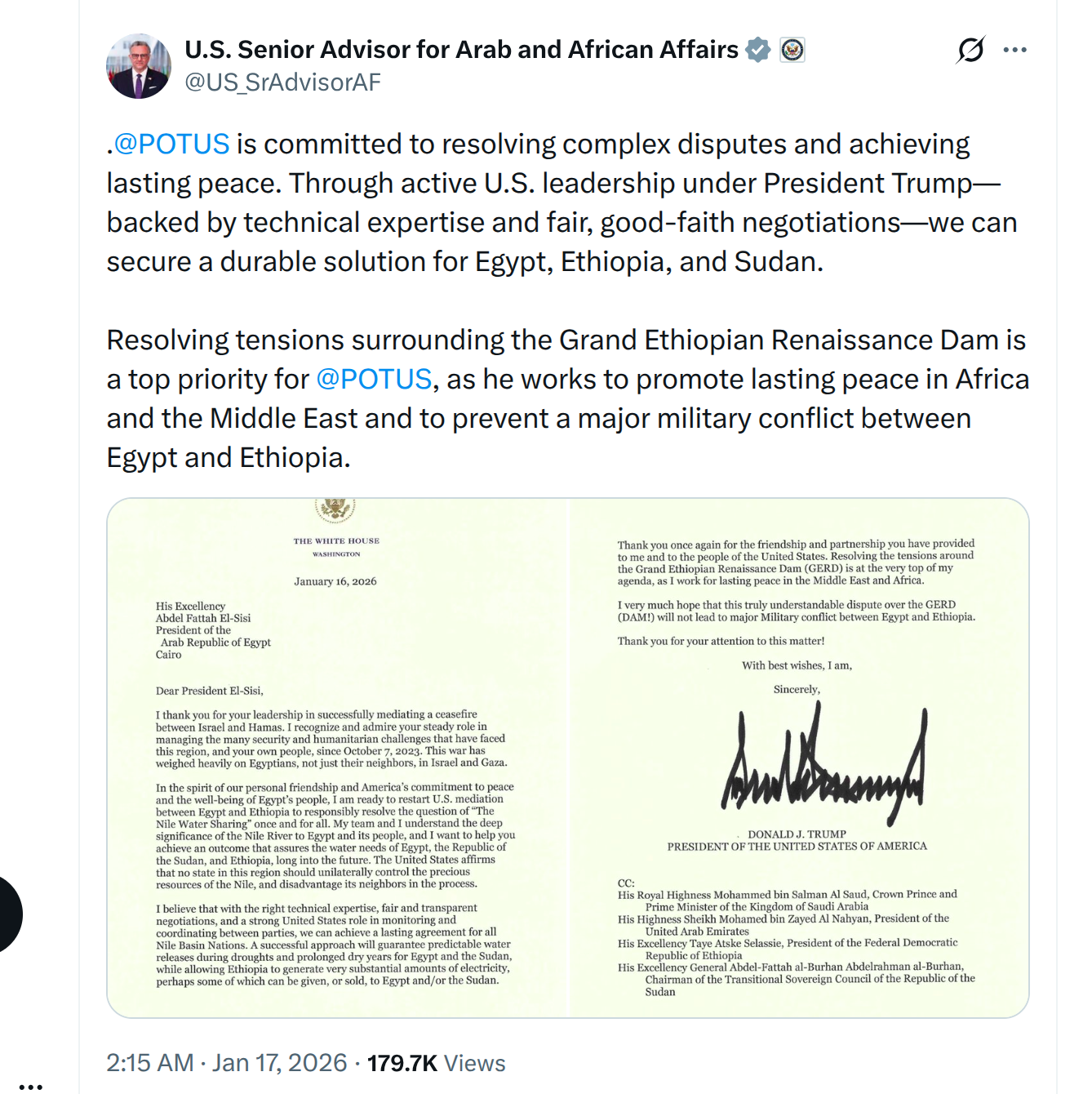
The meeting is expected to address the U.S. mediation initiative, which the Egyptian President welcomed in his response to the letter of thanks that the U.S. President sent to El-Sisi on Friday, expressing his readiness to resume the mediation previously led by Washington between 2019 and 2020.
Massad Boulos, Senior Adviser to the U.S. President for Arab and African Affairs, said that "resolving the tensions surrounding the Grand Ethiopian Renaissance Dam is a top priority for the U.S. President, as part of his efforts to reinforce lasting peace in Africa and the Middle East, and to prevent a large-scale military conflict between Egypt and Ethiopia."
Despite previous U.S. efforts ending in failure, there are expectations of more positive results this time, given Trump's personal intervention and the weight he is putting behind the upcoming efforts.
U.S. Influence
Former Assistant Secretary-General of the Organization of African Unity, Ambassador Ahmed Haggag, believes the chances of U.S. efforts succeeding are high. He told Annahar that "the United States has wide influence in Ethiopia, and in the entire Horn of Africa region."
Haggag notes that "what was stated in the U.S. President's letter is an extension of his previous efforts, when he sponsored negotiations between the three countries during his first presidential term and reached an agreement with Ethiopian approval, had Addis Ababa not suddenly withdrawn unilaterally and refused to sign."
He adds that "Egypt, in principle, does not object to development projects in the Nile Basin countries. What matters to it is that those countries take into account, in a binding manner, the potential impacts of such projects on the two downstream states (Egypt and Sudan)."
He continues: "Cairo has built development projects (including dams) in Tanzania and South Sudan and does not object to any development in the Nile Basin. Moreover, Khartoum and Cairo have similar, even united, positions, and they welcomed Trump's willingness to mediate in resolving the Renaissance Dam crisis," in a reference to the idea that the ball is now in Ethiopia's court.
Pressure Tools
For his part, African affairs specialist Ramy Zohdy believes that "the United States is not a technical party capable of offering new engineering or legal solutions, as all details of the dam file are known, and all negotiation scenarios have been exhausted, whether through the African Union, the previous U.S. sponsorship, or the trilateral negotiation tracks."
He adds in his comments to Annahar: "The new element lies in the potential pressure tools, which may include economic pressure on Ethiopia, as the intransigent party, whether through international financial institutions, aid mechanisms, or political and diplomatic pressure. The matter could also include proposing a broader political settlement linking the dam issue to other regional files in the Horn of Africa."
Zohdy notes that "Washington may use these tools individually or collectively," pointing out that "the American intervention, although not the first of its kind, is stronger this time in terms of rhetoric, yet it remains so far neither decisive nor guaranteed in its outcome."
A Rejected Bargain
There have been hints or "trial balloons" that Ethiopia is believed to have floated unofficially through media outlets and Ethiopian social media pages after Trump announced his intention to resolve the Renaissance Dam crisis. These hints suggested that Ethiopia could obtain a maritime outlet in exchange for agreeing to sign an agreement acceptable to Egypt and Sudan. It is likely that Cairo would reject such a bargain.
Egyptian observers also believe that Egypt is no longer in a position that allows Ethiopia to use the dam as a pressure card to force acceptance of granting a country that does not overlook the Red Sea maritime access or military bases, which Egypt considers a "red line" affecting its national security, according to previous statements by its Foreign Minister Dr. Badr Abdel Aaty.
Professor of Geology and Water Resources at Cairo University, Dr. Abbas Sharaky, wrote on Facebook that "the Renaissance Dam is not a matter of life or death for Egypt. The construction has been completed and the filling is done. The five years from 2020 to 2024 were the most harmful for Egypt, because they were the initial filling years of the dam's reservoir, during which part of the annual inflow was withheld, reaching 64 billion cubic meters, in addition to more than 40 billion cubic meters lost to evaporation and seepage over those five years. Without the High Dam and Egyptian measures, a definite disaster would have occurred."
Zohdy added: "I do not believe that Cairo would accept Ethiopia obtaining a maritime outlet, nor is it under pressure that would force it to accept that."

العلامات الدالة
الأكثر قراءة



توقيف غامض ونقل إلى سوريا وروايات متناقضة تضع الدولة أمام مسؤولية كشف ما جرى، وسط مخاوف أمنية وديبلوماسية.