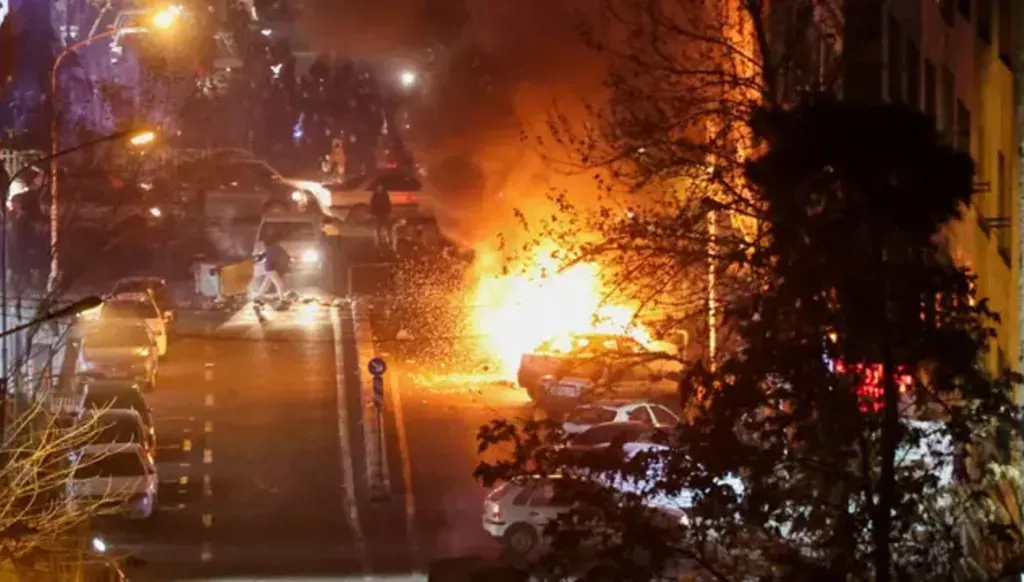
When Tehran contacted Washington, under the pressure of popular protests, to request a return to negotiations, it knew that it would have to deal with the abandonment of its nuclear program as an American condition that had been set before the 12-day war and continued afterward. Therefore, the contact seemed to signal that Tehran might be ready to accept the condition and negotiate an appropriate way out of it. It quickly became clear that this assumption was incorrect, as the U.S. president suspended the communications to activate the military option, then decided to close it, settling for a “deal” in which the Iranian regime offered to stop killing protesters from its own people and pledged not to carry out executions, while in return Donald Trump kept his planes at their bases. This was the announced aspect of what happened; the unannounced side was multifaceted: military readiness was incomplete (even in Israel), the objective—regime change—was not fully developed, the “alternative” was unclear, and the regional repercussions (security, economic, and political) were difficult to predict, prevent, or control.
War was temporarily avoided, but it cannot be postponed indefinitely. Trump is always eager, especially when he sees a significant power imbalance as an opportunity to secure quick acceptance of American terms. Yet Iran is a vast, entrenched country capable of resisting, striking back stubbornly, enduring sanctions, circumventing them, expanding its regional influence—and gradually losing it piece by piece. If its objectives are not immediately met, Iran knows how to be patient and wait.
Talk of a diplomatic path has vanished. Why? Perhaps in anticipation of mediators uncovering even harsher American conditions, but more likely because the U.S.—under Trump—and Israel—under Netanyahu—are preparing for a decisive confrontation. The goal of the looming war is clear: regime change. Whether it succeeds or fails is another matter. And if achieving that goal proves difficult, as recent developments suggest, it would not be surprising for the American-Israeli side to lean toward a strategy of chaos, igniting internal conflicts as a possible outcome.
Are there repercussions for Lebanon? Absolutely. Israel has essentially received all the green lights to act. While a full-scale ground invasion may be off the table, any strike targeting Iran’s ally, Hezbollah, is viewed by both Washington and Tel Aviv as a direct strike on Iran itself.
The latter continues to use the “party” for external maneuvers, while others use it against them. As long as the “party” remains unconvinced that its weapons are no longer effective for resisting Israel—or serving any other purpose—it will insist on retaining them. At the same time, as long as Tehran falsely claims it is not interfering in Lebanese affairs or in the affairs of “its party,” and has not counseled it to cooperate with the Lebanese state or seek a withdrawal formula, they are collectively paving the way for chaos—or even a “civil war” threatened and potentially provoked by the party itself.
The ongoing “mechanism” negotiations—marked by delays, emptiness, and a quiet U.S.-French disagreement—signal a potential slide toward confrontation. These “mechanisms” are multiple, and all appear to be cunningly managed by Israel. One aims to monitor a ceasefire by the “party” alone, which has already been implemented but not recognized by the American administration for the committee—here, a ceasefire effectively translates into “disarmament” across Lebanon. Another seeks to legitimize the implementation of the U.S.-Israeli strategy to continue targeting the “party,” without acknowledging Israel’s own violations of the ceasefire. A third is the political track, promoted by Washington and Tel Aviv, intended to separate it from the military path and steer it toward obligatory, yet illusory, “economic cooperation.
Disclaimer: The opinions expressed by the writers are their own and do not necessarily represent the views of Annahar.





 مسنجر
مسنجر
 واتساب
 ثريدز
ثريدز
 بريد إلكتروني
 الطباعة