Greenland: The new geopolitical chessboard in Trump’s Arctic strategy
From ice to influence, Greenland has become a strategic hotspot for the U.S., Europe, Russia, and China, fueled by melting Arctic routes, untapped resources, and the race for dominance in the North.



شارك على
 مسنجر
مسنجر
 واتساب
 ثريدز
ثريدز
 بريد إلكتروني
 الطباعة
شارك على


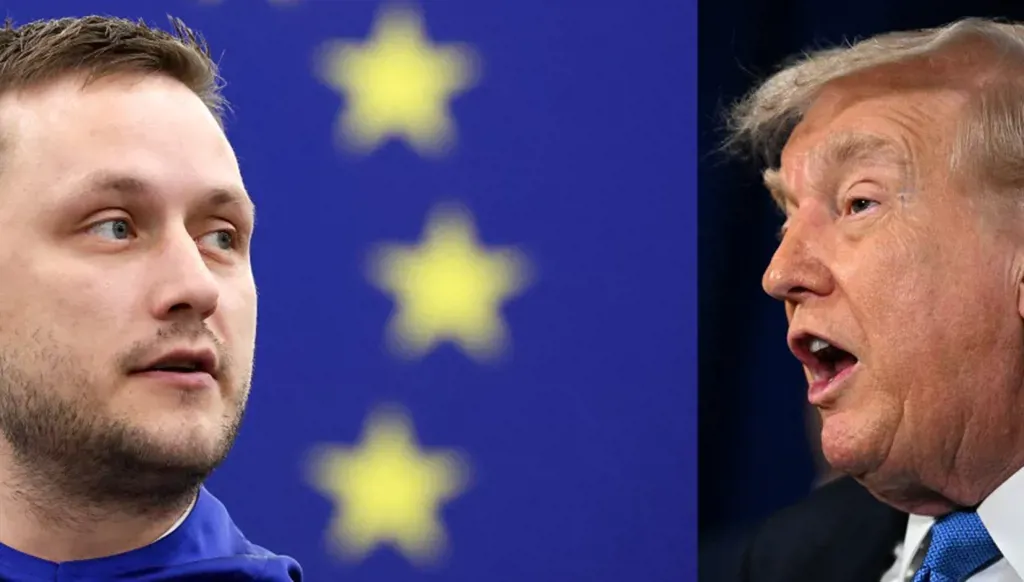


Since returning to the forefront of American politics, Donald Trump has made no secret of his core philosophy on international affairs: the world is less a system of rules and alliances than a field of major deals, and geography is not a fixed set of borders, but a collection of strategic assets that can be managed or redefined to maximize influence.
In this context, Greenland is back in the spotlight—not as a remote northern island, but as a central piece in the game of great powers and a potential focal point in Trump’s geopolitical calculations.
Greenland, the world’s largest island, occupies a unique position at the crossroads of three strategic spheres: the Arctic, the North Atlantic, and the emerging sea routes reshaped by climate change. With ice melting at an unprecedented pace, the Arctic is no longer a frozen periphery but the center of a new geopolitical contest where trade, energy, and security intersect. Shorter shipping routes between Asia and Europe, vast reserves of rare minerals and oil and gas, and the growing importance of early-warning and missile-defense sites all make Greenland a highly coveted strategic prize.
Officially, Greenland is part of the Kingdom of Denmark, but it enjoys extensive autonomy—a crucial detail in the world of realpolitik. This ambiguous legal status creates opportunities for unconventional forms of influence that stop short of annexation or outright “purchase,” yet can effectively undermine the practical exercise of its sovereignty.
When Trump proposed “buying Greenland” in 2019, it was met with European ridicule and a categorical Danish refusal. Yet the common mistake was treating the idea as a mere whim or media stunt. Trump does not see borders as sacred lines; he views territories as assets, sovereignty as a function of power, and foreign policy as a direct extension of the “winning deal” logic. From this perspective, Greenland was never a fleeting thought—it was an early signal of a broader vision to reshape American influence in the North, in response to China’s rise and Russia’s resurgence.
Over the past decade, Russia has reinforced its military presence in the Arctic, renovating bases and infrastructure, while China has expanded investments in ports, minerals, and research projects, boldly presenting itself as a “near-Arctic state.” This dual expansion alarms Washington—and Trump in particular—who views any strategic vacuum as a direct loss of American influence. In this context, Greenland emerges as a critical military pivot: a platform for early warning and observation, and a geopolitical barrier against the advance of rival powers.
However, the issue extends beyond Washington and its rivals: the European Union faces a genuine strategic dilemma. Greenland directly impacts European security, shapes the balance of influence in the North Atlantic, and touches on the very principle of sovereignty underpinning the European order. Yet any response is complicated by Europe’s deep security dependence on the United States through NATO, at a time when the EU lacks independent deterrent capabilities in the Arctic.
Direct confrontation with a Trump-led American administration appears risky, with uncertain outcomes. At the same time, allowing unilateral U.S. expansion could be seen as a strategic concession, setting a dangerous precedent. As a result, Europe tends to adopt a gray-area approach: politically affirming Denmark’s sovereignty and increasing its economic and developmental presence in Greenland, while avoiding an overt clash with Washington. Investments in infrastructure, clean energy, education, and offering European financial alternatives are all intended to reduce the appeal of the “American offer” without explicitly announcing it.
At the same time, the European Union is quietly working to internationalize the issue through polar cooperation frameworks and verbal commitments to international law, while carefully avoiding language that Trump might interpret as a direct provocation. It is a delicate balancing act: protecting Europe’s geopolitical interests while maintaining a working relationship with an American administration that places little faith in multilateralism or European sensitivities.
What has changed this time is the international context itself. The world is more turbulent, international law carries less political weight, and unconventional deals have become increasingly acceptable under the pressure of crises. If Trump returns to power or consolidates his influence, he is likely to pay less attention to European reactions and more readily employ tools such as economic pressure, investment incentives, or the redefinition of protection and sovereignty arrangements—rather than respecting them in their traditional form.
Instead of a direct “purchase,” we may see more realistic approaches: long-term agreements to control resources, an expanded U.S. military presence, or significant economic leverage that preserves legal sovereignty in name while shifting actual decision-making to Washington.
Meanwhile, the people of Greenland face a complex dilemma: a growing desire for independence, an urgent need for investment and development, and a legitimate fear of being caught between competing great powers. It is precisely here that Trump may find his most effective entry point, offering economic incentives in exchange for strategic influence.
Greenland is not an isolated case but a symbol of a post–old-rules world, where geography reasserts its strategic importance and influence is shaped less by liberal principles than by practical power. Trump is not inventing this world—he is simply engaging with it openly, without the usual diplomatic masks.
Greenland may not be for sale, but bringing it under broad influence is no longer a hypothetical scenario. In a world increasingly defined by conflicts over resources, trade routes, and strategic locations, the frozen island has become a high-value piece in the calculations of global powers. Amid hesitant allies, wary adversaries, and a Europe trying to navigate without confrontation, Greenland stands as an early test of the emerging international order.
Disclaimer: The opinions expressed by the writers are their own and do not necessarily represent the views of Annahar.

العلامات الدالة
الأكثر قراءة