Lebanon’s repeated official exam uncertainty: Can new curricula break the cycle?
As official exams in Lebanon swing between postponement and cancellation amid decades of disruption, education experts question whether long-promised curriculum reform can finally bring stability and restore trust in the system.
Official exams or not? This question seems to recur every academic year. In Lebanon, how many times have official exams been postponed? And why? It is an intermittently recurring issue; the delay of official exams in Lebanon is no longer an exceptional case but has become a reality that repeats itself every few years for various reasons.
The number of times exams have been postponed is not fixed; however, the instances can be tracked both before and after 1990. The reasons for postponement vary from political and security factors to socio-economic conditions, including health conditions imposed by the COVID pandemic.
After 1990
Here is a timeline highlighting the major periods when exams were postponed after 1990:
2011: Some vocational education exams were postponed due to a drivers' strike.
June 11, 2014: Official exams were postponed by one day after extensive debate between the Ministry of Education and the 'Coordination Syndicate', due to demands related to social and living conditions. After tough negotiations lasting until dawn, then Education Minister Elias Bou Saab announced the postponement of the exams for only one day, after promising teachers to supervise the exams.
2020: Extensive postponement of official exams due to the spread of the COVID-19 pandemic.
2021: 'Brevet' exams were cancelled after a period of remote learning. They were also cancelled in the years 2023, 2024, and 2025.
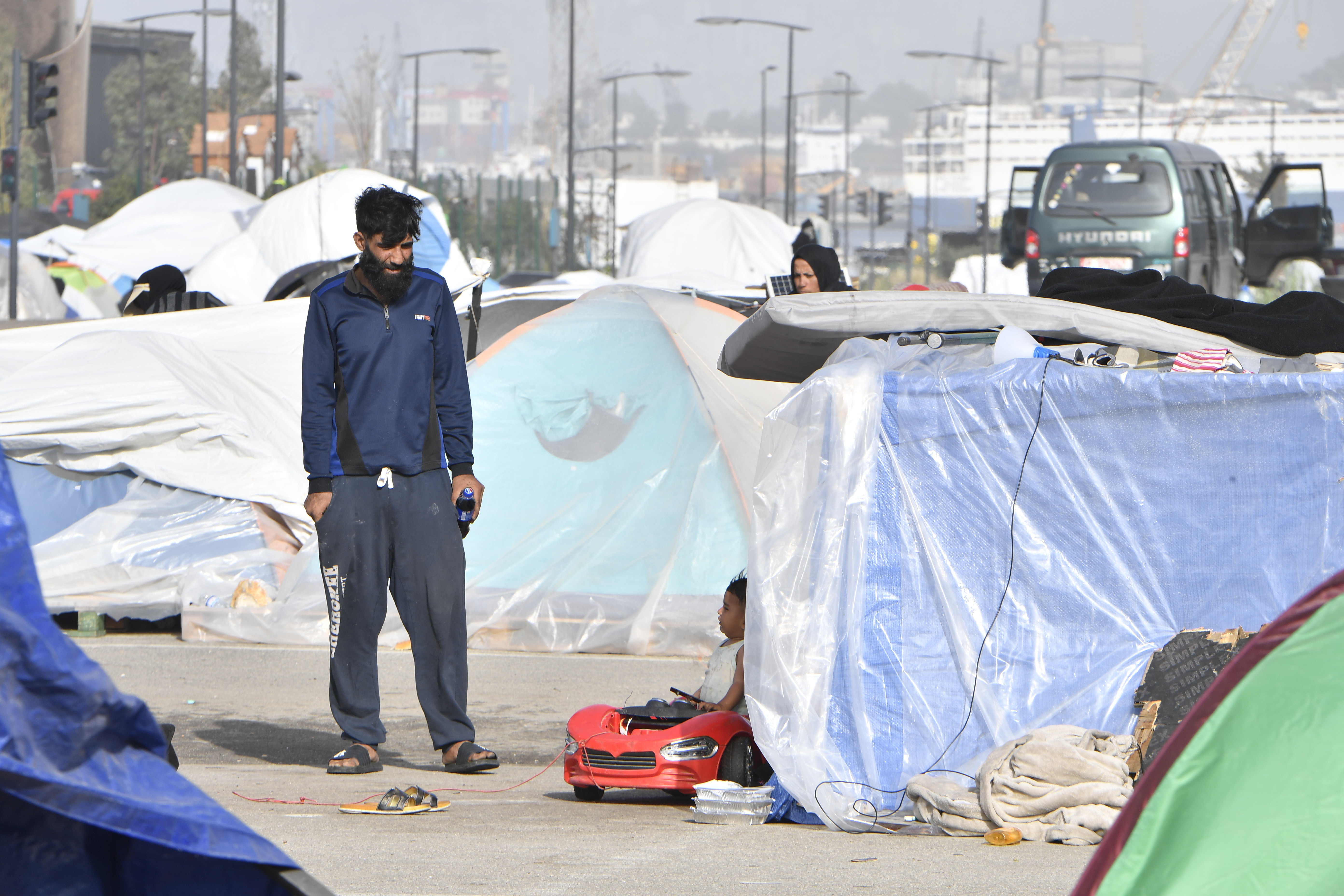
A refugee family with children deprived of education. (Annahar)
During the civil war period
Before 1990, those years were marked by frequent and continuous postponements due to the conditions imposed by the civil war at the time. The timeline reveals the following:
1975: Exams were conducted for all certificates, but the certification statement was used for passing, except for the second part of the baccalaureate, where students succeeded through contingency marks.
1976: Exams were cancelled, and applications for certification were not accepted.
1977: Only the second part of the baccalaureate exams was conducted, while school certificates were relied upon for other certifications.
1978: The certification statement was used.
1979: Exams were held, results were not released, and the certification statement was used for the first part of the baccalaureate. Exams were also administered to candidates from the previous year.
1982: The intermediate certificate was cancelled, and the certification statement was adopted for other certificates.
1984: School certification was relied upon.
1985: All exams were cancelled, and certification documents were adopted.
1986: Intermediate exams were cancelled.
1987: All certificates were cancelled; the certification document was adopted for the intermediate level, and a school certificate for the baccalaureate.
1989: Exams were cancelled, and a certificate of success from the ministry was adopted.
1990: The intermediate and first part of the baccalaureate certificates were cancelled, while the second part of the baccalaureate exam was conducted.
Postponing exams in Lebanon cannot occur without impacts or repercussions at various levels. While a student’s ability is not solely measured by performance in official exams, repeated cancellation or postponement without any clear plan can lead to several consequences.
Firstly, on a psychological level, leaving students uncertain until the last minute about whether they will take official exams creates significant psychological pressure, which compounds the broader crises the country is experiencing, whether security-related due to war or health-related.
Students often live in a state of anxiety and instability due to uncertainty about their academic future. Undoubtedly, continuous postponements exhaust them psychologically and affect their concentration, while also placing additional pressure on parents under extremely difficult general conditions.
Educationally, delays can undermine the principle of equal opportunity among students, particularly between public and private education systems. This may affect the value of official certificates at different levels and widen the gap in actual student assessment.
On the academic side, universities are directly affected by this wavering between postponement and cancellation, as new student admissions may be delayed. Some universities may adopt exceptional conditions or alternative entrance exams.
This also affects students who decide to travel to join foreign universities with fixed schedules and entrance exams. Overall, this situation creates disruption in the transition from secondary to tertiary education.
More importantly, cancellation or postponement is rarely linked to a clear vision of secondary and higher education as a whole. On the one hand, the unified national exam loses its value; on the other hand, there is a lack of a comprehensive vision for an integrated educational system.
After all these Lebanese experiences, it has become almost certain and necessary to move towards changes in curricula and educational vision, with exams being an essential part of this reform, rather than being addressed individually or on a yearly basis.
Will the new educational curricula be the starting point towards the solution?





 Messenger
 Whatsapp
 Threads
 Email
Email
 Print
Print
 X
X
 Facebook


 A refugee family with children deprived of education. (Annahar)