Iran’s regional power vs. economic strain: A two-decade balance sheet

Opinion 24-04-2026 | 13:58

Iran’s regional power vs. economic strain: A two-decade balance sheet

How geopolitical ambition, military spending, and sanctions have shaped Iran’s economy and regional influence since 2003.

Iran’s regional power vs. economic strain: A two-decade balance sheet
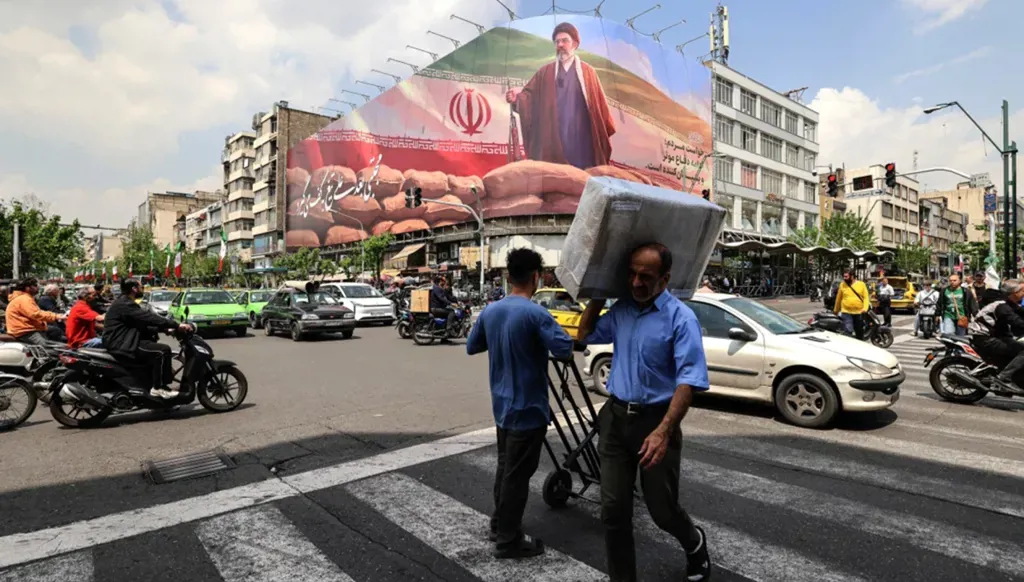
The draining of the Iranian economy affects the living standards of Iranians and lowers the quality of services provided by the state to them. (AFP)
Smaller Bigger


For two decades, since the United States invaded Iraq (2003) and effectively handed it over to Iran through armed sectarian militias acting as its regional proxies for political and functional purposes (as discussed in previous articles), the Iranian regime has become a key player in the Middle East—more so than the other two actors, Israel and Turkey—at the expense of the Arab system and with a degree of American acquiescence.


Manifestations of Iranian regime arrogance


During that period, Iran—through statements by many of its leaders—continued to boast about its expanding regional role, claiming influence over political decisions in several Arab capitals (Baghdad, Beirut, Damascus, and Sanaa) through its armed sectarian militias in those countries, while also threatening and blackmailing Gulf states, effectively acting as a destabilizing force for state and social structures in the Levant and the Arabian Gulf.


It also engaged in, or invested in, the use of the Palestinian cause and the conflict against Israel, with its leaders repeatedly threatening to destroy it within hours or days, describing Israel as weaker than a spider’s web, relying on its missile capabilities and its militias, primarily “Hezbollah” in Lebanon, while promoting the concept of “unity of arenas,” all in order to cover its internal political choices and external interventions and to enhance its status and legitimacy in the Middle East.


Moreover, the Iranian regime continued to challenge the US administration but in a calculated, cautious manner, avoiding any direct military confrontation or friction with it or with Israel, while at the same time threatening to displace it from its position as a dominant international and regional pole in favor of a multipolar world, relying on the BRICS countries (China, India, Russia, Brazil, and South Africa), and advocating a shift in international monetary transactions from the US “dollar” to the Chinese “yuan,” as well as leveraging its weight in global energy supplies of oil and gas, especially to China and India.


Finally, it emerged that Iran exerts significant leverage over the Strait of Hormuz, a critical chokepoint for global oil and gas shipments, thereby affecting the export capacity of several Gulf Arab states, in addition to posing a military threat to those countries, as witnessed in the ongoing tensions between the United States, Israel, and Iran.


Disconnection of will from reality


The idea here is that Iran appears strong enough to challenge the world, but this, in reality, stems more from a spirit of arrogance and a disconnect from reality on the part of its leadership than from genuine sources of power.


While Iranian leaders speak of their victory and of the strength of their leadership’s resolve in rejecting American dictates, American aircraft and warships systematically degrade its capabilities, urban infrastructure, and economic assets, while it faces a tight embargo on exports and imports, a sharp currency decline, and a severe economic deterioration or hemorrhage.


Now, let’s take the World Bank statistics for 2024 to observe the balance of power concerning Iran compared to some countries, noting that Iran has significantly declined after the war. For instance, Iran’s GDP reached $417 billion, while Turkey’s was $1.323 billion, meaning Iran’s economy equals a third of Turkey’s, despite being double its size and having vast oil and gas wealth. This can also be seen in GDP per capita, which was $4,770 in Iran, compared to $15,400 in Turkey (noting that tiny Israel, in terms of area, population, and resources, had an annual GDP of $542 billion and a per capita income of $54,000 annually).


Comparing with previous years, one can notice that Iran’s GDP was around $181 billion in 2004. In 2014, it reached $432 billion, and in 2024 it stood at $417 billion, whereas in Turkey it was $392 billion, $934 billion, and $1,307 billion for the same years, meaning it continuously rose or more than doubled. (Israel increased as follows: $130 billion, $307 billion, and $542 billion).


One can also notice the relatively low value of the Iranian economy in terms of export volume, which was approximately $44 billion, $95 billion, and $53 billion for the years 2004, 2014, and 2024, respectively. In contrast, Turkey’s exports rose from about $63 billion to $166.5 billion, and then to $262 billion over the same periods, reflecting a steady upward trajectory. In the case of Israel, exports increased from roughly $42 billion to $61 billion, and then to $74 billion, respectively, in billions of dollars.


It is clear that the Iranian economy is in a state of relative strain and depletion, reflected in its impact on the living standards of Iranians and the low quality of services the state provides, given the heavy spending on armaments, support for militias in other countries, and nuclear energy development.


At the same time, this spending has not provided Iran with adequate protection nor significantly enhanced its regional status. Moreover, its military expenditure, despite its size, does not match that of the United States, which accounts for nearly half of global military spending, especially when considering the technological and military superiority of the United States and Israel.


Disclaimer: The opinions expressed by the writers are their own and do not necessarily represent the views of Annahar.