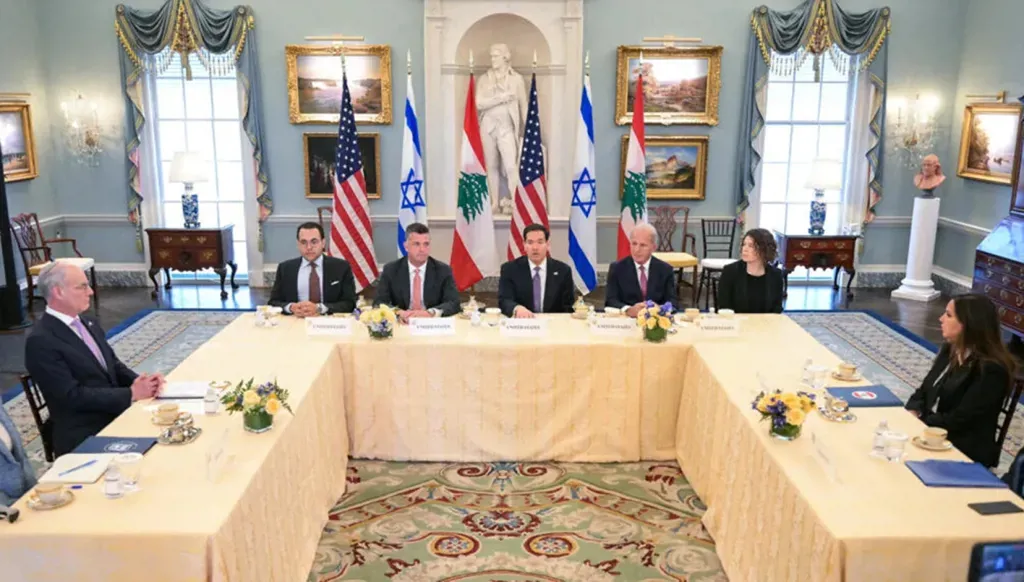
Lebanon is currently at a stage marked by the risk of renewed war and the collapse of the U.S.-imposed truce, personally backed by U.S. President Donald Trump. It faces a reality filled with considerable suspicion and doubt regarding the durability of the American commitment on one hand, and Lebanon’s true ability to leverage this commitment in its support on the other.
It is entirely legitimate and natural for this dual fear to overshadow hastily driven ambitions, because the first chapter of the “alleged” truce revealed what the Lebanese do not wish to discover by believing in it: that it failed to decisively and realistically separate the negotiation tracks of both Iran and Lebanon.
In fact, the current developments on the ground in the south have largely diverged from previous wartime experiences, shaping a reality that is among the most dangerous of all precedents. This reality, which Hezbollah claims it can eliminate with its weapons, has been turned by Israel into what amounts to a literal reproduction of Gaza.
For the first time in its history of invasions and wars with Lebanon, Israel has erased all urban and civilian landmarks in a buffer zone comprising more than fifty towns, heightening fears of permanent occupation, similar to what it has done in Gaza and in large occupied areas in Syria.
Collapse of the truce
This reality is being solidified while advocates of rejecting negotiations between Lebanon and Israel continue to serve the logic of confrontation, meaning that the collapse of the truce would result in one outcome: pushing Israel to expand its operations and raids in the south and further into the depths of Lebanon.
It may also lead to internal destabilization, reflected in the intense political and media campaigns launched by Hezbollah and its supporters against President Joseph Aoun and Prime Minister Nawaf Salam, along with all the party’s opponents and critics of its policies, which they describe as suicidal and linked to its allegiance to Iran.
Thus, President Aoun, supported by the Prime Minister and pro-negotiation forces, faces the greatest challenge in making full use of the American push as quickly as possible, by demonstrating firm commitment to decisive measures to advance negotiations with Israel toward a comprehensive agreement, rather than merely revisiting previous agreements or past experiences that ended as their conditions did.
The 1949 truce agreement
Playing the 1949 truce agreement’s tune has become akin to evoking a history that has faded. Renewed talk of strict ceasefire agreements, purely security measures, and independent land and sea border demarcations has all been tried before and ended with the consequences of the support wars waged by the party, which led Israel to abandon all previous invasion experiences and now embark on establishing what is widely seen as the most dangerous occupation-like version of the south.
Unless Lebanon moves towards a comprehensive security, border, and political agreement without hesitation or under the pressure of threats of civil war, Iran will remain capable of influencing its file and reality, even in the context of its negotiations with the United States. Meanwhile, Israel has secured enough for a lasting occupation that protects it from the repercussions of the anger of residents in northern Israel.
What may be even more dangerous is a return to the 1980s, when the Iranian Revolutionary Guard entered Lebanon in the aftermath of major attacks, including the bombings of the U.S. Embassy, the Marine barracks, and the French paratroopers’ headquarters. This scenario cannot be dismissed if truces collapse across both the war and negotiation fronts.
Although the current era is fundamentally different from that period, and Iran today, after the latest war, is at a different stage of its confrontation and remains a formidable force as it was before the war, Lebanon’s vulnerability would not require much for it to be exposed—unless the state moves toward what some describe as a surgical form of rescue, regardless of the cost.
Disclaimer: The opinions expressed by the writers are their own and do not necessarily represent the views of Annahar.






 Messenger
 Whatsapp
 Threads
 Email
Email
 Print
Print
 X
X
 Facebook