

Ceasefire in question: How border dynamics are reshaping Hezbollah’s strategic posture
Amid shifting “rules of engagement,” disputed territorial narratives, and rising regional tensions, Lebanon’s south faces an uncertain post-ceasefire reality shaped by deterrence, displacement, and diplomatic deadlock



 Messenger
 Whatsapp
 Threads
 Email
Email
 Print
Print
 X
X
 Facebook
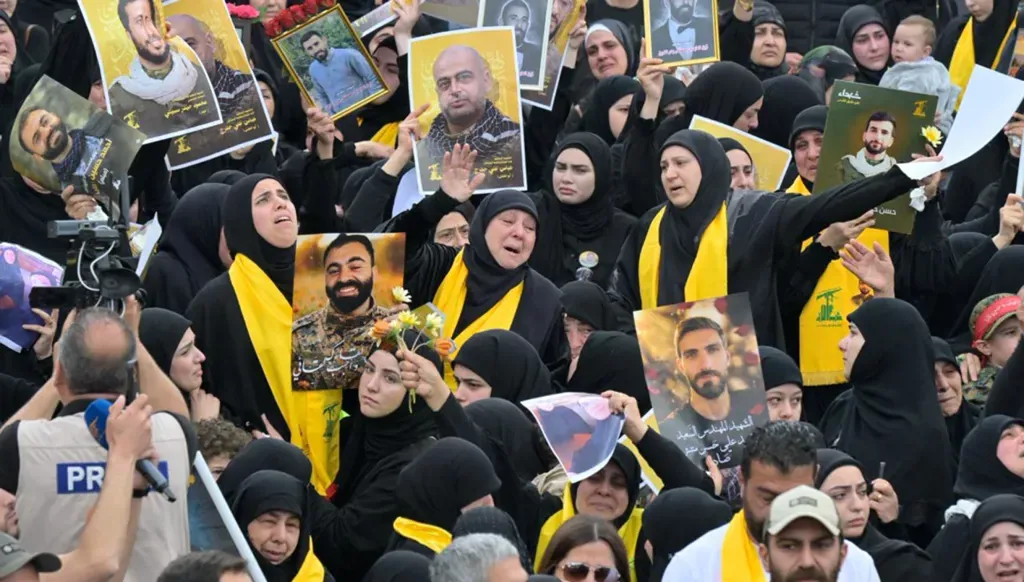


By all standards, the recent stance declared by MP Hussein Al Hajj Hassan, announcing Hezbollah's dissolution from the recent ceasefire agreement and the response to Israeli breaches, was not merely a slip of the tongue or an emotional reaction to Israel’s continuation of its violations of this agreement, according to a source closely connected to the party, who told Annahar.
In fact, Hezbollah’s environment has been swept by a wide wave of discontent and bitterness as it witnesses Israel’s systematic destruction of dozens of border villages and towns. This environment had been jubilantly under the belief that the party had regained its retaliatory power before the Gaza support war, only to be surprised by this Israeli defiance, which has wiped out dozens of border towns from the map.
In other words, that environment sensed that Israel is on the verge of establishing new “rules of engagement” in the border area, closely resembling those imposed following the ceasefire agreement on November 27, 2024, which allowed it freedom of movement throughout the south, extending to all of Lebanon.
This led it to intensify assassination operations of party cadres, killing over five hundred members over fifteen months, destroying hundreds of homes and institutions, and preventing inhabitants of the frontline towns from returning.
Undeniably, this situation provoked Hezbollah’s audience, leading it to interpret silence as “impotence and surrender” rather than as falling within the scope of “strategic patience”.
Based on all these facts, it became evident that the party felt the extent of discontent with the new reality, particularly as the Israelis did not cease engaging in actions that embodied challenge and provocation through deliberate and almost daily violations, and by leaking images, films, and information about large-scale demolition operations of houses and residential complexes.
Israel intentionally accompanied its field actions with statements indicating that it had adopted the “yellow line” plan as a precursor to a buffer zone along the border with Lebanon, extending eight kilometers deep and including no fewer than 55 towns to be devoid of any life or inhabitants, meaning that over two hundred thousand citizens are threatened with remaining displaced and forbidden from returning to their homes.
Israel has carried out, throughout the period since the recent ceasefire agreement, an operational plan aimed at undermining Hezbollah’s narrative of a victory achieved by its fighters over more than 40 days while facing Israeli advancement.
Notably, Israeli propaganda largely succeeded in instilling the belief that it now occupies at least 55 border towns, while doubts are emerging that weaken this narrative, placing Hezbollah in a critically awkward position in discussing the subject altogether and presenting a counter-narrative for various reasons.
It is also evident that there are additional reasons pushing Hezbollah to launch its threat to dissolve from the obligations of the ceasefire agreement, most notably the convening of the second round of direct negotiations between Lebanon and Israel in Washington, which Hezbollah opposed and refuses to commit to their outcomes and conclusions, in addition to escalating tensions between Iran and the United States and the ongoing tug-of-war between them.
Hence, the question posed is: Is this an indication of a return to the pre-March 2 situation at the borders?
Publicly, Hezbollah confirms through its symbols its readiness for all possibilities, including the worst, leaving the door open for this possibility when it has requested its supporters to delay returning to their homes.
Conversely, it implicitly relies on the premise that those who pushed for the ceasefire agreement and compelled Israel to adhere to its terms are still the ones guaranteeing to prevent its complete collapse, at least at the current stage.
Disclaimer: The opinions expressed by the writers are their own and do not necessarily represent the views of Annahar.