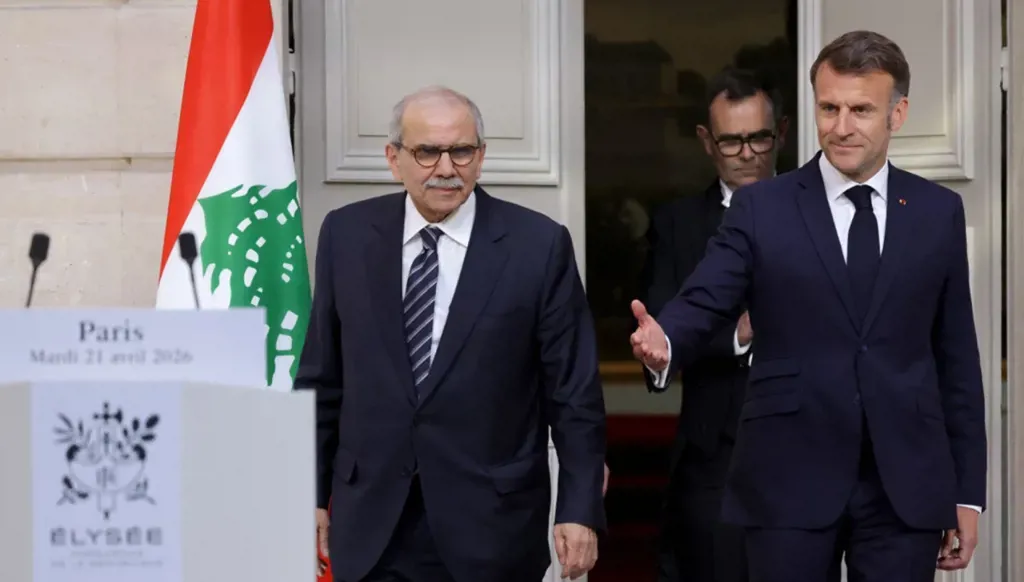
Perhaps between France yesterday and today, and Iran today, and across many years past, lies the story of Lebanon—exposed to danger, death, and displacement.
France brought us culture, administration, the judiciary, law, universities, hospitals, barracks, and the parliament building. Meanwhile, Iran came with the Assad regime’s resistance front and the “road to Jerusalem,” in a stark contrast to Pope John Paul II’s call that Lebanon is a nation of freedom and a model of pluralism for both East and West.
When President Fouad Chehab decided not to renew his term in 1964, the first thing he did was inform his friend President Charles de Gaulle, who responded with a letter expressing some reproach for this decision, adding that Lebanon is a country of giving, moderation, and balance for the entire East. Pope Benedict XVI added to this in 2012 upon arriving in Beirut, stating that Lebanon is a model for the whole world. This was reiterated by Pope Leo XIV during his visit to Lebanon last autumn.
Lebanon today, destroyed by the deadly confrontation between Israel and Hezbollah, stands contrary to everything this nation represented to France and the Holy See. French President Macron, who was the first to visit the streets of Beirut after the August 4, 2020 explosion disaster, remains committed to the longstanding French tradition towards Lebanon, even as responsibility for those to blame for the explosion is now in the hands of the Public Prosecutor’s office.
As for Washington, it revolves around its vital interests, as is well known in its foreign policy. Current President Donald Trump, who has baffled the world, may eventually turn his attention to Lebanon—the only country in the world that Iran, after Israel, seeks to reconsider.
The villages in the South are demolished, and the dead number in the thousands. But Lebanon rises and raises its voice: I am here, witness to the times, steadfast in the earth and its roots; those who caused the deadly storms are fading away. The Assad family was among the first to leave, and we are ready to negotiate to preserve these constants that justify our existence.
Israel left rubble and echoes of moans beneath the stones, while Iran brought upheaval into the soul, which may now be turning into cries of rebellion. Those who are always affected say: buildings can be rebuilt, but how do souls heal? Israel is a historical enemy known to Lebanese for its methods of killing and destruction. This was not expected from Iran, which was supposed to be a friend.
Lebanon today faces this dual challenge. Comparing Lebanon’s historical enemy since 1948 with the sudden presence that emerged after 1979, which Hafez al-Assad allowed into Lebanon, is not easy.
This happened due to a long and culpable negligence on the part of the state. For forty-six years, the Islamic Republic of Iran has been infiltrating Lebanon. There is no other expression for it, since there was no international mandate or regional agreement that allowed that regime, which overthrew the historical empire after beginning its existence with a long and devastating eight-year war with Iraq. That regime was able to create this breach in Lebanon.
So why did the Islamic Republic extend its hand to that country, distinguished in the entire East and whose unique form and enlightened experience were respected by both the Arab world and the world at large, creating within it such a rift while exploiting sympathy for one of its components?
From Bint Jbeil—then and now a city devastated by Israel—former Iranian President Mahmoud Ahmadinejad stood on October 14, 2010, speaking of the relationship linking the south to Iran, unknowingly recalling what King Abdullah II of Jordan had described as the “Shiite Crescent” in an interview with The Washington Post in December 2004. Ahmadinejad’s visit heralded the near liberation of Palestine by the resistance.
For reference, since a large portion of Lebanese adhere to slogans without scrutiny, Resolution 1701 was issued on August 11, 2006, and was accepted by both Lebanon and Israel. It stipulated that Israel should withdraw its forces from Lebanon simultaneously with the deployment of the Lebanese army and emergency forces, and the disarmament of armed groups in Lebanon, namely Hezbollah, ensuring that only the Lebanese army and emergency forces would be present south of the Litani River, with neither Israel nor Hezbollah present.
While Israel is a reality imposed by geography on our southern borders, the Islamic Republic of Iran was not predestined. It does not border us and is not an Arab state. Yet Lebanon has faced unprecedented destruction during this war with hostile neighbors, a level it had not experienced since 1948, the year Israel was established, in a confrontation between two states on Lebanese soil and across its people in various regions.
In past experiences with Israel, Lebanon witnessed the brutal destruction of Beirut’s buildings through Israeli airstrikes aimed at eliminating Hezbollah elements, inflicting unjust devastation on beloved towns unworthy of such ruin.
In 1983, when Lebanon negotiated with Israel, which led to the May 17 Agreement, the complaint at the time concerned the armed Palestinian presence—partly a result of the June 1967 war, the Black September events in Jordan in 1970, and the 1969 Cairo Agreement, which placed Lebanon under Israeli fire.
Today, and what an irony of fate, while Israel remains unchanged in its weaponry and capacity for destruction, the root of the conflict has shifted dramatically: it is now the armed question tied to the Lebanese component aligned with the Islamic Republic, the Shiite component. This is Lebanon’s major issue going forward. Why is that?
Because weapons will eventually be restrained, but minds and spirits that once contributed to Lebanon’s formation through the diverse creativity, literature, and arts of the Shiites of the south—known as the poets of the south—have now become parades returning to the south and to ruined villages, holding Hezbollah flags devoid of any Lebanese flag.
The fundamental question is: how do these southerners return to their Lebanon—our Lebanon—a Lebanon of concord, the final homeland for all its people as stated in the Constitution? “All for the Nation,” or “At your service Nasrallah” (Labayka ya Nasrallah)? Tehran as a friendly capital, or words of reproach from Iranian official Ali Akbar Velayati attacking current officials and the late Rafic Hariri’s approach. How dreadful! Iranian newspapers mock President Joseph Aoun. Where is all this heading?
Israel is a historical enemy of Lebanon, but what is the Islamic Republic of Iran to the Lebanese people today? Who are they, and what do they want from Lebanon? Unfortunately, a part of the Lebanese population has, with regret, come to see Iran as a point of reference or influence.
But Lebanon will not change, and the coming challenges, despite their difficulty, are overcome by a solid experience. There is today an overwhelming majority which rejects this blatant Iranian interference. All Arabs stand with us, as does the entire West, led by France and the Holy See, Europe, and all Lebanese diaspora countries in the four corners of the earth. Rest assured, the journey to taking back the country has begun.
Disclaimer: The opinions expressed by the writers are their own and do not necessarily represent the views of Annahar.





 Messenger
 Whatsapp
 Threads
 Email
Email
 Print
Print
 X
X
 Facebook