

Hezbollah and the battle over Lebanon’s negotiating authority
Amid debate over direct talks with Israel, questions grow over who represents Lebanon at the negotiating table and whether the balance of power allows it to secure meaningful concessions.



 Messenger
 Whatsapp
 Threads
 Email
Email
 Print
Print
 X
X
 Facebook
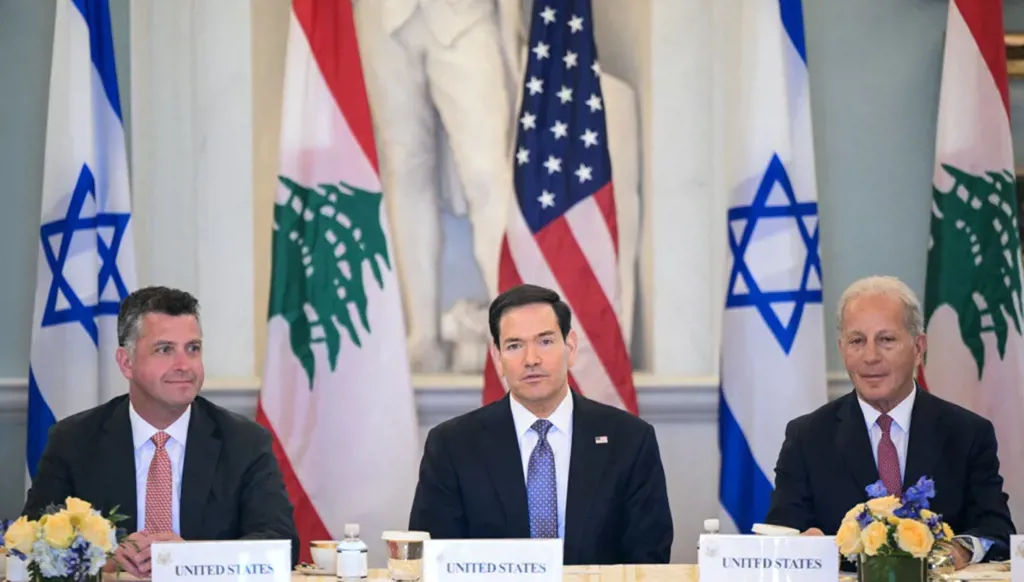


Hezbollah continues its challenge to the Lebanese state and its attempt to undermine its efforts, while also working to derail negotiations with Israel in order to ensure a ceasefire and move to the next stages, particularly regarding securing withdrawal and other steps.
MP Hassan Fadlallah says that the party has been in contact with Iranian officials and has informed them of Israeli “violations” of the ceasefire so that they can relay this to Pakistan, which would in turn pass it on to the Americans so that they pressure Israel to maintain the ceasefire.
The message behind this is an attempt to keep Lebanon as a bargaining chip in Iran’s hands, in the hope that it could reach an unwritten understanding with US President Donald Trump that would restore the relevance of previous understandings between Israel and Hezbollah, similar to the April 1996 understanding or even the post-2006 arrangement in the context of Iranian American understandings.
Despite the United States having taken the Lebanon file out of Iran’s hands by opening the door to direct negotiations with Israel, there are ongoing expectations of deals that could attract the US president to conclude what he considers most beneficial for him.
The other part of Hezbollah’s efforts is focused on demonizing direct negotiations, which Parliament Speaker Nabih Berri does not openly oppose but aligns with Hezbollah on and provides supportive cover for. The question raised by some, which could undermine the previous scenario, relates to at least two points: first, whether Israel, which is the other party being asked to withdraw from Lebanon, would accept resuming indirect negotiations with Lebanon. This is the price that President Joseph Aoun has expressed readiness to pay, meaning direct negotiations, which is not the easiest option but may be the only available one.
Hezbollah and its allies can easily outbid others in this context, noting that Lebanon has previously engaged in direct negotiations with Israel, not the May 17 agreement, but the negotiations launched after the 1991 Madrid Conference, when Palestinians, Jordanians, and Syrians were also negotiating directly with Israel in Washington.
The Lebanese delegation, which was headed at the time by the Secretary General of the Ministry of Foreign Affairs, Ambassador Suhail Chamas, included two respected Shiite ambassador members, Jihad Mortada and Jaafar Moawiya, in addition to officers assigned by the leadership of the army, among them at least one Shiite officer. All of this came as a result of Syria at that time sitting at the table of direct negotiations, when the sectarian composition of the delegation was not an issue.
The first principle of negotiations assumes that the balance of power on the ground must be taken into account, as it determines the balance in demands. Accordingly, Israel’s control over 55 villages in southern Lebanon, in addition to the destruction it inflicted on Beirut or the Bekaa, cannot be matched by destroying a tank, killing an Israeli soldier, or striking a building with a drone.
The issue is not one of resilience, but of who holds the upper hand in this war. It cannot be ignored that the balance of power is not in Lebanon’s favor, even if one assumes for argument’s sake that Hezbollah, which acts with arrogance and superiority and seeks to impose its conditions on the president of the republic, is working to strip him of the negotiation card and place it in Iran’s hands, and therefore in its own hands specifically.
So what can Hezbollah offer if the American condition, not only the Israeli one, is that negotiations must be direct? The Speaker of the Iranian Parliament, Mohammad Ghalibaf, said that “Hezbollah entered this war on our behalf. The ceasefire in Lebanon was one of our conditions. For many years, Hezbollah fought the Zionist entity, but this war was waged on behalf of the Islamic Republic. The axis of resistance came to the aid of the Islamic Republic.”
How can multiple parties, the Lebanese in particular, be convinced that if Hezbollah conducts the negotiations, they will serve Lebanon and not Iran? Then, if Hezbollah negotiates on behalf of Lebanon, it may secure more than what the state could obtain, considering that if one relies on the 2024 experience during which Nabih Berri negotiated on behalf of Hezbollah and under its mandate and on behalf of the Shiite duo, the ceasefire agreement amounted to surrender rather than a balanced agreement, as it included acceptance of disarming Hezbollah and limiting weapons to official security forces only.
Another issue relates to what the state will rely on in negotiations and which reference framework it will adopt. Some insist that this reference should be the armistice agreement, which would primarily embarrass Hezbollah, as this is not entirely clear, at least publicly. It is not sufficient to rely only on a ceasefire and Israeli withdrawal, without specifying to where and to what extent, nor to rely solely on the role of a mediator rather than a decision maker capable of delivering results.
Lebanon needs a fundamentally positive response from the United States and from Israel as well, especially after Lebanon has accepted the condition of direct negotiations, a response that Hezbollah withholds while it sits at the government table and demands all forms of support and assistance.
Disclaimer: The opinions expressed by the writers are their own and do not necessarily represent the views of Annahar.