

Iran’s long political arc: Power, paradox, and regional escalation



 Messenger
 Whatsapp
 Threads
 Email
Email
 Print
Print
 X
X
 Facebook
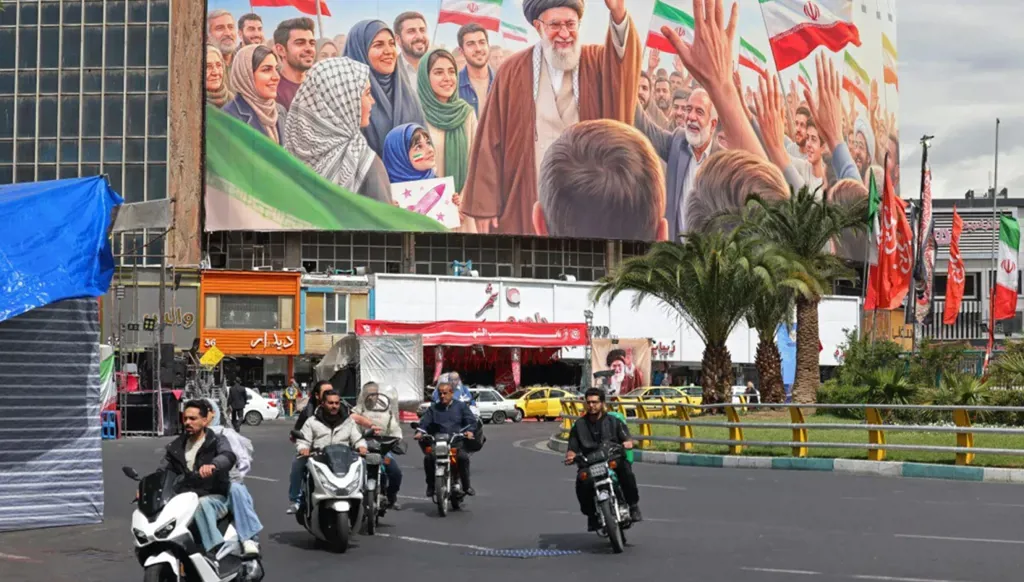


It is difficult to understand Iranian political behavior in recent decades without returning to the pivotal moment of 1979, when the Shah’s regime collapsed and a new system was established, raising religious slogans with a sectarian hue. This system carried within it a complex mixture of disparate elements.
Since that time, what can be called the “Iranian political mind” has been formed on a threefold basis: religious mysticism, historical nationalist inclination, selective touches of modernity, and a “guardian” vision over others. This mixture did not produce harmony but instead created constant tension and internal and external conflict, depleting people’s energy and damaging nations.
The first element, mysticism, gave the system a sense of moral superiority and a historical, perhaps even divine, mission. The state does not see itself as merely a political entity but as a project that transcends geography, linked to the ideas of “mission” and “empowerment.” This vision makes political decisions less subject to rational, realistic calculations and more inclined toward adventurism, as actions are sometimes justified as part of a sacred course rather than a choice open to revision.
As for the nationalist element, it predates the revolution itself. Iran, with its long history, has not abandoned its sense of centrality even while raising cross-border religious banners. Here lies another contradiction: we see an interplay between an apparent Islamic discourse and a political behavior that, at its core, carries a nationalist, expansionist inclination, manifesting in viewing its neighborhood as a sphere of influence to be expanded into.
This contradiction between slogans and practice has weakened trust with neighbors and created deep sensitivities between Iran and its Arab and regional surroundings. Then comes the third element, selective modernity; the system adopted the tools of the modern state—institutions, ostensible elections, more accurately “selection not election”, advanced technologies, and military and missile programs.
Yet it simultaneously rejected the essence of modernity based on political pluralism, social accountability, transparency in decision-making, and adherence to international law. Here a profound structural flaw emerged: an enduring conflict between form and substance.
This tripartite combination did not produce stability but instead led to a state of permanent tension with the world. A mindset that considers itself entrusted with a divine mission and armed with tools of power finds it difficult to engage in equitable dialogue with others. Dialogue requires recognizing the other, while this Iranian political mind tends to negate the other, interpreting disagreement not as legitimate difference but as targeting.
This complex blend led Iran to adopt the option of establishing networks in neighboring countries, training and funding them—whether active or dormant—to advance its agenda under different slogans, while keeping its project distant from direct confrontation. However, these networks have drawn it into direct conflicts it did not anticipate and from which it does not know how to extricate itself, due to the rigidity of this tripartite political thinking.
The result has been an expanding circle of enmity: strained relations with the West, deep regional rivalries, and a network of proxy conflicts that have drained resources and raised foreign policy costs to unprecedented levels. Over time, this approach has become more than just a policy; it has become part of the regime’s identity, making it difficult to retreat from without internal upheaval.
These choices have reflected on public life and the economy at home. Despite the country’s natural and human resources, it has entered a spiral of sanctions and mismanagement. The national currency has lost a significant portion of its value, and inflation has become a daily burden for citizens. With every crisis, official rhetoric tends to interpret what is happening as a foreign conspiracy, rather than as a result of its own political choices.
Tension in Iranian society
Since the beginning of this century, Iran has witnessed repeated waves of popular protests, reflecting a growing gap between the state and society. The response has generally been security-oriented, relying on an iron fist and justifying the use of force. In every uprising, victims fall, spaces of expression are closed, and a feeling is strengthened that the state does not see its citizens as partners but as potential threats to the existing regime.
This path reveals a striking paradox: a regime born in the name of the “oppressed” has ended up confronting wide segments of its own society. With every round of repression, its social legitimacy erodes. Stability based solely on power, no matter how long it lasts, remains fragile, as it does not address the deep causes of tension.
It can be said that the Iranian political mind has not succeeded in achieving a balance among its components. The belief in absolute truth has driven it toward rigidity, nationalism has fueled expansionist tendencies, and modernity has remained superficial. The result is a state suffering from internal imbalance, external isolation, and constant tension between what it declares and what it practices.
In recent weeks, the regime’s crisis has intensified. It has expanded its conflict with the broader regional environment, including escalating tensions with Gulf states, thereby turning doubt about its intentions into greater certainty. It has also raised threats regarding the Strait of Hormuz, drawing widespread international concern and criticism for violating international norms and laws. In these steps, as in its military buildup and nuclear program, it becomes clear how deeply the three aforementioned elements have taken hold of the regime, to the point of suffocation.
Disclaimer: The opinions expressed by the writers are their own and do not necessarily represent the views of Annahar.