

The Lebanese equation: Ceasefire stability, deterrence politics, and sovereignty challenges
Between regional rivalries, fragile truces, and disputed security arrangements, Lebanon faces a defining test of statehood and stability in a rapidly shifting Middle East.



 Messenger
 Whatsapp
 Threads
 Email
Email
 Print
Print
 X
X
 Facebook
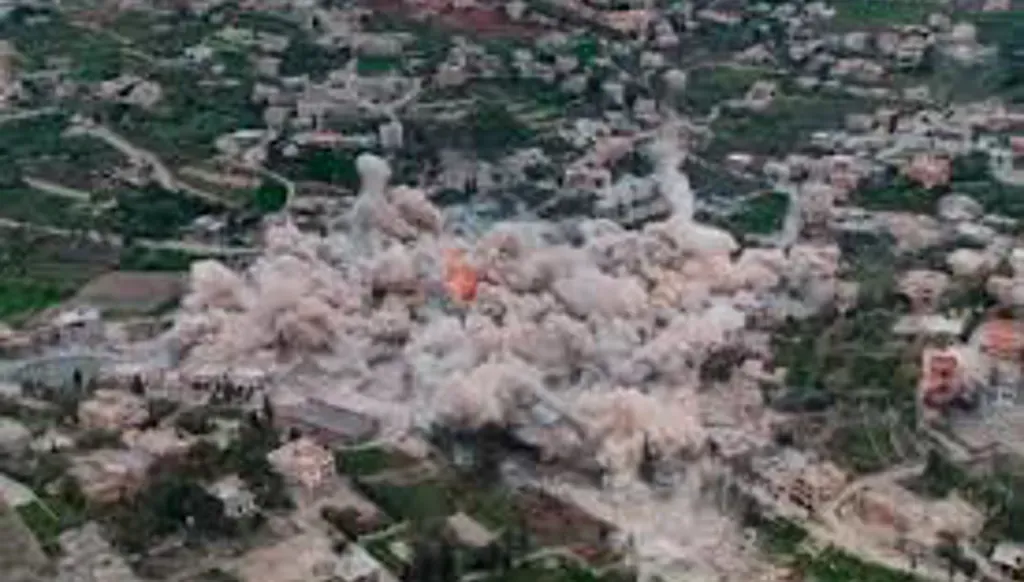


Six missiles were launched by elements of the “Iranian Revolutionary Guard Corps” from Lebanon toward northern Israel on March 2nd. This added to Lebanon’s existing losses: about ten thousand casualties between dead and injured, 1.2 million displaced people, increased destruction in areas where Hezbollah is present, and a vast number of tragedies. It also represents a significant violation of the country’s sovereignty and a “yellow line” marking a new Israeli occupation of land.
This is the heavy toll of revenge for the assassination of the late guide Ali Khamenei, and the high price of a “temporary” ceasefire. It is indeed the painful outcome of the recklessness of those claiming to “resist the enemy,” ultimately enabling it to achieve both its short- and long-term goals.
The ceasefire is a test for the Lebanese state, followed by a shift toward negotiations and “agreements,” as “what compels you to the bitter is what is more bitter.” But it is also a test for “Iran’s party,” which was quick to declare “victory,” claiming that Iran compelled Israel to comply with the truce. It did not concern itself with those who lost their loved ones and homes, and who spent their displacement in tents or shelters.
Amid the celebrations of this “illusory victory,” the leaders of Hezbollah increased their insolence and threats toward the heads of the republic and government because they chose to negotiate “to save Lebanon.” Hezbollah, and the IRGC that manages it, know well that achieving a ceasefire was difficult and that the negotiation process will be even more challenging, but they are determined to disrupt it. Why? Because it is the Lebanese state, not Iran, that negotiates on Lebanon’s behalf.
The separation of the Lebanese and Iranian tracks was a declared goal for both the American and Israeli sides, and it appeared to Lebanon as a historical opportunity. Hence, President Joseph Aoun said: “We have retrieved Lebanon for the first time in half a century and are no longer in anyone’s pocket or anyone’s arena.” This is theoretically true and needs to be proven in reality.
In 1976, the former Syrian regime entered its troops into Lebanon with an official invitation and the stated goal of ending the civil war. It soon gained Arab and international legitimacy for its presence without ending that war, and went on to directly control the country’s affairs for thirty years. After being forced to withdraw in 2005, following the assassination of Prime Minister Rafik Hariri, it rewarded Iran and Hezbollah, which were accused of involvement in that assassination, by handing them the reins of “guardianship” over Lebanon. This was quickly consolidated with the 2006 war against Israel.
Today, in 2026, after the shifting wars from Syria to Gaza to southern Lebanon, Iran has practically begun to exit Lebanon, while “its party” still faces stages before returning to a purely Lebanese identity.
The Lebanese governmental side defended the choice of negotiation, emphasizing that it is “not weakness, nor retreat, nor surrender, nor relinquishment of any right.” It remains unclear whether these denials are considered, from the perspective of Donald Trump and Benjamin Netanyahu, to constitute— as intended by Lebanon—“a realization of justice.”
The Israeli Prime Minister achieved what he wanted through the acknowledgment of the “memorandum of understanding” with Lebanon, which states that halting hostilities “does not restrict Israel’s right to take necessary steps to defend itself at any time against planned, imminent, or ongoing attacks,” while it does restrict “any Israeli operations against (Lebanese) governmental targets.”
Since the problem has been, and remains since the end of the 2024 war, Israel’s use of that “right” recognized for it by the United States, Trump found it necessary to point out that Washington is now “working separately” with Lebanon and that it “prohibits Israel from bombing Lebanon.”
If this “prohibition” is sincere and proves serious, it could suggest that Washington has finally—albeit belatedly—understood that the success of any Lebanese–Israeli negotiations cannot be achieved through the principle of “enforcing peace by force,” but must instead proceed through respect for the Lebanese state, without constraining it or placing it in an embarrassing position vis-à-vis Iran and Hezbollah.
The manner in which the Israelis exercised their “right to self-defense,” combined with unconditional American support for them and the obstruction of support for the Lebanese army, contributed to the marginalization and weakening of the state, while the IRGC strengthened Hezbollah. This dynamic led to what has been described as the “War Supporting Iran,” and gave Israel the opportunity to establish what it calls a “buffer security zone,” which it is unlikely to relinquish. Even if it agrees to reduce it through negotiations, it would likely do so in exchange for difficult, if not unattainable, conditions.
For decades, the United States and Israel have ensured that arming the Lebanese army remained at a minimum, in order to avoid any threat to Israel. However, they allowed room for Iran to develop in Lebanon a militia that later became a “stronger parallel army,” which Israel came to regard as a security threat and has used as a justification for its wars.
The objective of separating Lebanon from Iran is clear, and Washington needs to clarify the intended outcome of Lebanese–Israeli negotiations: if it is “peace,” then peace has known requirements. Negotiation in “good faith” would require that Israel not forcibly seize any Lebanese land. If it withdraws, the rationale for “Iran’s party” existing in Lebanon would disappear; if it persists, it would indicate that it can only survive in a state of continuous conflict.
Disclaimer: The opinions expressed by the writers are their own and do not necessarily represent the views of Annahar.