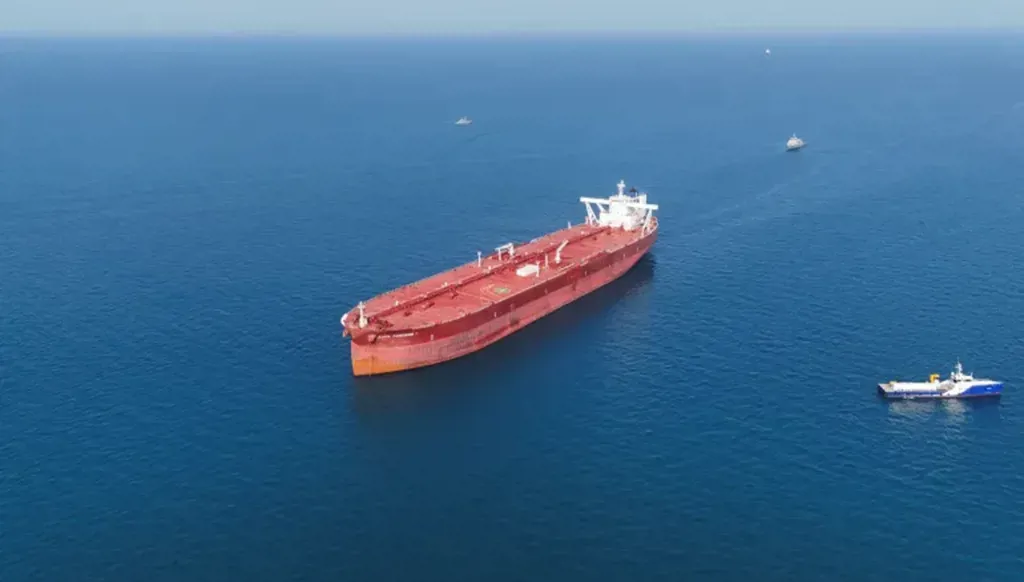
The Strait of Hormuz is no longer just a vital waterway; it has become a direct reflection of balances that transcend the Middle East, extending beyond the ongoing conflict between Washington and Tehran. At this artery through which more than 20% of the world's oil passes, scenes of opening and closing, port blockades, and targeting of oil tankers cannot be reduced to mere negotiation leverage or political impositions. What is happening is much deeper.
It is part of a broader geopolitical rearrangement associated with Donald Trump’s foreign policy approach, extending from Venezuela and its oil resources to the Strait of Hormuz, as part of an effort to consolidate leverage over energy flows and their routes. This strategy can be interpreted as a response to China’s gradual but steady expansion toward becoming the dominant force in the global economy.
Many rule out a return to full-scale war, given the congestion within the American interior with major entitlements, from the midterm elections to preparations for the World Cup, in addition to an anticipated visit to Beijing in the coming weeks to meet Chinese President Xi Jinping.
In this context, Henry Kissinger’s early warnings about China’s rise return to the spotlight, where he wrote in World Order that “the rise of China is not a fleeting event, but a structural shift in the global balance of power.” This perspective helped pave the way for Richard Nixon’s historic 1972 visit to Beijing, where he met Mao Zedong, in a moment that redefined international balances. Today, Washington once again turns toward Beijing with Donald Trump’s anticipated visit, in what appears to be a continuation of an unfinished geopolitical cycle.
Yet the scenario of escalation has re-imposed itself after the optimism generated by Donald Trump’s tweets about a historic agreement with Tehran began to fade. Meanwhile, Pakistan has taken on a delicate mediating role through its army chief, Asim Munir, who has travelled between Tehran, Washington, and Riyadh, so far without achieving a decisive breakthrough, particularly on the issue of uranium enrichment.
The Perspective from Lebanon
However, the situation cannot be understood solely through the lens of Hormuz or Tehran; it must also be viewed through Lebanon.
In an unprecedented development, a preliminary negotiation track between Lebanon and Israel has begun at the ambassadorial level, under the sponsorship of U.S. Secretary of State Marco Rubio in Washington, in an attempt to contain escalation and prevent the southern front from sliding into full-scale confrontation. Yet this path faces clear internal division: on one side stands the state’s position, expressed by President Joseph Aoun, calling for the consolidation of sovereignty and the restriction of military decision-making, while another discourse by Hezbollah, voiced by its Secretary-General Naim Qassem, directly links Lebanon to the regional axis of confrontation, further deepening internal fragility.
On the ground, a new reality is taking shape along the borders: a buffer strip roughly 10 kilometers deep, with 55 southern villages under strict restrictions, in a scene reminiscent of the “Yellow Line” model in Gaza, laying the groundwork for an open-ended security phase with multiple possible outcomes. Inside Israel, tensions are rising as Wednesday—the final deadline set by Donald Trump—approaches, prompting Benjamin Netanyahu to convene a mini-cabinet meeting to discuss “the day after” scenarios, weighing escalation against efforts to contain an explosion.
Economically, the scene is no less turbulent. According to The Economist, the reopening of the strait has not ended the chaos in energy markets. At the same time, markets are moving in rhythm with escalation: Brent crude prices no longer reflect supply and demand as much as they reflect the probability of war, with even the mere threat of closing the strait or targeting a tanker being enough to instantly drive prices higher, in a market that is pricing risk more than oil itself.
In contrast, Washington continues to raise the ceiling of threats, while The Wall Street Journal reports reveal reluctance to enter an open confrontation. This contradiction can be understood through the logic of game theory: a calculated escalation to the brink of explosion without crossing into it, where the threat of war becomes a tool for managing it rather than triggering it.
However, the cost in Lebanon is no longer theoretical. More than 2,000 martyrs, over 7,000 injured, and around 1.2 million displaced, in addition to widespread and unprecedented destruction in southern villages and the southern suburbs of Beirut, where entire towns have been leveled and infrastructure has been severely damaged, raising difficult questions about the state’s ability to rebuild.
In the backdrop, there emerges the proposal of releasing approximately $20 billion in frozen Iranian funds in exchange for nuclear concessions, turning the issue into a comprehensive financial and political deal.
But the most serious development is that Lebanon is no longer waiting for the outcome of negotiations; it has become part of them. It is no longer merely a sphere of influence, but a pressure tool.
Amid an American president raising the threat ceiling to its highest level, and an Iranian regime clinging to its red lines while negotiating, a complex path of mutual pressure is taking shape: calculated escalation to extract concessions, and measured steadfastness to prevent collapse.
In this scene, war does not appear to be an end in itself but rather a tool of pressure within an open negotiation process, where the threat is used in order to avoid it.
In the background of this conflict, there emerges the prospect of a grand bargain and a historical settlement needed by both rivals more internally than externally, aimed at ending nearly fifty years of enmity between Washington and Tehran, should the conditions of the political moment align with the balance of power on the ground.
It is neither a resolved war nor a peace that has yet been achieved, but a winding path that may lead, for the first time, to a historic settlement.





 Messenger
 Whatsapp
 Threads
 Email
Email
 Print
Print
 X
X
 Facebook