When art becomes a bridge: The journey of a painting from Algeria to the Vatican




 Messenger
 Whatsapp
 Threads
 Email
Email
 Print
Print
 X
X
 Facebook
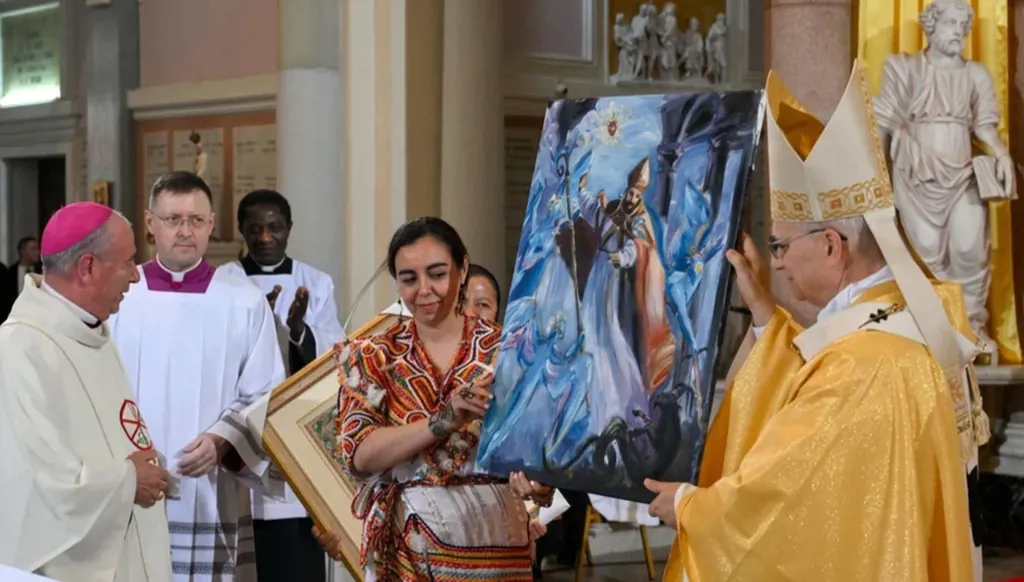


The world followed the apostolic visit of Pope Leo XIV to Algeria with great interest. It listened to his speech to the civil authorities, saw him at the Great Mosque, and walked with him along the footsteps of Saint Augustine. It also saw that painting that was gifted to the Holy Father, which depicts the Christian philosopher and theological thinker, created by a young Algerian Muslim artist who believes in humanity.
In our contemporary world, identities are reduced to narrow definitions, and meanings are confined within rigid frameworks. In contrast, a calm artistic act emerges to suggest a different path, one based on the idea that art is a space of connection rather than separation, and that it restores the human being, through the image, to their original and deeper dimension.
From this perspective, the work of the young Algerian artist Mouawiya Rouag, known by his artistic name “Aziz Mouawiya,” appears as an inner manifestation taking shape slowly over time. His art, nourished by dreams and drawing its language from imagination, finds itself, without prior planning, within a dialogue that goes beyond the painting itself. It is a dialogue with history, with memory, and with those deep layers of belonging that cannot be divided between what was and what has become.
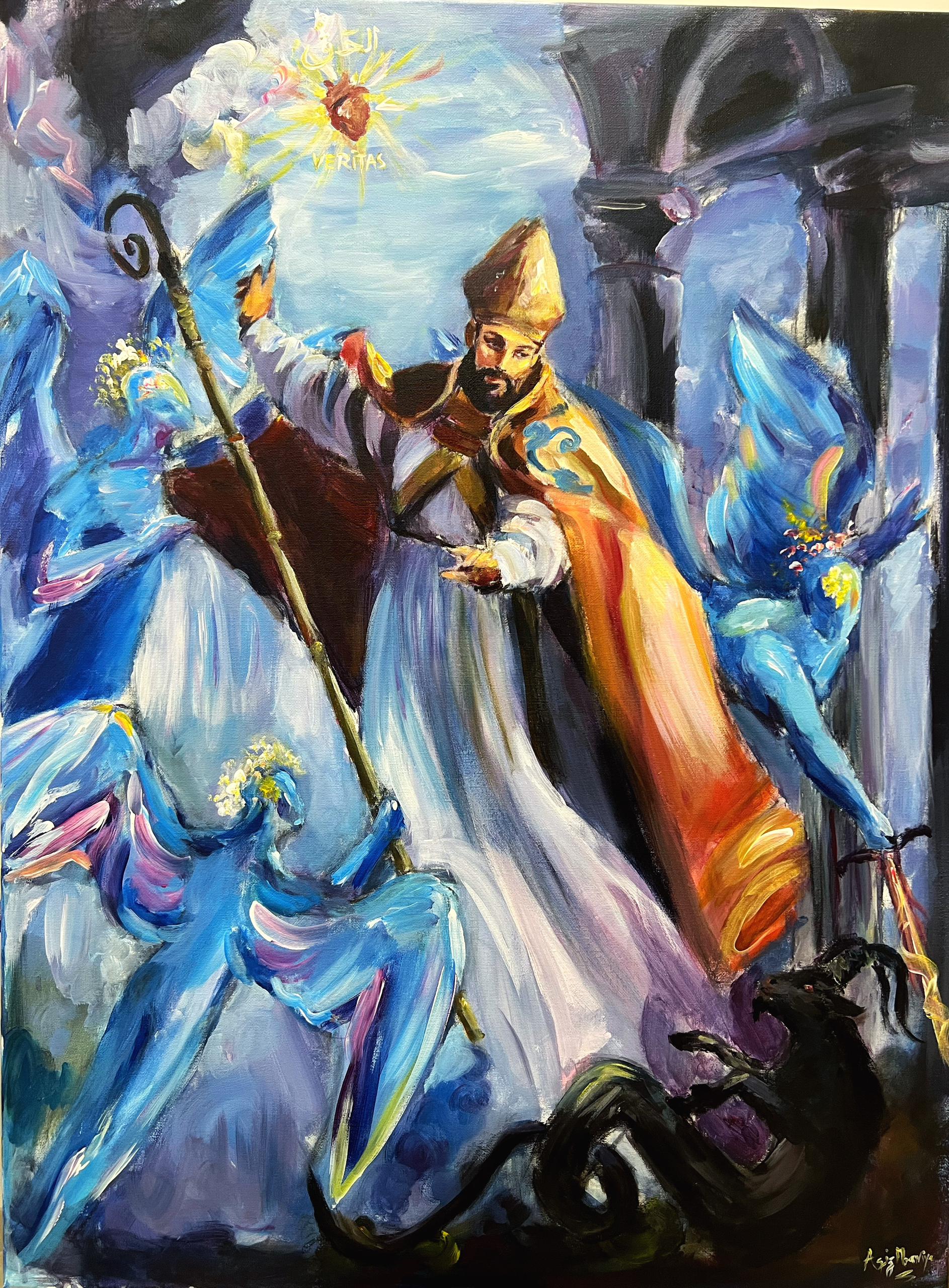
When he chose to reinterpret “The Triumph of Saint Augustine,” he was not invoking a major theological figure as much as he was recalling a living root in the very soil of Algeria itself. Augustine’s presence is deeply rooted in the land; he is a voice that emerged from Hippo (present-day Annaba) to become one of the pillars of human thought. His writings shaped Christian theology and contributed to forming the language of inner contemplation, redefining the relationship between the human being and the self, and between truth and the paths of seeking it.
In this context, Rouag’s act of painting becomes something like the recovery of a shared memory and a history that was never single or monolithic. For him, Augustine is both a great philosopher and a symbol of that noble restlessness that drives a human being to pursue truth, even while knowing its complete unattainability. This idea, the idea of pursuit, seeps into the heart of the painting and gives it its deep pulse.
The color blue, which dominates the composition, forms a language of its own. It is the trace of the sea that lives in the artist’s memory, an extension of his field of study, and a longing for an open horizon that cannot be contained. In this blue, sky and clarity, depth and elevation, matter and metaphysics coexist, as if the painting itself is suspended between two levels: what is seen and what is felt.
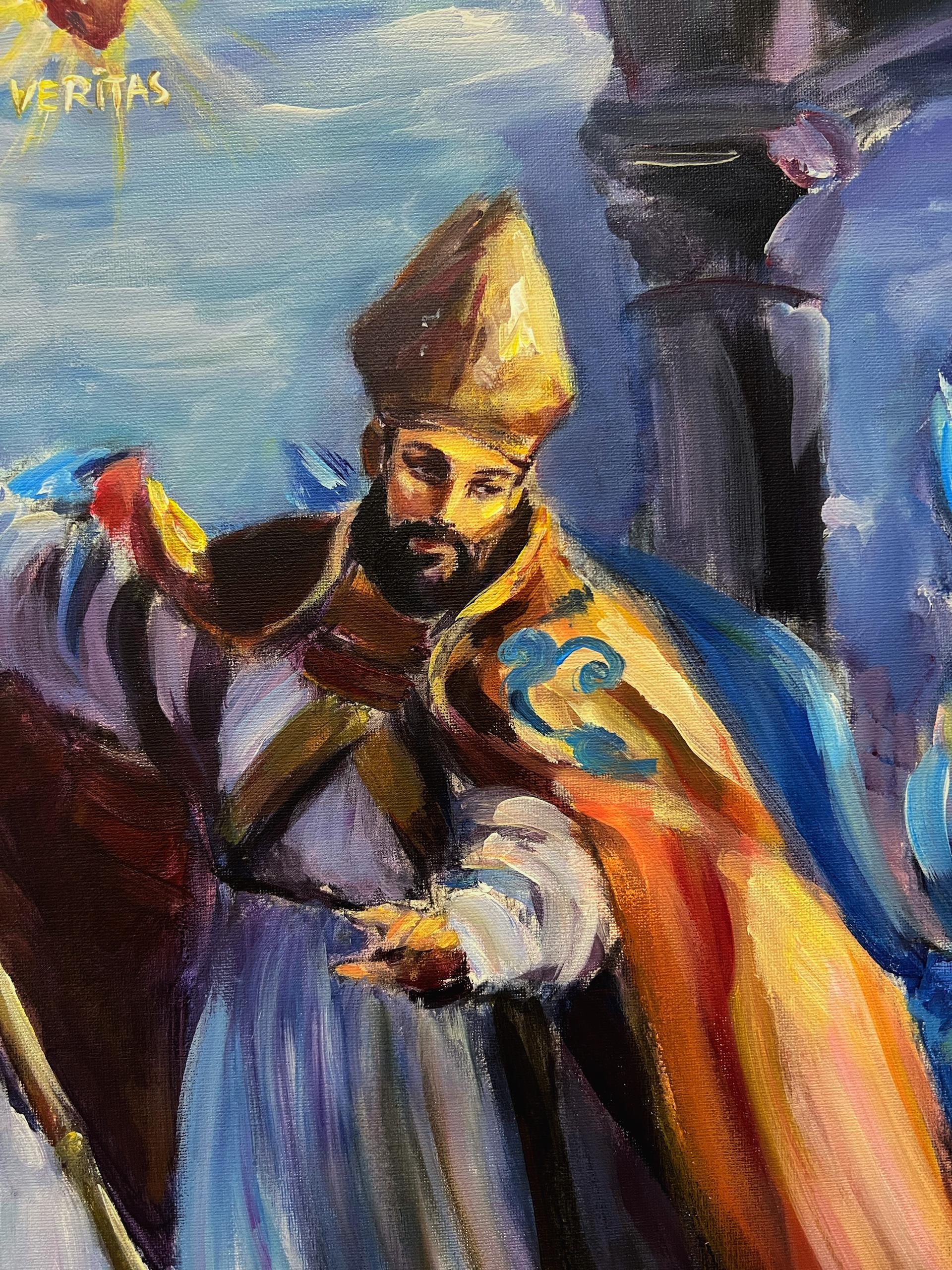
And although it is inspired by a classical work by Claudio Coello, Rouag’s version does not reproduce the past; it rethinks it. The composition retains its narrative grandeur and the idea of triumph as a symbolic state, but the vision shifts toward a more personal horizon, where symbols are dismantled and reassembled in a language closer to dream than to representation.
At the top of the work, the heart that traditionally accompanies artistic depictions of Augustine appears, a symbol of essence and purity, and above it the word “Veritas,” meaning “Truth.” Yet in the context of Rouag’s practice, this word does not remain confined to its Latin meaning; it opens onto another horizon. “Truth” is also one of the names of God in Islamic understanding. The meanings therefore intersect and coexist, as if truth in its essence is broader than any single tradition’s claim to it.
In contrast, evil appears as a presence already defeated from the outset, rather than an assertive force. The devil at the bottom of the painting is a fading trace, while angels advance in transparent forms without faces, beings made of pure light. By being stripped of features, they lose any narrow identity and become a universal presence, defined only by their purity.
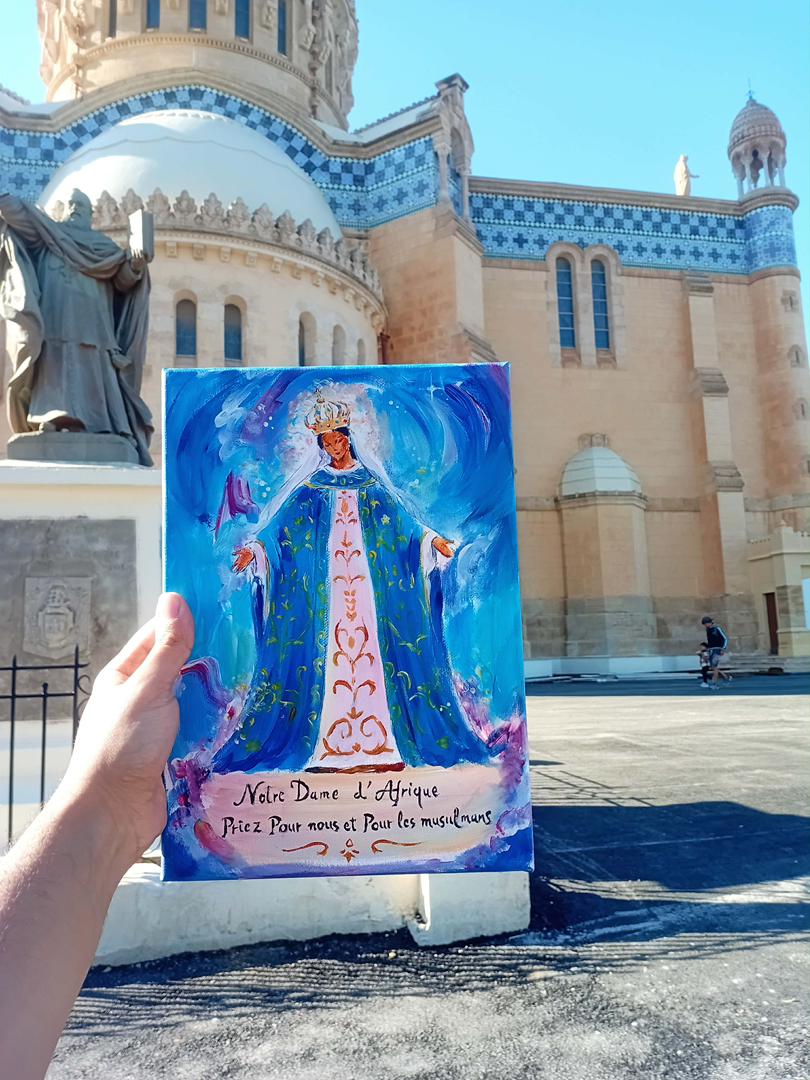
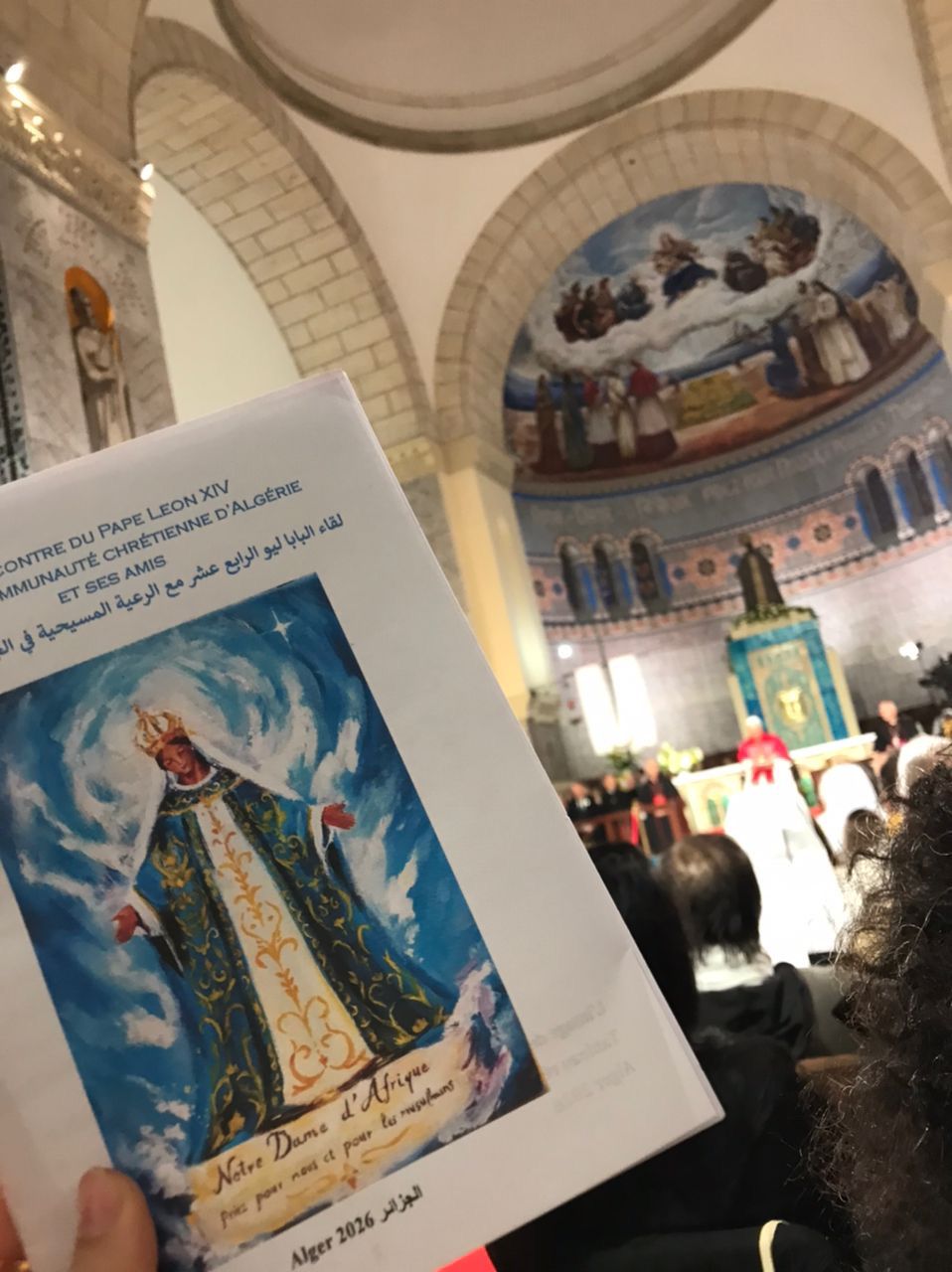
As for the painting reaching Pope Leo XIV, it happened beyond the artist’s expectations and planning. His earlier commission to produce 25 paintings representing the Virgin Mary as “Our Lady of Africa” to be offered to the Vatican delegation already carried the seed of this dialogue, especially through a phrase requested by the local Church for him to inscribe: “O Lady of Africa, pray for us and for Muslims.” A phrase that, in its simplicity, encapsulates the possibility of coexistence outside the logic of conflict.
The painting of Augustine came later. Rouag was not present when it was presented to the Holy Father, as he lives in the province of Algiers, but his absence did not diminish the presence of the work; on the contrary, the painting found its own way, as if art, when it is sincere, does not need an intermediary.
Rouag is aware of how rare what he has undertaken is. He says: “Honestly, I have not seen Algerian or Arab artists depicting the Christian history of Algeria or its pre-Islamic past,” adding: “I wanted my painting to be a bridge between Christians and Muslims.” It is a simple statement on the surface, yet heavy with meaning. In a region where memory is often selectively curated, his work insists on continuity rather than rupture.