




 Messenger
 Whatsapp
 Threads
 Email
Email
 Print
Print
 X
X
 Facebook
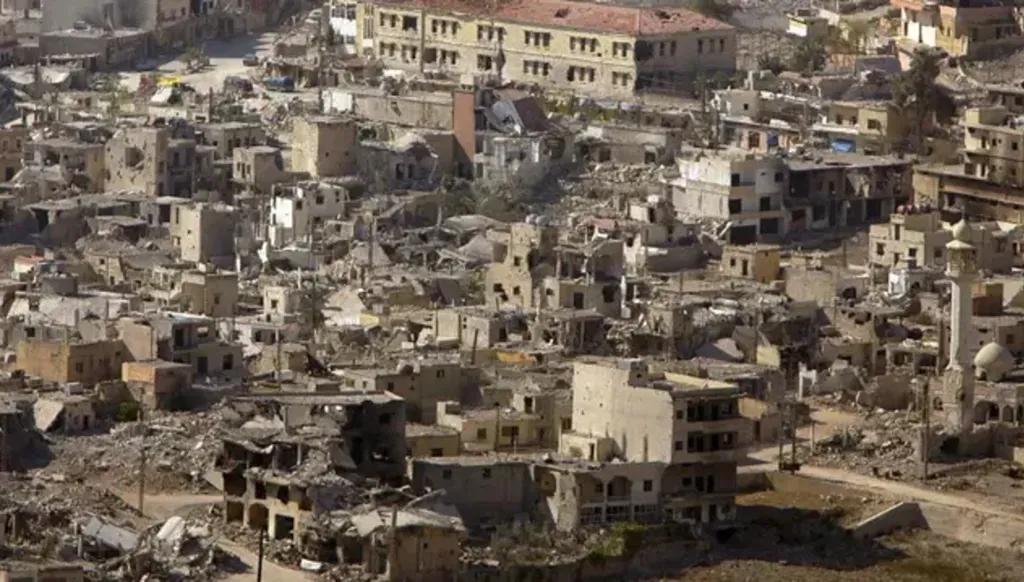


Bint Jbeil is an urban city in southern Lebanon that is no less important than the country’s major cities. The historic town has played a major role in the history of Jabal Amel, both economically and politically, since before the establishment of the modern Lebanese state and before the establishment of Israel on the historical land of Palestine.
The large town, which served as a commercial market for the triangle of northern Palestine, southern Lebanon, and Hauran and the Golan in Syria, declined after the occupation of Palestine and the displacement of a group of southern Lebanese villages in 1948. However, it soon returned to the southern scene through the gateway of conflict and successive wars with Israel, from the days of the Palestinian resistance to the wars involving Hezbollah.
The city, whose sons initiated waves of southern migration to the United States, especially to Michigan where they established a parallel community in Dearborn and where one of its sons became mayor, and which contributed to the development of the mother city, is also a city of culture in the fullest sense.
From it have emerged hundreds of writers, poets, and men of letters. With the successive wars, the city gained a wide reputation as a city of steadfastness and resistance, especially after the former Secretary General of Hezbollah, Hassan Nasrallah, announced victory from its stadium following the July war of 2006, launching his famous slogan that Israel is "weaker than a spider's web".
What is happening now is not the first destruction the city has witnessed. Israel has sought to break its image before breaking its urban fabric, sending thousands of soldiers and hundreds of tanks and vehicles against its front under devastating air power and exceptional intelligence support.
The current war on the city has made it the peak of Israel’s ongoing war, with the goal of striking the symbol and the idea that Israel is weaker than a spider web. It is a war of revenge with a retroactive effect, and the fall of the city, in the Israeli view, would be a declaration of victory from the same place where Nasrallah announced victory in 2006.
The war of symbols is intensifying and will not stop. The conflict in the region will not end with a single battle or war. Israel occupied Beirut and half of Lebanon in 1982 and expelled the Palestine Liberation Organization to Tunisia, yet the wars did not stop.
Bint Jbeil is a complex mixture of residents who are open to the West due to migration, and to the internal Lebanese sphere due to industry and trade (it was a pioneer in shoe manufacturing in Lebanon despite its decline), as well as internal migration to Beirut and its suburbs, and also to the nearby Christian communities in the border villages, despite some current tensions.
Its political composition is dominated by supporters of the Amal Movement, some of whom hold leadership positions, and by Hezbollah, which penetrated the structure of the young town and attracted many of its residents and families. Like most southern villages, especially the border ones, it has undergone major transformations in its relations with Palestine, the Palestine Liberation Organization, leftist parties, Arab nationalist parties, Arabism, Islam, and more recently Iran.
Southern Lebanon suffered from long-standing official neglect. It lived entirely on the margins, poor and deprived of the state’s privileges and benefits, closely tied to feudal leaderships that were keen to keep it dependent on them in both daily life and politics. This reality created fertile ground for the spread of leftist ideas that adopted a discourse of revolution against poverty and inequality and led grassroots demands, so the Communist Party spread its populist rhetoric across most villages.
But the people of the south were also emotionally Arab nationalist; images of Egyptian leader Gamal Abdel Nasser filled their homes as evidence of their belonging to a “revolutionary” Arab identity committed to the liberation of Palestine and seeing Israel as an enemy.
Within the Arab nationalist and Islamic context, some also raised images of the Hashemite King Hussein, as a sign of belonging to the Hashemite family, from which the Prophet Muhammad and his family—revered by Shiites—are believed to descend.
The south, then, was a fertile ground for leftist and nationalist parties before the “Shiite awakening” launched by Imam Sayyed Moussa al-Sadr from Tyre in 1959. On the basis of nationalist commitment and revolt against an unjust system, the Shiites of the south aligned themselves with Palestinian resistance factions, which used the border area of Arkoub as a launching point for operations against Israel under the Cairo Agreement of 1969, before later spreading across most of the South.
The southerners eventually grew weary of uncontrolled Palestinian armed activity, which had turned from a “sacred” tool of liberation into chaotic disorder and blatant interference in local affairs. This growing rejection of the Palestinian armed presence became evident during the 1978 and 1982 invasions, when Israel occupied the entire southern Lebanon without significant resistance.
Since then, the Shiite community underwent a major transformation with the emergence of Hezbollah and its Iranian ideology, which reshaped patterns of thought and behavior and introduced new concepts into Shiite life based on strict religious commitment and the idea of jihad and the reward of paradise. This transformation enabled Hezbollah to attract young people into its “sacred” struggle, achieving its first major accomplishment with the withdrawal in 2000, and later its resilience in the July 2006 war, which it considered a major victory.
The party’s role became entrenched militarily, politically, and socially, and its dominance over the Lebanese reality became evident, turning the Shiite community into a decisive force in the internal balance. This made any concession difficult to accept, and also created an internal opposition, which at times reached the point of advocating isolation.
Today, the situation of the community appears even more complex. Between a devastating Israeli aggression and internal opposition—some of which has gone so far as to accept or even call for this aggression in order to pull Lebanon out of an existential crisis—the community is going through a critical phase whose outcomes will not be known until the war ends and its military and political results become clear. In this context, the battle of Bint Jbeil stands out for its strategic importance and its future implications.
Disclaimer: The opinions expressed by the writers are their own and do not necessarily represent the views of Annahar.