

Writing as survival: Manahel Alsahoui on war, memory, and self-expression
Syrian writer Manahel Alsahoui reflects on war, writing, and survival through poetry and blogging.




 Messenger
 Whatsapp
 Threads
 Email
Email
 Print
Print
 X
X
 Facebook



Since the age of nine, Syrian writer and poet Manahel Alsahoui began writing her first words in the form of small personal reflections, which quickly grew with her and became a daily companion, opening the doors of poetry, theatre, and the novel for her.
Alsahoui points out in an interview with Annahar that writing is a confrontation with the self that requires courage, explaining that each time she not only faces her fears but also tests writing itself and how far it can adapt to her idea.
This experience, which began as a personal confrontation, gradually became a broader space for testing possibilities, discovering the world, and a means of understanding it. In times of war in particular, writing becomes a personal record of what we have lived through.
What is known as confessional poetry is not limited to being a means of confrontation and overcoming psychological obstacles, despite its importance in that regard. It is also a search for meaning that eases the weight of pain, a tool for understanding and analysis, and a way of organizing thought in an attempt to dissect the human experience.
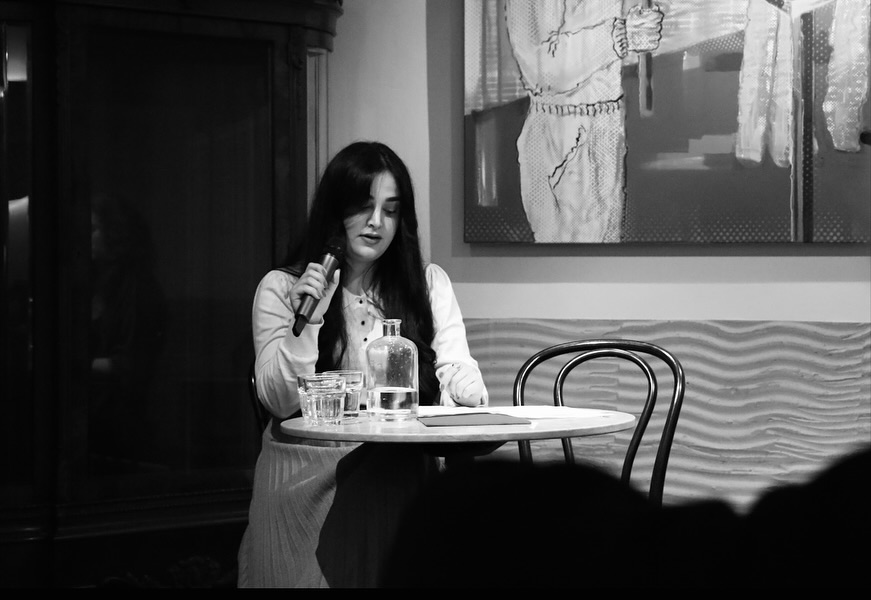
During the harsh years of war in Syria, Alsahoui found refuge in writing. She describes that period as if it were writing in a different time, a time that pushed her into new spaces in poetry and blogging, making her more daring and more aware of herself, as small fears fade when death becomes a daily presence.
She wrote about war and women, and about the brutal overlap between death, desire, the body, and life. She believes that writing became for her a means of confrontation and an attempt to understand a complex reality, and she documented this experience in her poetry collection “Thirty Minutes in a Booby Trapped Bus.”
Later, she turned to writing blog posts and publishing them on several news websites, and her texts appeared like diaries from Syria, each time starting from a small angle to reach wider human experiences around her. There, she realized that blogging is a way to capture daily pain and try to make sense of it.
In one of her texts, she recalls the scene of extreme heat in Damascus, and the inability to cope with it amid the breakdown of the simplest means, even turning on a fan.
Those blogs and poems undoubtedly became a means of psychological balance in a country where death and the loss of everything had become easier than life itself. She believes that writing gave her a sense of control over her life at a time when we were daily targets of death and absurdity.
Alsahoui offers advice to those who want to blog, seeing it more as sharing an experience than giving guidance: if you feel the desire to write inside you, start. Do not look for the most beautiful sentences, but for the most honest ones, because honesty alone gives a text its impact. Write about what occupies you, what others do not notice, do not look where everyone else is looking, but look within yourself and write.