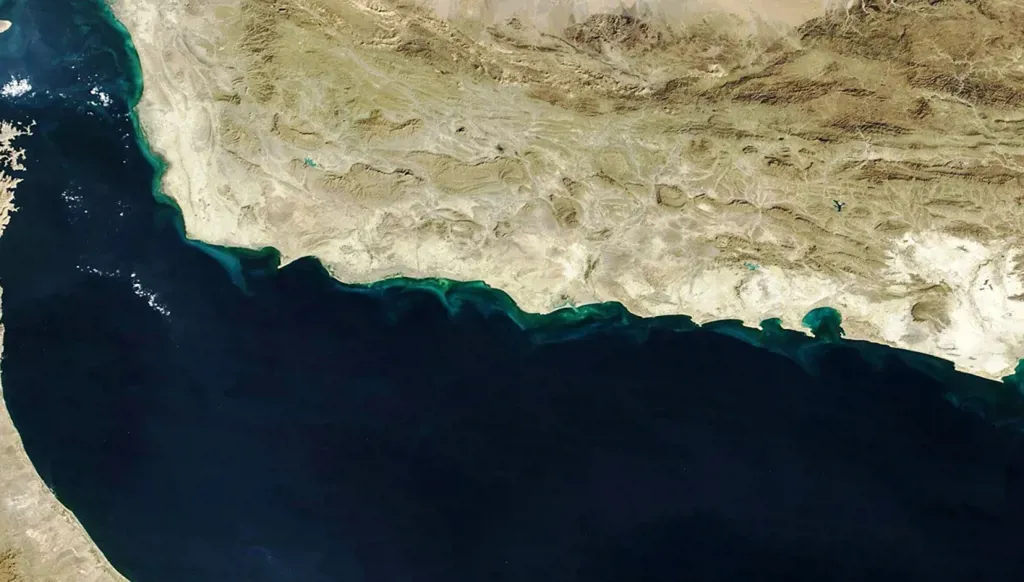
Tehran seeks to tighten its grip over the Strait of Hormuz by imposing charges on ships to ensure their safe passage, in coordination with the Islamic Revolutionary Guard Corps.
The following is an overview of the law governing the collection of such fees and the potential actions nations opposed to these charges may take.
What is the Strait of Hormuz?
The Strait of Hormuz is a waterway connecting the Gulf to the Gulf of Oman, located between the territorial waters of both Iran and Oman. It could be described as possibly the most critical energy shipping lane in the world, with about 20 percent of the world’s oil passing through it.
The waterway is approximately 104 miles (167 kilometers) long. Its width varies, with its narrowest point featuring two lanes, each two miles wide for incoming and outgoing ship traffic, separated by a two-mile-wide buffer zone.
Iran has effectively closed the Strait following strikes by the United States and Israel against the country and is demanding the right to collect transit fees as a precondition for ending the conflict. The collection of such fees has not yet been confirmed.
What law governs passage through the Strait?
The United Nations Convention on the Law of the Sea was adopted in 1982 and has been in effect since 1994.
Article 38 provides for the right of ships to unimpeded passage through more than 100 straits worldwide, including the Strait of Hormuz.
The convention permits any state bordering a strait to regulate passage within its "territorial waters" up to 12 nautical miles from its border, allowing "innocent passage."
Passage is "innocent" if it does not threaten the state's peace, order, or security. Military operations, serious pollution, espionage, and fishing are not permitted. The concept of innocent passage was central to a 1949 International Court of Justice ruling concerning the Corfu Channel off the coasts of Albania and Greece.
About 170 countries and the European Union have ratified the United Nations Convention on the Law of the Sea. Iran and the United States have not ratified it, which raises questions about whether the convention’s rules guaranteeing freedom of navigation have become customary international law or whether they are binding only on states that have ratified it.
Experts say the Convention is generally seen as customary international law. Some non-ratifying states may claim they are not bound by it.
How can the imposition of transit fees be challenged?
There is no formal enforcement mechanism for the United Nations Convention on the Law of the Sea. The International Tribunal for the Law of the Sea in Hamburg, Germany, established by the convention, and the International Court of Justice in The Hague, Netherlands, can issue rulings but cannot enforce them.
States and companies have other potential mechanisms to challenge the fees.
Any state or coalition of states could work to enforce the convention. The United Nations Security Council could issue a resolution opposing the imposition of fees.
Companies can redirect their shipments away from the Strait of Hormuz and have already begun to do so. Countries could expand sanctions targeting financial transactions deemed beneficial to the Iranian government by sanctioning companies willing to pay the transit fees.





 Messenger
 Whatsapp
 Threads
 Email
Email
 Print
Print
 X
X
 Facebook