

Lebanon–Israel talks signal a political turning point in the region
Beirut’s unprecedented move toward direct negotiations raises questions over sovereignty, armed groups, and the future balance of power in the Middle East.



 Messenger
 Whatsapp
 Threads
 Email
Email
 Print
Print
 X
X
 Facebook
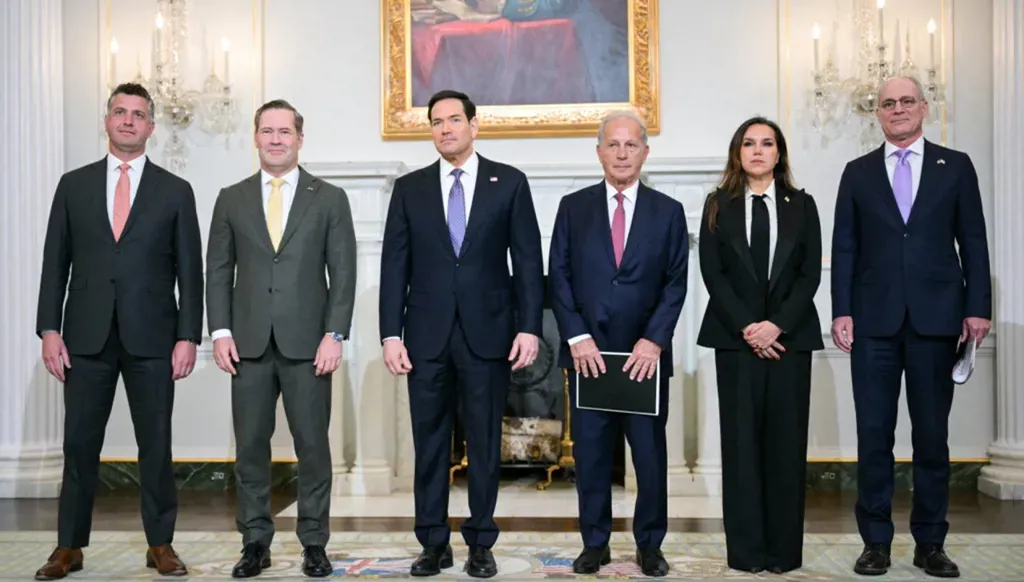


Lebanon and Israel have begun their first direct negotiations. Beirut takes an unprecedented step, emerging from an initiative proposed by President Joseph Aoun. The Lebanese government expresses a will it desires as independent from any foreign guardianship, especially Iranian, to address the issue from its roots, face to face, even if the efforts do not meet high expectations. No sane person expects happy endings, even in the distant future. Yet no sane person opposes the right choice: the state alone negotiates.
The answer to the issue has become straightforward. Will the negotiations help Lebanon restore peace to the country? The answer is: would the militias’ weapons and their “support” ventures do that? Does the “mini-state” bring anything to the country other than ruin, destruction, chaos, and all the symptoms of civil strife? Has the weapon provided protection for the country, prosperity for its people, and peace, especially for its south? The environment of that “resistance” is openly questioning its own disappointment: is there an end to this night?
The return of the occupation
Lebanon does not control the balance of power to confront its negotiator with weighty papers and tools. The “weapon arsenal” has deeply harmed the country, its resilience, unity, and the strength of its state. It has dragged Lebanon to the margins of the international system and turned it into an Iranian front from which Tehran overlooks Israel from our southern borders and the Mediterranean maps from our coast. Hezbollah's "weapon" brought the war to our doorstep, while others’ wars were fought elsewhere. The occupier left in 2000 for good, and “the Sayyid” declared victory and weaponry from Bint Jbeil. The occupation has been gone for a quarter-century and returned to the city with the “virtues” of that weapon.
“Cry like women for a kingdom you did not defend like men.” This saying is attributed to Aisha, mother of Emir Abu Abdullah Muhammad XII, known as Abu Abdullah the Small, the last king of Andalusia, who surrendered Granada to King Ferdinand and Queen Isabella.
The defense of men is not only about weapons, cheers, or the blood of martyrs, but also about maturity, prudence, shrewdness, insight, and a good understanding of the international scene. This night could have ended since that liberation 26 years ago. But the goal was not liberation or freedom, but dominance, tyranny, assassinations, black shirts, and then reckless support after support, disregarding history, geography, the science of power balances, and people’s lives and destinies.
Lebanon is not alone
Beirut is resetting what remains of its power to the correct time. Lebanon does not possess the power of deterrence, which other states do not have either, but it holds the power of argument and the right to defend the country’s security and interests. Lebanon is not alone. With it are Arab, regional, and international frameworks that have always supported its existence, cohesion, territorial unity, and continued survival, even when geopolitical earthquakes seemed to forecast its disintegration and the end of its story.
The world is changing. U.S. Secretary of State Marco Rubio hosts an inaugural meeting bringing together the Lebanese ambassador and the Israeli ambassador at his department’s building in Washington. The world is changing. “Hezbollah” has nothing but to mobilize hundreds of its followers and issue positions rejecting the “sin” in Washington and not acknowledging its outcomes. And the world is changing, with some of its features shaped by what emerges from the war on Iran and its conclusions alone foreseeing what the situation in Tehran will lead to and the future of its revolution, which will no longer be exportable.
The exercise will not be easy. It faces Iran’s opposition and Israel’s reluctance. The former loses its influence in Lebanon after losing it entirely in Syria. The latter seeks to impose a new reality in southern Lebanon after imposing it in southern Syria. Lebanon wants to stop its destruction and not tie its fate to the strongmen’s battles in its neighborhood. The country enjoys broad international support and has returned to being a priority in Paris, London, and Berlin. It has become a gateway to success that Donald Trump wants to add to his record. It is a beginning with a path ahead that will be fraught with obstacles, resembling the dramatic scene of intense transformation and unpredictability in the entire world.
Disclaimer: The opinions expressed by the writers are their own and do not necessarily represent the views of Annahar.