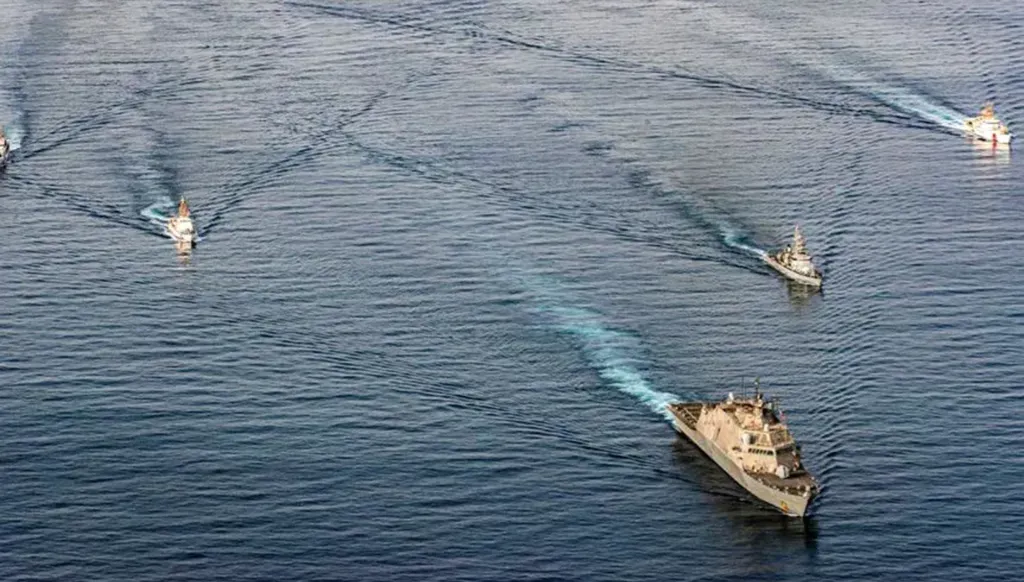
The Strait of Hormuz is no longer just a bargaining chip waved by parties, nor merely a vital passage affected by crises. In the past two days, the line between threat and execution has been crossed, turning the strait into a direct arena of confrontation where realities are imposed by force, and the meanings of control and legitimacy in the international system are being redefined.
What has happened is not a traditional escalation but a qualitative shift in the nature of the conflict. The United States did not merely protect freedom of navigation, as it claimed, but went further into the practical exercise of selective control over passage, by disrupting ships, redirecting others, and imposing what resembles an undeclared naval blockade on Iran. This shift places Washington in a different position—from a guarantor of the international system to a party redefining it according to the requirements of power.
But this power, despite its clarity, reveals its limits at the same moment. The Strait, by its geographic nature and military complexities, cannot be fully subdued. The dense U.S. presence does not mean full control, but rather high-risk management, especially with the continued threat of naval mines, fast boats, and short-range missiles. In a more precise sense, Washington can disrupt but cannot impose sustainable stability without an open cost.
"Destruction Without Explosion" Strategy
Conversely, Iran did not treat this escalation as a traditional confrontation but absorbed it within its strategy of “disruption without explosion.” It did not close the strait or enter into a full-scale confrontation, but maintained enough threat to make any attempt at control risky. This delicate balance is the core of Tehran’s “golden card”: the ability to keep the world in constant anxiety without reaching the point of no return.
Here, the equation changes completely. The Strait is no longer a tool in the hands of a single party. Iran uses it to increase the cost of pressure on itself. The United States uses it to isolate Iran and apply economic pressure. In other words, Hormuz has become an arena of dual power projection, rather than merely a unilateral bargaining chip.
Prolonged Attrition
The most perilous aspect of this shift is that it reproduces the “tanker war” model, but in a more complex context. Securing maritime navigation is no longer about preventive action, but part of an ongoing struggle in which every oil tanker becomes a test case, and every passage a political-military decision. This pattern does not lead to resolution, but to prolonged attrition, increasing the cost of the conflict for everyone, not just the two primary parties.
At the heart of this scene, the world stands as a recipient of shock. Markets react, energy prices fluctuate, and supply chains are recalculated, while one of the most important arteries of the global economy becomes an unstable space governed more by mutual deterrence than by rules.
Nevertheless, a parallel path emerges that is equally important. Talks about resuming negotiations have not stopped but have intensified alongside the escalation. This is not a contradiction but rather an expression of the nature of this phase. What is happening in the Strait of Hormuz is not a substitute for negotiation but a prelude shaped by new conditions.
The United States seeks to enter the negotiation table equipped with effective tools of economic pressure. Iran, meanwhile, aims to sit at the table while retaining the capacity to threaten the global energy artery.
Between these two paths, the Strait becomes something akin to a “field negotiation table,” where the boundaries of any agreement are shaped before its terms are formally drafted.
No complete resolution
The unchanged reality, despite all that has happened, is that neither party has the capacity for a complete resolution. The United States cannot impose stable control without sliding into a broader war. Iran cannot sustain extensive disruption without paying the price of confrontation with the wider international system.
Therefore, the question is no longer whether the Strait will be closed, but rather to what extent it can be used as a weapon without causing the conflict to explode.
In this context, it becomes clear that any solution, if it is found, will not be purely military or purely political. Instead, it will take a composite formula, based on a delicate balance between freedom of navigation as an international norm and undeclared understandings that reduce targeting of Iran and partially reintegrate it into the regional equation.
More precisely, there will not be an agreement on “Hormuz” itself, but rather an agreement on what lies beyond Hormuz: sanctions, influence, and mutual recognition of the limits of power.
The Strait is no longer just an energy passage, but a reflection of a deeper conflict between a force seeking to impose order and another seeking to redefine it. Between them, the world faces a real test: can the international system still protect its vital arteries, or have these arteries themselves become tools in an open, ruleless conflict?
Disclaimer: The opinions expressed by the writers are their own and do not necessarily represent the views of Annahar.





 Messenger
 Whatsapp
 Threads
 Email
Email
 Print
Print
 X
X
 Facebook