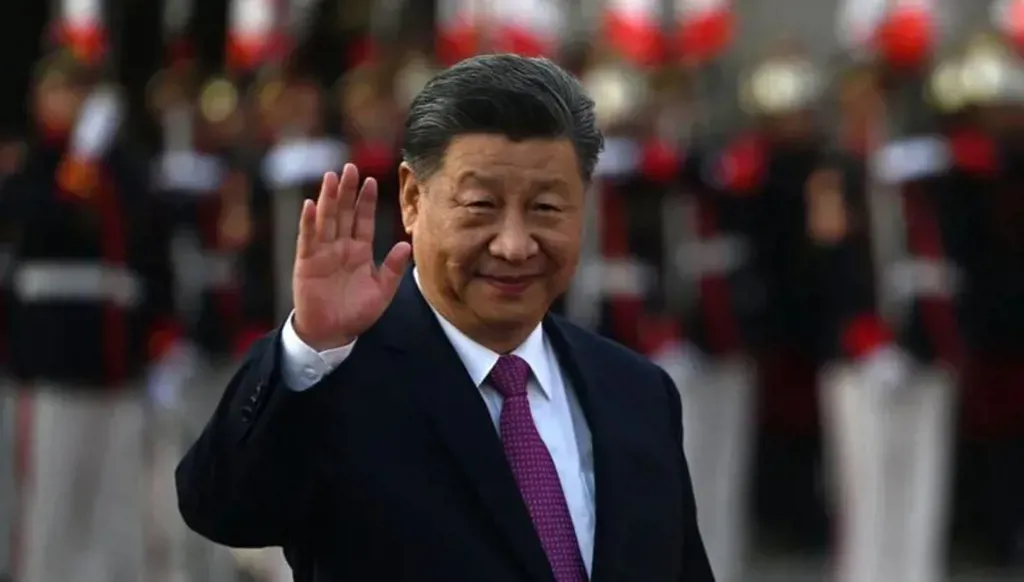
In a regional moment marked by an unprecedented level of strategic fluidity—where lines of fire intersect with negotiation paths and fronts stretch from the Strait of Hormuz to the Red Sea—Chinese President Xi Jinping’s proposal offered a different approach, not merely interpreting the crisis but seeking to redefine the rules for managing it.
During his meeting in Beijing with Abu Dhabi’s Crown Prince Sheikh Khaled bin Mohammed bin Zayed, Xi did not simply reiterate traditional positions, but instead put forward a comprehensive four-point vision to safeguard and strengthen peace and stability in the Middle East at an exceptionally sensitive moment, giving the initiative significance that extends beyond its theoretical framework to its deeper political implications.
This vision should not be seen as a transient diplomatic stance, but as part of a broader Chinese repositioning in the region—shifting the focus from “crisis management” to the “reengineering of the security environment.”
The first of these pillars is adherence to the principle of peaceful coexistence—not as an ethical slogan, but as a geopolitical reality: the countries of the region, as the Chinese proposal noted, “cannot be relocated geographically.” This phrase captures the essence of Chinese philosophy in international relations: stability is not imposed from the outside, but built from within the region through a network of mutual interests and a comprehensive, shared security framework.
The second point, relating to the sovereignty of states, comes in a sensitive context where the concept of sovereignty itself is being forcibly redefined under the pressure of interventions and proxy conflicts. Here, Beijing reaffirms this concept as a red line, especially for developing countries, arguing that any infringement on it threatens not just a single state, but the entire international system.
The third point highlights the primacy of international law, but with a clear warning against its “selective” application. The problem, from the Chinese perspective, lies not in the absence of rules, but in how they are enforced. Hence the explicit warning against a slide into the “law of the jungle”—a description that implicitly criticizes the current international system as much as it calls for a rebalancing of the mechanisms of global governance.
The fourth point, which may initially appear economic, is deeply political: it links development with security. According to this approach, security is not merely a product of stability but a precondition for it, and development is not a luxury but a lasting guarantee of it. This duality reflects a cumulative Chinese philosophy that sees the economy as a tool for reshaping balances, not merely a consequence of them.
Here, this vision acquires its deeper meaning when placed within its broader, cumulative context. For years, China has been shaping its approach to the international system—beginning with the Belt and Road Initiative, which redrew economic geography, and continuing through the Global Development Initiative and the Global Security Initiative, to the Global Civilization Initiative, and finally the Global Governance Initiative, which seeks to redefine the rules for managing the international system itself. In this context, the four points appear as yet another link in a comprehensive Chinese trajectory, gradually moving from the economy to security, and from both toward the reshaping of global governance.
However, what gives this vision its significance is not only its content, but also its timing and context. It comes at a moment when the region is undergoing a delicate redistribution of roles, with the ability of traditional actors to impose stable equations declining, alongside the rise of forces seeking to offer more flexible and less confrontational alternatives.
In this context, China is not presenting itself as a competing alternative, but as an “organizing” force within the international system, seeking to reshape the rules of the game without engaging in direct confrontation. This explains its emphasis on concepts such as “common security” and “balanced development,” rather than military alliances or rigid alignments.
Yet the main question remains: Does this vision have the tools for its implementation?
So far, China appears more comfortable in the role of “theoretical engineer” of the international system than in the role of “security guarantor.” However, at the same time, it is accumulating different instruments of influence—economic, technological, and diplomatic—that may gradually enable it to move from theorizing to action.
In this context, the conclusion emerges: what Xi Jinping proposed is not merely a situational initiative, but an indicator of a deeper transformation—from a Middle East whose crises are managed from outside to one in which security is redefined within new international balances—and China is seeking to position itself as one of its architects.





 Messenger
 Whatsapp
 Threads
 Email
Email
 Print
Print
 X
X
 Facebook