

Lebanon and Israel move toward new US backed talks on ceasefire and disarmament
Following renewed fighting, diplomatic efforts resume with proposals for limited military restraints, a phased disarmament process, and possible steps toward broader negotiations.



 Messenger
 Whatsapp
 Threads
 Email
Email
 Print
Print
 X
X
 Facebook
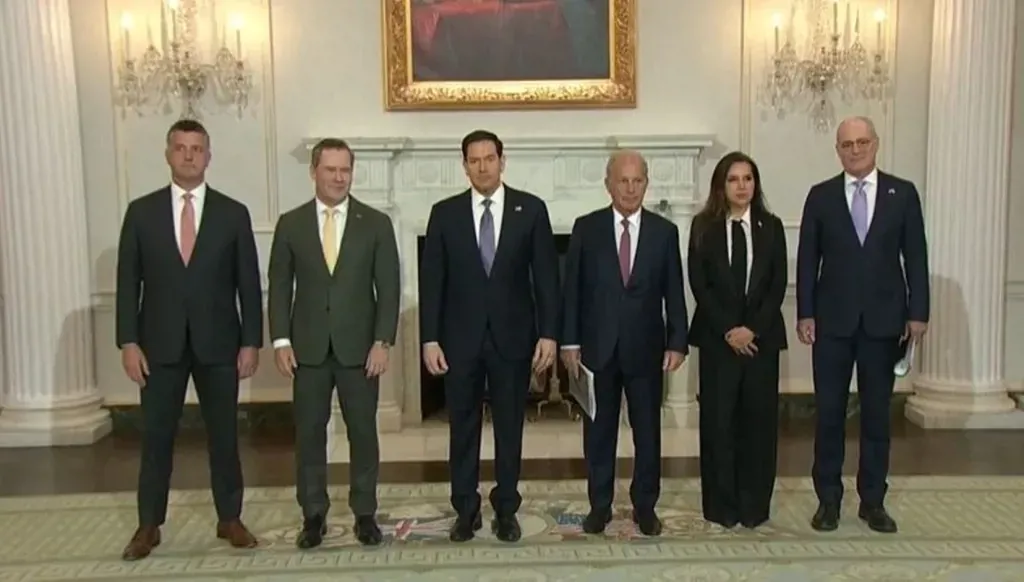


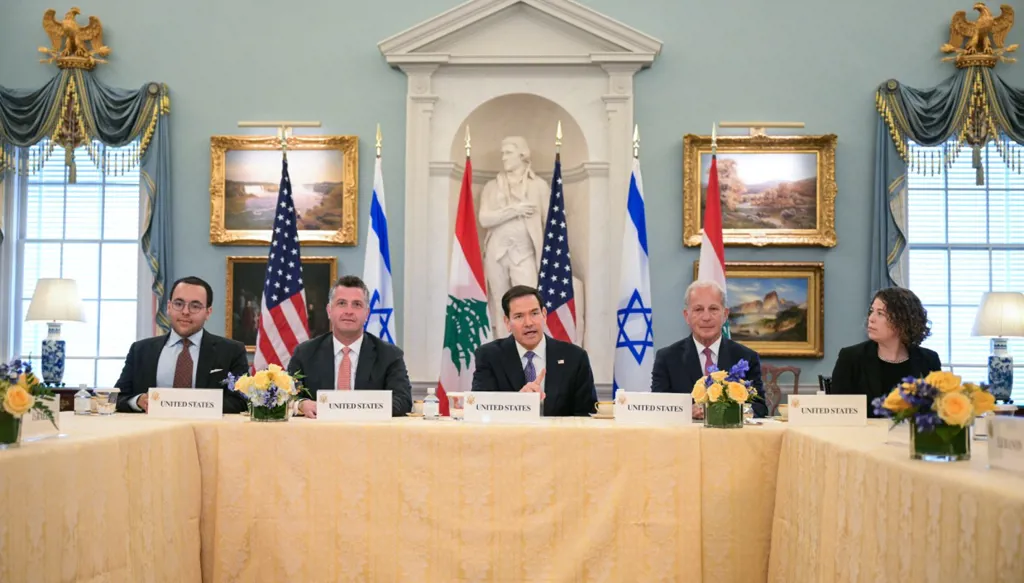
The Lebanese and Israeli talks under US sponsorship have led to an agreement on a formula that is less than a ceasefire agreement, but it will allow the launch of negotiations aimed at disarming Hezbollah and achieving bilateral peace.
Sources indicate that the meeting between Lebanese and Israeli representatives under US sponsorship opened the door to talks that could eventually lead to peace negotiations. This step represents a promising opportunity to expand Arab-Israeli peace through reaching a formula that addresses the flaws of the ceasefire agreement signed in November 2024, which failed to achieve the main goal of disarming the organization, in addition to reducing the impact of ongoing military operations on Lebanese civilians.
The agreement that was brokered at the time by US President Joe Biden’s administration had a greater chance of success compared to the faltering Gaza ceasefire agreement, because the main third party was the Lebanese government, which changed its perception of the party and removed from it the label of “national resistance,” so that it became, in the view of most Christians, Sunnis, and a portion of Shiites, an arm of Iranian influence.
After about a year and a half since the agreement was signed, its shortcomings began to emerge, and the issue of disarming the party within a fixed timeline was one of the points of disagreement. On one hand, the government delayed in asking the army to prepare a plan to monopolize weapons, and on the other hand, the army adopted a cautious approach and avoided any direct confrontation with Hezbollah.
This may be due to its preference to preserve internal stability rather than enforce disarmament by force, or because part of the political class has interests in the complex political system that has allowed the party, and still allows it, to exercise its influence behind a civilian facade.
Israel also refused to withdraw from the territories it occupies and continued its military operations against the party. Whatever the reasons, the ceasefire agreement was undermined.
Sources say that the 2024 agreement included some useful innovations, such as a mechanism under US supervision to transfer intelligence information to the army as an intermediary and to resolve disputes between the Lebanese and Israeli sides, but it failed to address the core issue, which is disarmament, as the army refused to risk confrontation with the party and the political leadership did not exert sufficient pressure to implement its decisions.
Six weeks after the fighting, diplomacy sees a second opportunity with agreement to hold talks between the Lebanese and Israeli sides. The bombing that targeted Beirut strengthened the government’s position, which ordered the army to deploy in the city to turn it into a demilitarized zone, while the President overcame attempts to obstruct these negotiations. The main challenge will be reconciling the differing positions regarding military operations. Lebanon is calling for a ceasefire to ease the humanitarian crisis and support the option of negotiation, while Israel refuses to accept a ceasefire without progress on restricting weapons.
Despite this divergence, both sides have an interest in reaching a compromise. President Joseph Aoun needs to justify his choice of entering negotiations, while Israeli Prime Minister Benjamin Netanyahu needs to advance his vision of regional peace. The two sides may reach a limited agreement, such as restricting or suspending Israeli military operations in certain areas for a period of several weeks, which would put pressure on the Lebanese army to demonstrate its effectiveness.
In this context, sources note that the disarmament process could begin from the north toward the south, after the failure of the attempt to start from the south, with the role of the mechanism being strengthened and the scope of the US monitoring system expanded, including the involvement of field personnel to follow up on implementation and assess performance.
In parallel with security issues, the talks could address the goal of peace by examining the points of disagreement between the two countries, which could in an initial stage lead to normalization. Netanyahu recently indicated the possibility of reaching full peace, something that may be difficult for the Lebanese and would require favorable regional conditions.
These negotiations are seen as an opportunity for US diplomacy to achieve a political breakthrough after stalled talks with Iran and no tangible progress in Gaza. Reaching an agreement would require a degree of diplomatic creativity, which is not impossible, especially if there is an agreement to commit to restricting weapons, limiting military operations, and launching parallel security and political negotiations to achieve peace.