

Washington Hosts Lebanon–Israel Talks as Beirut Signals Break from Iran’s Grip



 Messenger
 Whatsapp
 Threads
 Email
Email
 Print
Print
 X
X
 Facebook
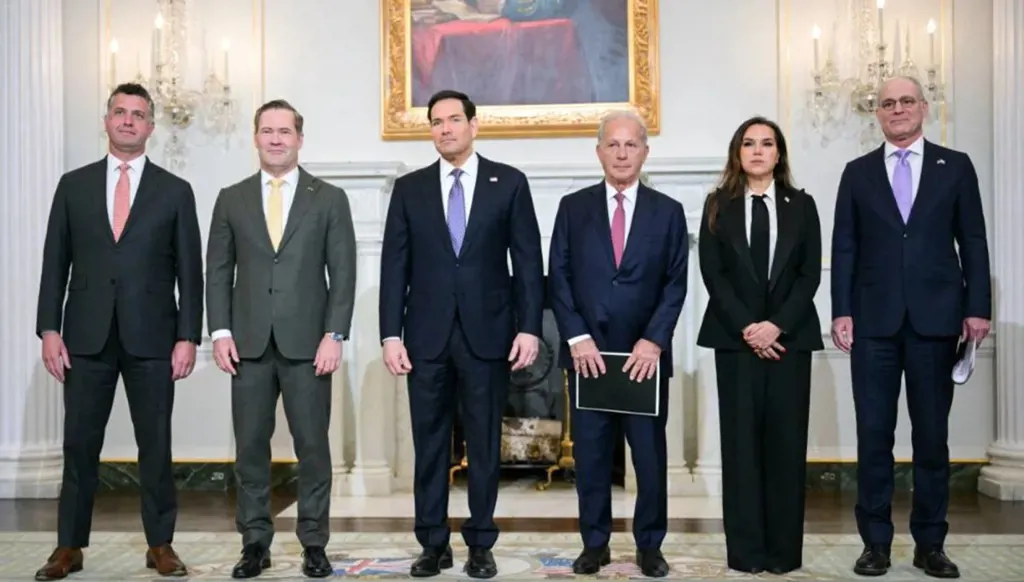


Around a U-shaped table, amidst heightened interest, Lebanon's ongoing war returned to the forefront of American concerns, as evidenced by the U.S. State Department hosting this significant diplomatic event. The presence of U.S. Secretary of State Marco Rubio at the meeting added utmost importance. Washington brought together Lebanese Ambassador Nada Hamadeh Mouawad and Israeli Ambassador Yehiel Leiter in an unprecedented direct Lebanese-Israeli meeting for decades, signaling a framework for subsequent negotiations between the two countries.
Despite the significant complexities surrounding this development, highlighted by extensive military escalation in southern Lebanon at the time the meeting convened in Washington, the event held strategic significance in showcasing Lebanon's independent negotiation path following the U.S.-Iran talks. This effectively isolated and undermined Iranian attempts to keep Lebanon under its control. The meeting was historically marked, joining other historical direct negotiations alongside the 1949 armistice talks, the May 17 Agreement in 1983, direct military negotiations in Naqoura in 1984, and the direct talks in Washington post-Madrid Conference headed by Lebanese Ambassador Suhail Shammas.
The start reflected a mix of caution and openness. There was no handshake between the Lebanese Ambassador and the Israeli Ambassador, who entered the hall together after the American delegation. Only a commemorative photograph was taken before sitting around the table, with each ambassador seated on the opposite side, flanked by Rubio, the U.S. Ambassador in Beirut Michel Issa, and two State Department officials.
U.S. Secretary of State Marco Rubio, in his public remarks opening the meeting before converting it to a closed session, emphasized the "ascent" of the Lebanese issue on Washington's agenda, speaking of a "historic opportunity." He noted these efforts are amidst "decades of history and complexities" governing the bilateral relationship. Rubio explained that the goal of these talks is to put a definitive end to 20 to 30 years of Hezbollah's influence in the region, affirming that significant progress will require time. "Not all differences will be resolved in the next six hours, but we can start making progress and establish a general framework for negotiations." Rubio highlighted the current phase focused on laying the groundwork and roadmap for Lebanon-Israel dialogue, paving the way for gradually addressing outstanding issues. He added, "Remember that this is an ongoing process, not just a one-day event; it transcends the scope of a single day. It will take time, yet we believe this effort is worth every bit of investment. It’s a historic gathering we hope to build upon moving forward. Today, the hope is to help shape the framework through which lasting and stable peace can be achieved, so the Israeli people can live in peace, and so the Lebanese people not only enjoy peace but also the prosperity and security they deserve."
The U.S. State Department clarified that talks had been planned for a month, before the confirmation of Islamabad talks, stressing that there is no connection between U.S.-Iran negotiations and Israel-Lebanon discussions. It affirmed, "Iran has dragged the Lebanese people into war, so it cannot pretend to be Lebanon’s protector, and Hezbollah is a terrorist organization that deserves no place. Its disarmament is essential, and the United States supports this goal. Iran will no longer dictate Lebanon’s future, and these talks are part of that effort."
The closed meeting lasted over two hours, with Israeli media reporting that Lebanon and the United States asked Israel for a ceasefire or temporary calm as a potential achievement. After the delegations’ departure, the Israeli Ambassador addressed reporters, stating the talks addressed long-term issues. "We explicitly said that civilian safety is not negotiable and this is understood by the government of Joseph Aoun." He added, "We agree to liberate Lebanon from the clutches of Hezbollah, and the government of Joseph Aoun said no to Hezbollah. This is a strong battle against Hezbollah, and together we will continue to face Iran’s proxy." He noted Lebanon has an opportunity now after weakening Iran and Hezbollah. "We will continue negotiations with Lebanon in future stages."
The U.S. State Department subsequently issued a joint statement on the meeting: "This meeting was the first high-level direct communication between the governments of Israel and Lebanon since 1993. Participants held fruitful discussions on the necessary steps to launch direct negotiations between the two countries."
The United States congratulated both countries on this historic achievement, expressing support for continuing the talks, and the Lebanese government's plans to restore arms monopoly and end excessive Iranian influence. It also hoped these talks would surpass the 2024 agreement’s scope and lead to a comprehensive peace agreement. The U.S. affirmed Israel's right to self-defense against ongoing Hezbollah attacks and stressed that any ceasefire agreement should be concluded between the two governments, under U.S. auspices, not via any separate track. Additionally, these negotiations could pave the way for substantial reconstruction aid and economic recovery for Lebanon, expanding investment opportunities for both countries.
Israel, for its part, expressed support for the disarmament of all non-governmental armed groups and dismantling terrorist infrastructure in Lebanon, committing to work with the Lebanese government to achieve this goal in a manner that ensures the security of both nations’ peoples. Israel affirmed its readiness to engage in direct negotiations to resolve all outstanding issues and reach a lasting peace that enhances security, stability, and prosperity in the region.
The state of Lebanon stressed the urgent need for the full implementation of the November 2024 ceasefire declaration, affirming the principles of territorial unity and the complete sovereignty of the state, calling for a ceasefire and tangible measures to address the severe humanitarian crisis the country continues to face due to the ongoing conflict.
All parties agreed to commence direct negotiations at a time and place to be agreed upon."
Lebanese governmental sources considered the Washington meeting a preparatory encounter to initiate the negotiation path between Lebanon and Israel. This is a significant step for Lebanon, as the decision to participate is an execution of the President's initiative despite Hezbollah's objections. They noted this meeting demonstrates Lebanon’s foreign policy independence from Iran and the state's ability to choose an independent path, aiming to secure a ceasefire in Lebanon and Israeli attacks, providing protection for the widest possible area of Lebanese territories, while striving to implement the "November 2024 Ceasefire Declaration" and end the Israeli land occupation of Lebanese territories. There is a growing view in Lebanon advocating that the negotiation goal should be to reach an agreement that ends the state of armed conflict, serving as a step towards establishing a path for sustainable peace.
Before the talks in Washington commenced, a joint statement was released by the foreign ministers of 17 countries including Australia, Belgium, Croatia, Cyprus, Denmark, Spain, Finland, France, Greece, Iceland, Luxembourg, Malta, Portugal, Norway, the United Kingdom, Slovenia, and Sweden, calling for Lebanon's inclusion in efforts aimed at regional de-escalation, and urging "all parties to work towards a sustainable political solution." The statement read: "The ongoing war in Lebanon threatens the current regional de-escalation efforts, which we welcome and must be fully respected by all parties. We welcome President Joseph Aoun’s initiative to open direct talks with Israel and welcome Israel’s acceptance to start U.S.-mediated talks. We call on both parties to seize this opportunity."
Conversely, Hezbollah continued to escalate its opposition to the negotiations. Hezbollah’s Political Council member Wafiq Safa stated that the party would not abide by any agreements resulting from the direct talks between Lebanon and Israel in the United States.