

Pope Leo XIV begins African tour in Algeria with message of dialogue
The visit bypasses France’s traditional role as the Vatican’s gateway to Africa, reflecting changing diplomatic and church dynamics amid strained France–Algeria relations.



 Messenger
 Whatsapp
 Threads
 Email
Email
 Print
Print
 X
X
 Facebook
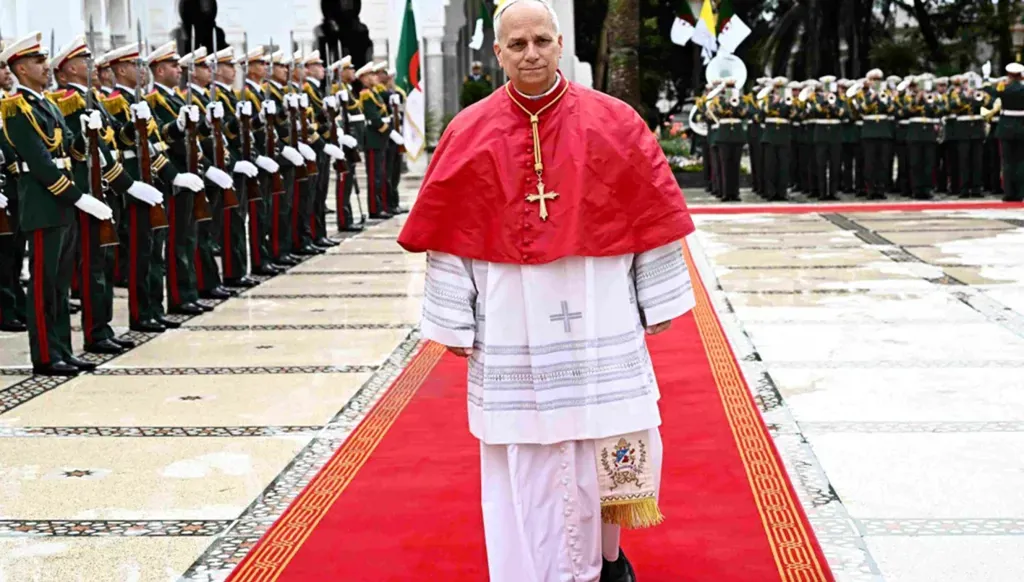


Pope Leo XIV began his African tour with a visit to Algeria, the first stop on a trip that will also take him to Cameroon, Angola, and Equatorial Guinea. The visit carries two main messages. The first is aimed at strengthening Muslim Christian dialogue. The pontiff deliberately chose a neutral Muslim country, away from regional conflicts, to promote interfaith understanding, much like Pope Francis did during his visit to the United Arab Emirates in 2019.
The second aspect of the visit is more personal. The pope belongs to the Augustinian order, inspired by Saint Augustine, who lived and died in what is now Algeria. In his first address from the balcony of Saint Peter’s Basilica, Leo XIV described himself as a son of Saint Augustine. He had also visited Algeria twice before his election as head of the Catholic Church in May 2025.
The itinerary includes two major highlights. On the first day, the pope will visit the Great Mosque of Algiers, an iconic structure that includes the tallest minaret in the world, rising 267 meters. He will then head to the Basilica of Our Lady of Africa, one of the country’s most important Christian landmarks overlooking Algiers Bay.
At a gathering bringing together Christians and Muslims, the pope is expected to deliver a message calling for greater human fraternity. Later that day, he will hold a private prayer at the chapel dedicated to the nineteen Martyrs of Algeria, a group of priests and nuns killed during the civil war between 1992 and 2002. He is not scheduled to visit the Tibhirine monastery, where monks were abducted and killed in 1996 in circumstances that remain unclear.
On the second day, the pope will travel to the city of Annaba, formerly known as Hippo, where Saint Augustine once served as bishop.
The Archbishop of Algiers, Cardinal Jean Paul Vesco, told France 24 that the visit carries a purely human and spiritual message, with no hidden motives. He said it would also help renew attention to the religious and historical importance of Saint Augustine, while presenting Algeria as a country open to dialogue.
Another notable aspect of the pope’s visit is that it did not go through France, as has traditionally been the case given France’s historical role in Africa. From the nineteenth century until the early twenty first century, France served as the main gateway for the Vatican into Africa because of its colonial presence. As a result, Catholic churches in colonized countries were administratively linked to France, and bishops were French until independence. Papal visits also typically began in French speaking countries.
All of this comes alongside current tensions between France and Algeria, which led the Vatican to coordinate the visit directly with Algerian authorities, without going through France.
Disclaimer: The opinions expressed by the writers are their own and do not necessarily represent the views of Annahar.