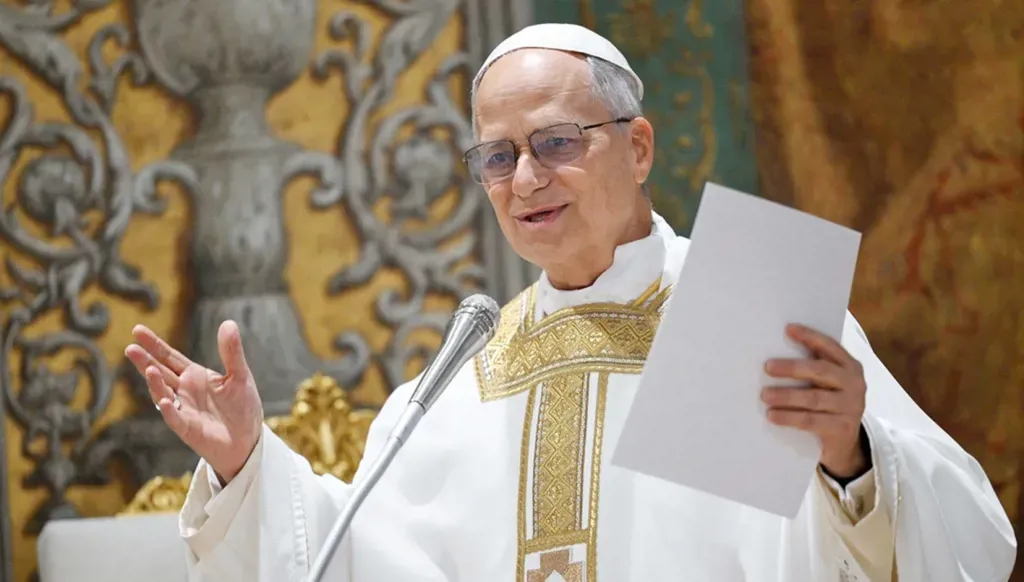
The American President spares no one in his political and verbal battles. At the end of January, the Trump administration sent a senior Pentagon official to summon the Vatican's top diplomat to a closed-door meeting. According to leaks in the American press, a significant threat was used when an American official invoked the "Avignon Papacy" incident, which took place in the 14th century when France subjected the papacy to its will. While this reference might be obscure to many, church leaders understood it immediately as a direct threat. Despite Pentagon denial, the incident reveals a rift that had been growing between the two parties since the election of Pope Leo XIV.
'Avignon Papacy': a deliberate analogy
The tension significantly escalated with the Pope’s speech on the state of the world at the beginning of the current year. The Trump administration objected to parts of the speech that openly opposed war and called for peace. Among the phrases that particularly angered officials was the statement that “diplomacy that promotes dialogue and seeks consensus among all parties is being replaced by force-based diplomacy.” The reference to the Avignon Papacy was not merely a passing historical remark. It caused concern within the Vatican to the extent that the Pope canceled his plans to visit the United States. The historical analogy was deliberate. In the 14th century, the French monarchy exerted immense pressure on Pope Boniface VIII, ultimately forcing his successor to relocate the papacy to Avignon, a step that led to the breakdown of the unity of the Western Christian world. It appears that invoking that incident in conversation with the Pope’s senior diplomat is not merely a footnote in a historical lecture, but rather expresses a direction whose meaning is not yet fully understood.
The confrontation between Washington and the Vatican appears primarily theological. The Trump administration, especially under Defense Secretary Pete Hegseth, developed what critics describe as a “theology of war,” which fundamentally contrasts with everything the Pope advocates. Hegseth repeatedly invoked God in relation to the American military campaign, likening the rescue of a fallen American pilot to the “resurrection,” and calling on the American people to pray for military victory “in the name of Jesus Christ.”
An American public opinion clash
Much of this rhetoric stems from Hegseth’s shift to an evangelical tradition associated with the nationalist pastor Doug Wilson, who has long mixed religious language with military terminology. The Pope’s response, from Pope Leo XIV, was clear. In his Palm Sunday sermon, he said, “Jesus is the King of Peace, who rejects war and cannot be used as a justification for war.” The clash reached its peak when Donald Trump threatened to wipe out “the entire Iranian civilization,” a call the Pope deemed unacceptable, describing war as “solving nothing,” and pointing to the global economic crisis, the energy crisis, and increasing instability in the Middle East.
There is a deep irony at the heart of this clash. Donald Trump’s coalition includes millions of devout Catholics, and J.D. Vance, a converted Catholic, holds the position of Vice President. Yet, the White House managed to clash with the first American Pope in history, Pope Leo XIV. Approval ratings for Trump’s handling of his role dropped to 52% from 59% in February 2025 among Catholics and to 23% from 31% among Hispanic Catholics.
Meanwhile, Pope Leo XIV’s popularity is increasing in the United States. The reason for the American administration’s eagerness to entice or demand the Vatican’s support lies in something that cannot be overlooked: the Catholic Church may be the only remaining global institution perceived as having genuine moral authority capable of guiding peoples in the Western world.
Disclaimer: The opinions expressed by the writers are their own and do not necessarily represent the views of Annahar.





 Messenger
 Whatsapp
 Threads
 Email
Email
 Print
Print
 X
X
 Facebook