Lebanon negotiates under bombardment and devastation, while Israel continues its arrogant approach, demanding that the Lebanese state comply and implement.
However dire, it is not only about the human tragedy but extends to the fate of the state’s structure. Negotiations under fire consume the very state that should spearhead national sovereignty and monopolize violence. Thus, any agreement loses its meaning. This seems to be what Israel desires: fragmentation and dissolution in favor of militias and chaos.
When that happens, the war does not end but transforms into both an internal and external conflict, one in which Israel will soon reengage.
The negotiations require significant political courage from the Lebanese political elite, as negotiations conducted under the guise of slogans and a mix of verbal resilience with national wisdom and sound judgment are futile. The strength and stability of the state are prerequisites for ensuring sustainable security for all.
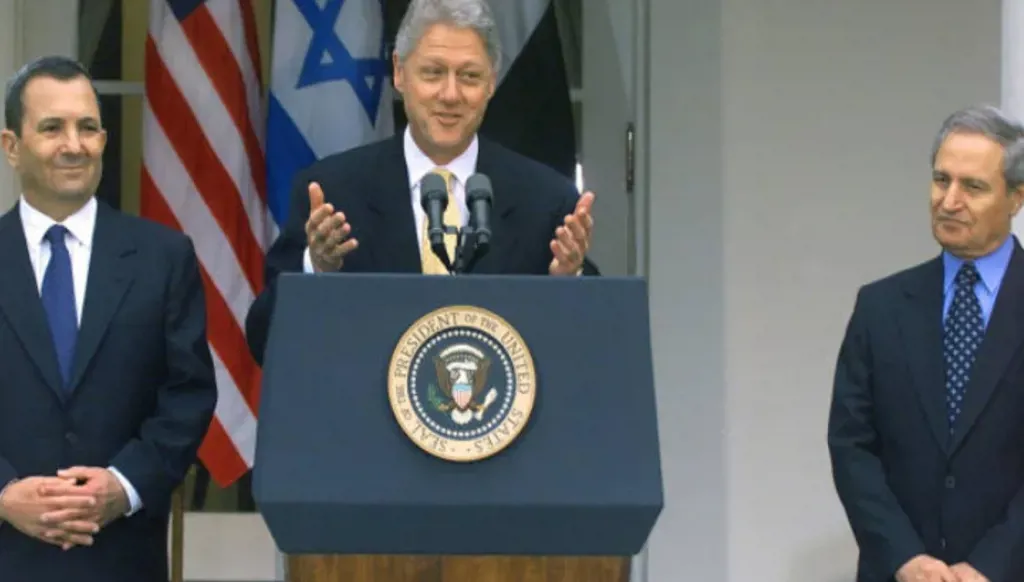
There are lessons to be learned from the failed Syrian–Israeli negotiations.
The first lesson is the importance of consolidating state power as a prerequisite for stabilizing commitments. Hafez al-Assad, before, during, and after the negotiations, was given the opportunity to eliminate all forces that could undermine his commitments. He secured complete silence on the Golan front and managed to suppress anti-Israeli activities from Syrian territory. However, he failed to reach a clear formula to uphold Syrian rights regarding boundaries, including the Shebaa Farms. Because the peace was incomplete, he soon took a gamble under the pressure of his ideological policies, using the Lebanese void to reignite matters, which eventually rebounded on Syria, eradicating any near hope of reclaiming the Golan and achieving an honorable peace between the parties in the foreseeable future.
Thus, it was essential for the Syrian negotiations to establish, publicly and legally, the borders of both parties at the start of negotiations, with the understanding that Israel would only withdraw upon meeting specific security-related conditions.
Had this been implemented in the Syrian case, it would have prevented the annexation of the Golan and the U.S. recognition of it, a request from Israel.
Secondly, while the U.S. administration still nominally insists on Lebanon’s unity and avoiding a new civil war cycle, the next possible and pressing goal is to separate the Lebanese arena from regional entanglements and impose an immediate ceasefire on Hezbollah. In the Syrian example, Assad evaded his obligations by fostering militias within the Lebanese arena. Achieving this might require assistance from international forces—UNIFIL—with the assumption of gradually expanding its mandate, rules of engagement, and operational areas. All this would be in exchange for the complete cessation of Israeli aggression through documented, clear mechanisms and a practical path to restoring the state’s authority in the south.
And here lies the real knot, not in the lack of formulas, but in the lack of reliable commitment. Hence, resorting to the Security Council to approve agreements at every stage, and to stabilize borders, becomes a fundamental condition for achieving this, preventing Israel from exploiting Lebanon at the slightest shift or opportunity.
Lebanon’s firmest leverage here is international law and the logic of UN resolutions: stabilizing borders and creating consistent negotiation grounds, to avoid miscalculations and impose international decisions that affirm Lebanese state rights and ensure the cessation of hostilities, protection of civilians, respect for sovereignty, and strengthening the role of the Lebanese army with international assistance. Absolute transparency allows Lebanon, beyond rhetoric, to achieve a unified negotiation language based on legitimate monitoring and verification mechanisms, and to impose a political cost on the Israeli side if it persists in its attempts to undermine the state or entrench displacement.
Moreover, Lebanon might clearly state what many have overlooked: that the collapse of the Lebanese state does not make Israel more secure, but less so, and instead turns the south into a vacuum, transferring chaos north of the Litani, where unchecked escalation networks proliferate. What may appear to Israel in the short term as a decisive military solution will inevitably, in the longer term, turn into chronic attrition: repeated infiltrations, escalating international pressure, and possibly an unwanted occupation.
Thirdly, in terms of negotiations, the flaw in the failed Syrian experience lay in ambiguous formulations and reliance on verbal understandings entrusted to the United States to provide ambiguous guarantees that expire with the end of each American president’s term, only for the cycle of explosions to resume anew.
Hafez al-Assad preferred ambiguity and secret understandings to maintain victorious slogans and ideological revolutionary legitimacy as a substitute for a lack of internal legitimacy; thus, deal arrangements multiplied, while publicly declared and internationally binding texts disappeared, offering Israel hollow promises and buying the regime some time, yet securing long-term territorial gains.
Fourth, Lebanon should not currently waste its time negotiating a “final status” while the Lebanese house is ablaze. The priority is to halt the bleeding. This requires agreement on two clear phases: an urgent phase that establishes a mutual, verifiable cessation of hostilities, guarantees civilian return, and accelerates Lebanese Army presence in the south under international forces’ oversight and participation. The core task now is solidifying and enabling the Lebanese state. The state is not a negotiation detail, but its first and last condition and sole tool. At such a moment, a separate ceasefire does not seem a retreat, but the last viable option for a rational state.
A second phase addresses complete disarmament, border arrangements, reconstruction, and compensation in further, more realistic stages.
Fifthly, contrary to the peace process with Egypt and Jordan, deferring the second and final phase in the Syrian–Israeli negotiation context was the primary reason for renewed escalation and the loss of the Golan. Hafez al-Assad agreed, hoping for subsequent gains, and Israel agreed, hoping to retain the Golan. Thus, the negotiation timeline should include a second phase within a defined timeframe, away from rhetoric and with a clear curtailment of Israeli ambitions.
Last, Rabin’s deposit in the failed Syrian–Israeli negotiations exemplifies the danger of a lack of transparency and documentation. The absence of media clarity was the reason for sacrificing the Golan. All of this resulted from concentrating all negotiation contexts between Hafez al-Assad and the United States—Kissinger.
Thus, it might be useful for France, Egypt, and Gulf Arab countries to play a role in the second phase. This would limit Israel’s unilateral actions and mitigate fluctuations in American policy, preventing negotiations, as in the Syrian example, from becoming "empty promises."





 Messenger
 Whatsapp
 Threads
 Email
Email
 Print
Print
 X
X
 Facebook