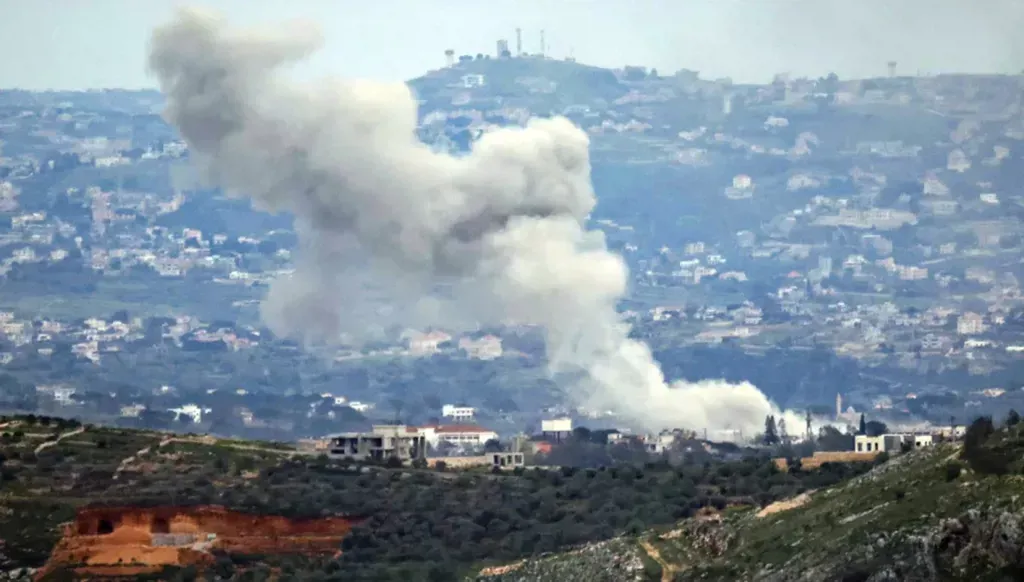
What about the Lebanese front? It is the most dangerous theater after Iran. If the war expands further, Lebanon would not just remain a “support front” but could become the most perilous theater for a sustained drain. Israel appears determined to prevent the establishment of an advanced Iranian–“party” structure in Lebanon, and it has intensified its strikes and evacuation orders. On the other hand, Reuters indicates that “Hezbollah” rearmed for months in anticipation of a new war. This suggests that the Lebanese war may continue even if the direct Iranian front with the United States and Israel recedes, making Lebanon the most likely link to turn into a long-term conflict.
What about the Gulf, the critical depth of the war? In this scenario, the Gulf is not marginal but a decisive arena. If attacks or threats continue against Bahrain, the UAE, Kuwait, and maritime corridors, military calculations would immediately turn into international economic ones.
In this case, the war between Iran and Israel fundamentally becomes a war of time, energy, and global trade. It transforms into a comprehensive conflict if three elements converge: extensive strikes on Gulf oil and water infrastructure, a sustained and significant drain on Israel’s depth, and the Lebanese front turning into an open and prolonged war. So far, available data suggest the region is moving toward this trajectory but has not fully entered it yet; the war still relies more on aerial and missile strikes and mutual deterrence than on large-scale regional land occupations.
How do the boundaries of influence in the Middle East change after the war? A retreat of Iran’s hard influence occurs if Iran’s central infrastructure is damaged. If strikes continue on Iran’s military and economic depth, its hard influence—built on direct military support, financing, armament, and operational linkage between fronts—may recede. This does not mean Iran will disappear from the region, but it may instead shift from an offensive expansion force into a regional defensive actor trying to protect what remains of its network. However, Iran’s influence may be reshaped rather than eliminated. Even if its central capacity declines, it may retain asymmetric influence through remaining missile networks and deterrence, as well as the ability to disrupt rather than build.
Iran’s influence may shift from a “progress” paradigm to a “prevention and obstruction” paradigm. This is an important analytical point. Its weakening does not automatically mean the end of its influence. Israel may expand its deterrence margin but not its political control. If it emerges from the war having degraded Iranian infrastructure and pushed its adversaries into operational retreat, it would likely gain a broader deterrence margin in the region. However, this does not necessarily translate into building a stable, allied political system around it. Regional experience suggests that military gains do not always translate into political stability. Therefore, Israel may succeed in expanding its security influence without eliminating the hostile environment surrounding it.
Lebanon may lose more than both Iranian and Israeli influence combined. In a long-war scenario, Lebanon itself could emerge as the biggest institutional loser. As the conflict drags on, the likelihood increases that it becomes a permanent contact zone, reducing the state’s ability to control decisions of war and peace, and widening the gap between the state, armed actors, and an already exhausted economy. This would not only alter the internal balance of power in Lebanon but also shift its regional position from a crisis-affected state to a permanent crisis arena.
The Gulf will shift from an economic depth to a security-oriented entity. If attacks on its facilities, maritime corridors, or sensitive infrastructure continue, Gulf states will likely redefine their priorities. Instead of focusing primarily on development, openness, and investment, greater emphasis would be placed on energy security, air defense, protection of installations, and maritime resilience. In practical terms, this means the Gulf may emerge from the war more heavily armed, more closely tied to American security guarantees, and more cautious about any regional openness that is not backed by firm assurances.
The United States may regain its security centrality. If the war turns into a prolonged conflict, the need for defenses, bases, early warning systems, and maritime shipping protection will reinforce American security centrality in the Gulf and Eastern Mediterranean. This would mean the war could end up reducing the maneuvering space of some regional powers, while increasing demand for the American security umbrella, even if it carries political costs for certain capitals.
Is there a new Middle East? Yes, but not a more stable one. The outcome is not a “settled” Middle East under a single axis, but rather a more fragmented, militarized, and mutually deterred region. Israel becomes more security-driven. Iran becomes less expansionist but more inclined toward disruption. Lebanon becomes weaker and more fragile. The Gulf becomes more security-oriented and less assured. The United States becomes more present militarily, even if it does not seek an open-ended war. This means that post-war boundaries of influence will not be drawn solely by maps, but by each actor’s ability to endure, position itself, and prevent others from imposing a definitive regional order.
The deeper assessment is as follows: If the war lasts for years, Israel and the United States may tip the military balance. However, Iran may still prevent them from achieving a decisive strategic victory.
The complete military scenario is heading toward strikes on Iran’s strategic depth and a multi-layered Iranian response. However, the post-war outcome is likely not the end of the conflict, but rather a redistribution of influence within a more fragile and militarized region. In brief, the “victorious” party is the one that manages to remain active after the war, not the one that carries out the most strikes during it.
Disclaimer: The opinions expressed by the writers are their own and do not necessarily represent the views of Annahar.





 Messenger
 Whatsapp
 Threads
 Email
Email
 Print
Print
 X
X
 Facebook