US President Donald Trump said he agreed to “suspend the bombing of Iran and attacking it for two weeks,” indicating this would be a ceasefire from both sides.
This was confirmed by Trump in a post on his “Truth Social” platform, stating that “almost all previous points of contention between America and Iran have been agreed upon.” This was echoed by Iranian Foreign Minister Abbas Araghchi in a statement, saying that his country will stop its attacks if the attacks against it are stopped, and that safe passage through the Strait of Hormuz will be possible for two weeks.
Based on the principle of “neither the wolf dies nor the sheep perish,” both Tehran and Washington ended a war that lasted over 40 days, during which bombastic slogans about a clash of civilizations were raised. A truce was expected after a fragmented war, as a solution needed to be formulated, especially since the Iranian Revolutionary Guard deliberately used all its cards at once—from closing the Strait of Hormuz to attacking the security of neighboring countries under flimsy pretexts, to deploying its arms to actively participate in this war, with Hezbollah in Lebanon as one of the first supporters.
Did everyone win?
In terms of gains and losses among the fighters, everyone won, and narratives celebrating victory will headline the upcoming scene in the media and on social platforms. There is no debate that the Arab Gulf states maintained their strong presence despite Iranian attacks on their territories. Their capitals were not dragged into a war that was not theirs, and they did not give Iran or Israel the opportunity to achieve their goals of destroying the region and its resources, even though they received more drone and missile attacks from Iran than the Revolutionary Guard directed at Israel. The war did not derail into paths planned to undermine the region’s foundations. This strengthened the position of these states, which would naturally need to map out their diplomatic relationships and define their alliances.
Is Lebanon the biggest loser?
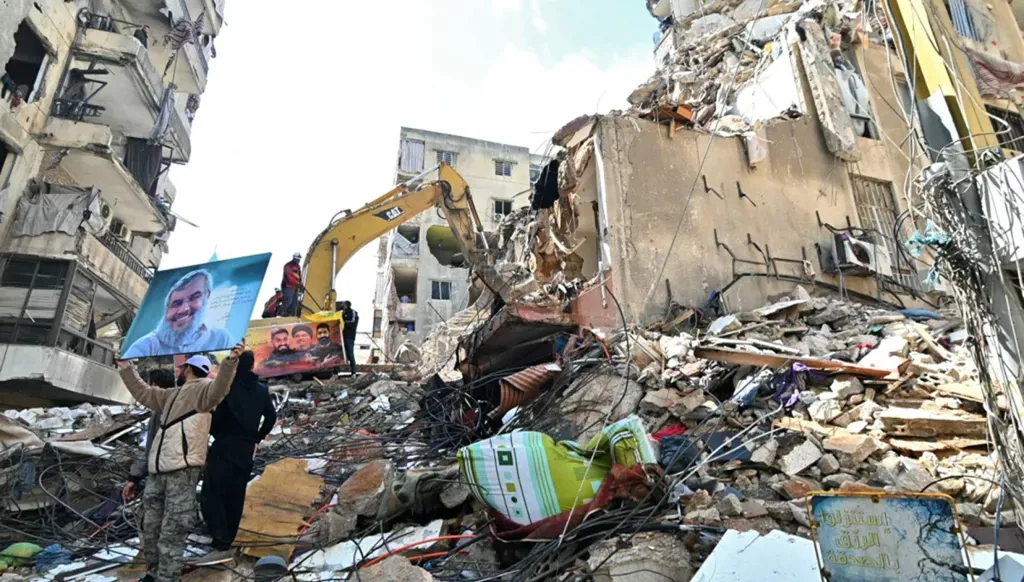
In the midst of this chaotic “tumult” overshadowing the region, and amid questions accompanying the fate of the agreement in light of what Israeli Prime Minister Benjamin Netanyahu announced—welcoming the agreement and confirming that the war in Lebanon will continue—the question remains: Will Lebanon be the biggest loser in this war?
No matter what Israel’s objectives in Lebanon are, and no matter the banners of victory and triumph Hezbollah raises, it remains certain that the Lebanese state is the biggest loser in a war in which it has no stake. This war imposed by Hezbollah has further isolated Lebanon internationally and distanced it from allies who, over the years, have been a lifeboat for it from sinking. Following this war that Hezbollah entered, it has entrenched a state of division, while remaining without surrendering its weapons—a primary condition for reconstruction by friendly Arab states.
The war revealed the state’s inability to confront Hezbollah, which turned Prime Minister Nawaf Salam’s government into a crisis management hub due to its adventures, and will turn it into a begging position in the future, asking for funds due to the catastrophe caused by Israeli attacks that “erased” areas from existence. Not only that, but this war entrenched a sharp division among sects in Lebanon that manifested in more than one area, prompting President Joseph Aoun to stress and emphasize the issue of sectarian strife and civil war.
The truce brought international relief, but not for Lebanon, which awaited its end on a basis of victory and defeat. Today, Hezbollah sees itself as victorious, and this may translate into pushing for a change in domestic political and perhaps security engagement rules. There is a looming confrontation with President Joseph Aoun’s option to rely on diplomacy from the patriarchal edifice on Easter, April 5th, criticizing Hezbollah for its military options.
The scope of engagement will expand inside Lebanon, with Israel’s insistence on keeping its military advance, linking withdrawal to Hezbollah surrendering its weapons. This will prevent hundreds of thousands of southerners from returning to their villages and homes, potentially prolonging their displacement and creating confusion over reconsidering new demographic changes for Lebanon’s population.
The Lebanese state has no capacity to address the post-truce phase and no ability to disarm, nor will American ears be attentive as long as there is no definitive resolution to the issue of Hezbollah and its exclusive possession of arms. Thus, Lebanon will live in a “patchwork” crisis with an absence of support after this war. Amid this foggy situation hovering over Lebanon, will returning to war be the party’s best option?
Disclaimer: The opinions expressed by the writers are their own and do not necessarily represent the views of Annahar.





 Messenger
 Whatsapp
 Threads
 Email
Email
 Print
Print
 X
X
 Facebook