




 Messenger
 Whatsapp
 Threads
 Email
Email
 Print
Print
 X
X
 Facebook
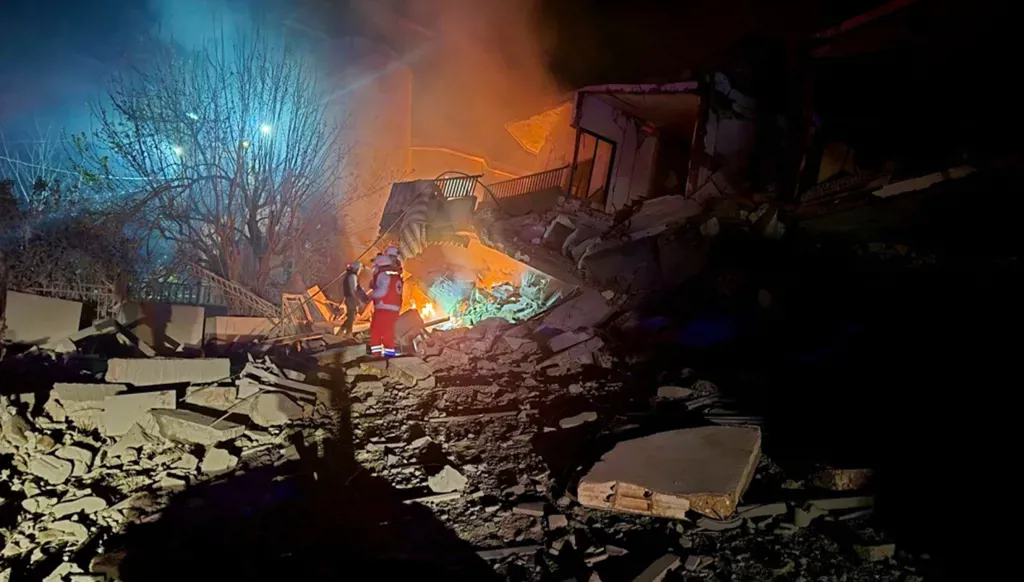


A truce may look like a period of calm on the surface, but in reality it is only a short pause between two rounds of conflict, where both sides regain their breath but not their intentions. This is how the situation appeared along Lebanon’s borders, where the silence was not the beginning of peace but only a brief preparation for something louder and more severe. Once the tension eased, Israeli strikes resumed, sending a clear message that no truce can hold in unstable conditions and no peace can exist where the balance of power is uneven. In this sense, the truce was not an end to fighting, but a reset before a more intense phase, where determination is tested rather than intentions.
Lebanon, a small country caught between geography and politics, once again found itself on the front lines of regional conflict, coming under attack without Iran intervening as many had expected. This reveals an important shift: what once looked like an ideological alliance has become a network driven by interests. Today, Iran does not manage its allies based on loyalty, but based on costs and benefits, which explains why recent strikes passed without a direct response to restore balance. At this point, the difference becomes clear between Hezbollah’s ideological loyalty to Iran and Iran’s pragmatic approach toward Hezbollah. One is driven by belief and commitment, while the other is cold and calculated. This difference alone is enough to reshape how this conflict is understood and where its limits lie.
Preventing Decisive Resolution
However, this does not mean that Iran is acting as a passive observer. On the contrary, it is quietly reshaping its options. It's understanding that the war is not over, but only waiting for future rounds, is pushing it to expand the arenas of pressure, from Iraq to Yemen and from the seas to vital shipping routes. It is not seeking a full-scale confrontation, but rather to increase the cost of confrontation for its adversaries by dispersing pressure across multiple fronts and exhausting decision making. This kind of distributed escalation is not aimed at winning a decisive outcome, but at preventing one, and this is what makes it one of the most dangerous modern strategies, as it keeps the region in a permanent state of conflict without a clear end.
Inside Lebanon, President Joseph Aoun’s statement emerges as a voice attempting to restore the logic of the state amid the noise of weapons. His assertion that negotiation is not concession, and that diplomacy is not surrender, reflects a deep understanding of the fact that wars are not managed by slogans alone. A state that is bleeding cannot afford stubbornness, and a population under exhaustion cannot bear open ended adventures. In this sense, the call for negotiation appears as an attempt to salvage what can be saved, not as submission, but as a different form of sovereignty, the sovereignty of reason in the face of emotion.
However, this call collides with a complex internal reality, where a large segment of Lebanese society feels that the decision of war and peace is no longer in the hands of the state. As destruction spreads and casualties rise, there is a growing sense that a key component of Lebanese society has been drawn into a battle beyond its capacity to endure. This does not imply unity of position within that component. On the contrary, there are exhausted voices, silent voices, seeking an exit from the cycle of fire, but finding no safe framework through which to express it.
This is the core dilemma: when there is no alternative, silence becomes a form of survival, not acceptance. On the human level, the scene goes beyond politics into tragedy. Entire families have been wiped out, homes reduced to rubble, and infrastructure collapsed under the weight of bombardment. Numbers, no matter how large, fail to convey the scale of loss, yet they remain necessary reminders that what is happening is not merely “military messaging” but a human cost paid daily. In moments like these, political discourse loses its detachment, and the question becomes harsher: how much suffering does the world need before it admits that this path leads only to further destruction?
A true crossroads
Lebanon today stands at a genuine crossroads, not between war and peace, but between becoming a battlefield or reclaiming its role as a state. Political initiatives, calls for neutrality, and attempts to redefine the national contract all point to a latent desire to escape this tunnel. But this desire alone is not enough unless it is translated into a resilient political project. History is unforgiving to states that miss their moment, and it does not pardon societies that hand over their fate to others.
In the end, what is happening in Lebanon is not just another chapter in a regional conflict, but a harsh test of the very idea of the state itself. Between a truce that resembles a pause and a war looming on the horizon, the question remains open: does Lebanon have the capacity to write its next round with its own hand, or will it remain a field where others decide the outcome of the game? That is the question that will determine whether this pain is the beginning of an end, or the end of beginnings.
Disclaimer: The opinions expressed by the writers are their own and do not necessarily represent the views of Annahar