Ten Minutes of Devastation: Beirut’s Rescue Teams Race to Save Lives After Deadly Airstrikes
Inside Lebanon’s emergency response to a devastating surge of airstrikes, where ambulances, medics, and hospitals turned into a nationwide race against time amid overwhelmed wards, shattered streets, and relentless rescue operations.
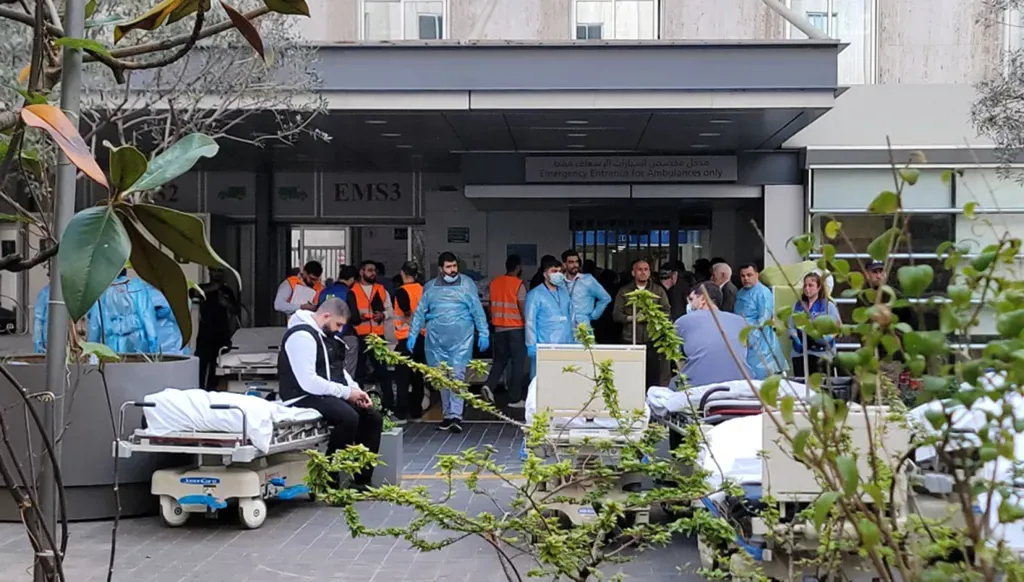
Hospital in Beirut receiving victims of Israeli massacres on Wednesday (AFP).
The sounds of Red Cross and Civil Defense vehicles did not cease on Wednesday as they moved through the streets of Beirut and its suburbs amid widespread destruction. Around one hundred ambulances belonging to the Lebanese Red Cross rushed between rubble and destroyed buildings, racing against time to evacuate the wounded and recover the dead, following a violent wave of Israeli airstrikes that included about 100 raids in just ten minutes, resulting in 203 martyrs and more than 1,000 injuries, according to the Ministry of Health. Civil Defense teams are currently continuing search operations under the rubble, attempting to reach those still unaccounted for.
Ten minutes were all it took to bring back the scene of destruction to collective memory, evoking the moment of the Beirut Port explosion on August 4th, along with the chaos and devastation it caused, as well as the scenes of pager explosions that turned hospitals and roads into areas filled with critical injuries within moments.
It was a race against time for first response teams between the field and hospitals, as they tried to rescue those trapped under the rubble and reach the targeted areas, while simultaneously managing the influx of injuries according to emergency plans and securing the necessary blood units to save the injured.
The scene in the field was anything but ordinary. About two thousand Civil Defense personnel left everything behind and headed to the ground, where danger and debris lay, searching for lives trapped under the ruins. From Jounieh, Batroun, Antelias, and Jbeil, they rushed toward Beirut and its suburbs, while others extended their efforts to Zahle, Hermel, and Shmostar, reaching Nabatieh and Sidon, as if the entire nation moved at once to try to save itself.
In those moments, ambulances were not just vehicles but a pulse moving through the destroyed streets. More than 100 Civil Defense ambulances carved a path through the rubble, racing against time to save the wounded in transfer operations that have continued since the very first moment.
In addition, more than 200 vehicles spread across Beirut and its suburbs, responding to emergency calls amid a scene where dust mixed with blood, and cries mingled with hope.
The Red Cross was present nationwide, with approximately 250 ambulances distributed between Beirut and its suburbs (125 vehicles) and Saida, Hermel, and the Bekaa (another 125 vehicles). The roads were filled with the sound of their sirens, a single sound summing up everything: an attempt to save what remains of life.
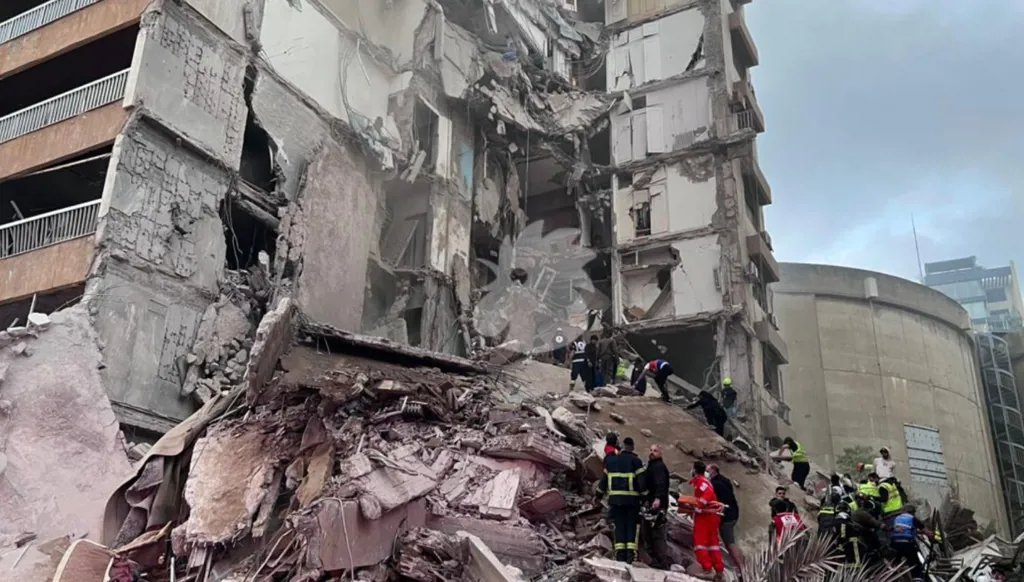
Medics on the rubble of the building destroyed by Israeli aircraft in Tallet al-Khayyat last night. (Nabil Ismail)
In Hay el-Sellom, one of the most affected areas, Brigadier Imad Khoury has been in the field for many long hours, where three airstrikes targeted different sites within minutes of each other. From the site, he confirms in his conversation with "Annahar" that Civil Defense teams “have been working nonstop since Wednesday to retrieve those trapped and the victims from under the rubble; the number of injuries is significant due to the population density in these areas.”
Adding to the harshness of reality, Khoury points out that “a number of bodies remain under the rubble, and we have not yet managed to reach them,” clarifying that rescue teams are working in extremely difficult conditions, surrounded by dense debris, narrow passageways, and fires still burning in some locations.
Severe head injuries predominantly
At the Rafic Hariri Governmental Hospital, near Bir Hassan, severe injuries have accumulated one after another, imposing a harsh emergency reality following the intense Israeli air raids targeting residential neighborhoods in Beirut.
Safaa Bleik, a registered nurse with Doctors Without Borders at the hospital, recounts the first moments, saying, “At two minutes past two, we saw a white cloud before we heard a loud explosion, with Red Cross vehicles then starting to flood into the emergency department. The injuries were terribly severe, and we lost four people in our hands despite all efforts to save them.”
The injuries were not typical, with most described as critical, concentrated on the head and limbs. Bleik explains, “We received a patient who lost both his legs entirely, in addition to suffering shrapnel injuries across his body. Most cases involved deep and severe wounds.”
Within a few short hours, from two in the afternoon until five, the emergency department received more than 40 injured individuals, with about 85% of them in critical condition. Bleik likens what the medical teams faced to the Beirut Port explosion on August 4th, “The injuries are gravely severe, and what makes the situation more difficult is the presence of about 95 unidentified individuals in the hospital, who have yet to be recognized.”
The hospital continues to receive new cases to this day, some of whom are injured individuals retrieved from under the rubble and others who are victims. Bleik notes that “families carry pictures of their loved ones on their phones, asking us about them, but we have no names or information. Some faces are burned or severely damaged, making identification difficult… These moments are tough for us, and for their families as well.”
Some images remain etched in memory. Bleik admits, "I will never forget the patient who lost both his legs and whose body was full of shrapnel, and his head injury was critically severe, nor the man whose face was entirely covered in blood. But the most painful scene was of a child who arrived alone after his mother was transferred to another hospital… he was silent, lost, unaware of where he was or what happened. That scene broke me."
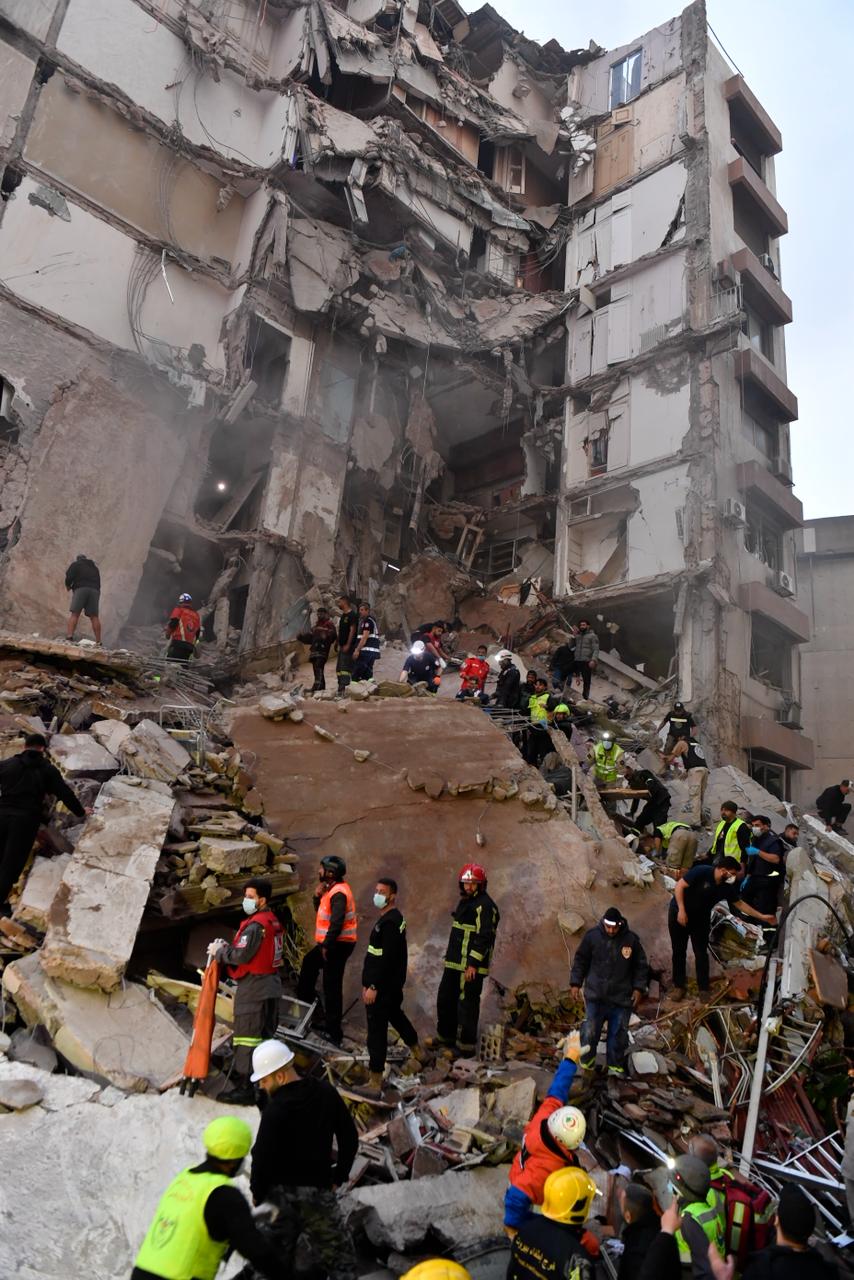
From the targeted site in Tallet al-Khayyat - Beirut (Photo: Nabil Ismail)
Hospitals overflowing with patients
What Lebanon witnessed on Wednesday was not an ordinary event, but a severe moment in all its details: simultaneous raids targeted numerous locations within minutes, turning the country into an open scene of bloodshed. Just ten minutes transformed Lebanon into a scattered site of devastation.
“What we witnessed on Wednesday was by no means easy,” says Dr. Antoine Zoghbi, President of the Lebanese Red Cross, summing up the scene. This description appears closest to the violent reality of the day, coinciding with the ceasefire in the conflict with Iran, yet carrying within it one of the most intense waves of targeting since the “pager” bombings.
In Beirut's hospitals, the scene was even more severe. Zoghbi explains that “hospitals reached their maximum capacity. Ten minutes were enough to cause this magnitude of destruction, killing, and varied injuries.”
On the ground, Red Cross teams faced doubled challenges. Amid the rubble and destroyed roads, ambulances struggled to reach the injured. Zoghbi says, “The response was complicated, but we managed to transport the injured and evacuate others, in an operation that continued until late at night.”
Zoghbi describes the situation as a case of “medical exhaustion,” reminiscent of the Beirut Port explosion on August 4th. However, he notes that the difference this time was the preparedness of hospitals, which managed to continue their work despite the enormous pressure, unlike in 2020 when several hospitals were directly damaged.
Throughout the hours, emergency departments worked nonstop. Medical staff mobilized their full capacity and dedicated their expertise to treat as many injuries as possible. It was an open race against time, fought by rescue teams among the rubble in the field and followed by medical teams within the corridors of the emergency and operating rooms, facing a scene still open to further challenges.
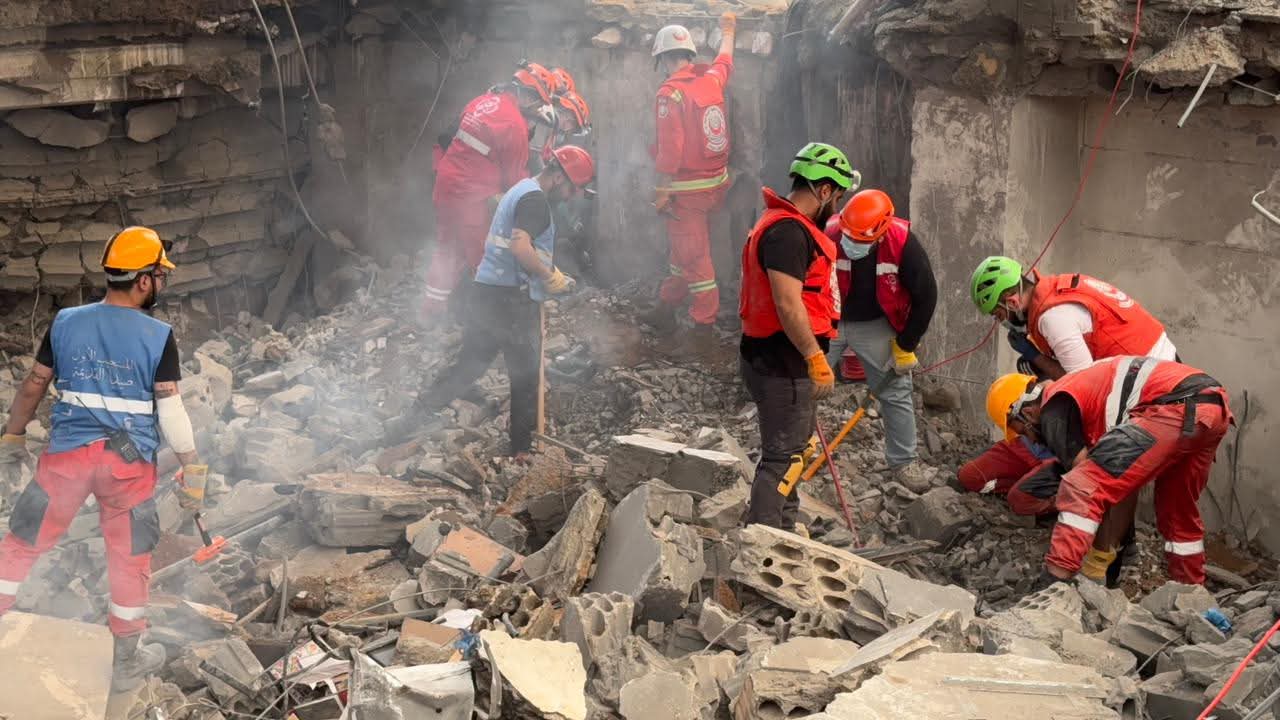
Rescue workers searching among the debris. (Ahmad Montash)
Severe bleeding and organ rupture
The President of the Lebanese Red Cross does not deny that “handling strikes of this magnitude and violence is not an easy task. While initial response is often bewildering, it soon gets reorganized, as happened in the first hours following the raids.”
Nonetheless, the scale of challenges remained large. Zoghbi explains that the nature of the injuries was extremely severe, mostly resulting in severe bleeding due to foreign objects penetrating the body, leading to muscle, artery, or sensitive tissue ruptures, in addition to deep wounds caused by scattered glass or metal shrapnel.
He confirms that "what hospitals consumed in one night in terms of supplies and medical materials equals what is usually consumed in two months."
On the ground, the task was no easier. More than a hundred ambulances tried to trace a path through the debris and destruction, reflecting the magnitude of the challenges these strikes impose. Zoghbi says, “The narrow streets and complexity of reaching targeted areas add to the difficulty of the task, before the most significant challenge becomes assessing the nature of injuries and transporting them quickly.”
Inside operating rooms, the scene resembled a beehive that never stops under the surgical and anesthetic lights. Doctors and surgeons worked tirelessly to perform complex surgeries, attempting to save what could be saved from cases arriving in critical condition.
Outside, Red Cross ambulances continued to transport severe injuries between targeted locations and hospitals, or from one hospital to another as medically required. Zoghbi acknowledges that “transporting critical cases is not easy, as the patient’s condition could deteriorate at any moment, and in fact, we transported about 50 medical cases between hospitals within a few hours.”
He emphasizes that the most urgent need in such crises remains the quick and efficient provision of blood, as it is a crucial factor in saving the injured. He reveals that “around 100 blood units were distributed to Beirut hospitals in one day,” clearly indicating the scale of the human toll faced by medical teams.






 Messenger
 Whatsapp
 Threads
 Email
Email
 Print
Print
 X
X
 Facebook