Lebanon between managed calm and regional bargain

Lebanon 10-04-2026 | 14:03

Lebanon between managed calm and regional bargain

As ceasefire talks, internal power balances, and US–Iran dynamics intersect, Lebanon faces uncertain war outcomes shaped as much by regional deals as by local realities.

Lebanon between managed calm and regional bargain
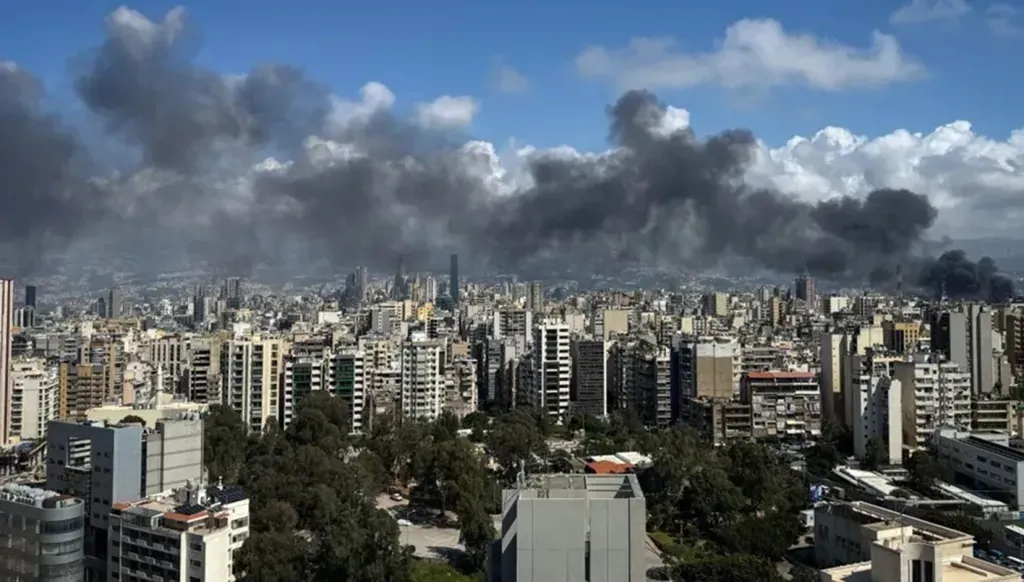
Beirut after 100 airstrikes carried out by Israel in 10 minutes, April 8, 2026. (AFP)
Smaller Bigger

In Lebanon, the question is no longer about how to stop the war, but rather how it can end, at what cost, and what form the state will take afterward. Recent developments, along with accompanying positions and communications, indicate that the discourse has moved beyond the idea of a ceasefire as a final objective, and has instead become a gateway to a deeper trajectory that redraws internal balances, in parallel with broader regional arrangements.


In this context, the proposal by Deputy Speaker of Parliament Elias Bou Saab for a temporary truce lasting two weeks acquires meanings that go beyond its temporal scope. It is not merely a field break, but an attempt to open a political window that allows for serious negotiations, amidst a clear dispute over Lebanon’s inclusion in any ceasefire, and the open rejection by Israeli Prime Minister Benjamin Netanyahu to include it. Between this rejection and Lebanese maneuvering, the country stands at the edge of two options: either imposing a ceasefire that opens the door to a solution, or remaining in a cycle of attrition.


However, if the truce is realized, it will be only the beginning of a complex process with competing scenarios. The first and most realistic involves a temporary settlement: a ceasefire followed by indirect negotiations leading to security arrangements in the south, including strengthening the role of UNIFIL or any international force, regardless of its name, and expanding the deployment of the Lebanese Armed Forces. Yet, this path, despite its importance, does not end the conflict but merely freezes it, laying the groundwork for a phase of fragile calm susceptible to disruption.

Additionally, a scenario emerges of redrawing the rules of engagement that does not end the war but organizes it within new red lines, through an undeclared understanding between Israel and Hezbollah. This model had been tested in Lebanon after 2006, but it is more fragile today amid multiple fronts and interconnected arenas.


What occurs behind the scenes surpasses these propositions. There is a quietly forming trend that links ending the war with rearranging internal affairs within Lebanon itself. Here, the discussion about extending state authority and implementing the Taif Agreement becomes more than merely a slogan, approaching an implicit condition for any settlement. The proposed equation, even without explicit declaration, is based on a “state versus weapons” logic: strengthening state institutions and the army’s deployment in exchange for controlling or reorganizing the weapons of Hezbollah, whether by removing them from border areas or subjecting them to new regulations.


This proposal does not mean immediate disarmament, which is unrealistic, but rather integrating it into a gradual, long-term process tied to delicate internal balances and decisive regional factors, particularly Iran’s role. Thus, any progress in this direction is conditional on understandings that extend beyond Lebanon itself, specifically regarding Iran’s relationship with the United States.


This appears to be the most decisive scenario: a grand regional deal. Any agreement between Washington and Iran is capable of imposing a comprehensive settlement that would directly impact Lebanon, either by rapidly ending the war or by reshaping its rules. In this scenario, Lebanon is not the decision-maker but rather an arena for the implementation of broader understandings.


Conversely, the escalation scenario cannot be overlooked, in which Israel seeks to impose facts on the ground by force through expanding its operations and targeting the infrastructure of Hezbollah. This option, although it appears limited in its objectives, carries the risk of sliding into a broader confrontation that may spiral into an open conflict.


Amid these paths, Lebanon stands before a delicate equation: the ceasefire is the entry point but not the solution. A truce may open the door to negotiations but does not guarantee their outcomes. A settlement may rearrange the internal state, but it depends on missing agreements. As for the regional deal, it remains the decisive factor, even if it lies beyond Lebanese control.

Thus, the war’s possible endings are distributed among three scenarios: a temporary settlement that freezes the conflict, a broader agreement that reshapes it, or an escalation that imposes its end by force. Among these options, the question remains open: can Lebanon turn a transient truce into the beginning of a solution, or will it once again find itself facing a war that ends only to begin in another form?