

Forty-day war redraws the Iran conflict and returns nuclear issue to center stage



 Messenger
 Whatsapp
 Threads
 Email
Email
 Print
Print
 X
X
 Facebook
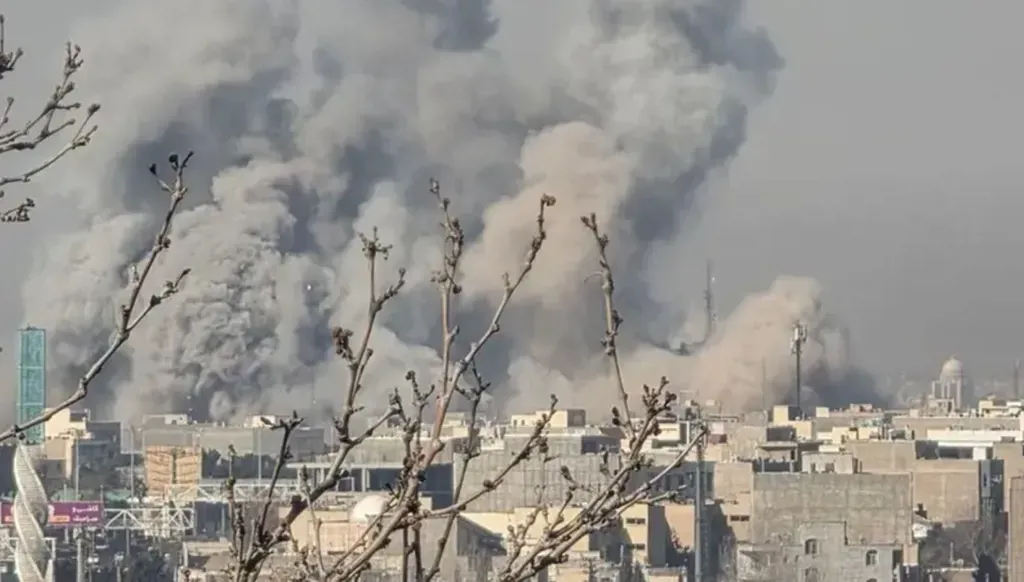


After two American Israeli wars against Iran, Washington and Tehran have returned to the negotiating table, this time with Pakistani mediation and without the usual involvement of the United States’ and Russia’s traditional allies.
The war was extremely destructive and very costly on human, economic, urban, and military levels. It caused massive damage in Iran, Israel, and Lebanon, as well as in Gulf countries that were not directly involved, in addition to American military and human losses.
It was expected that US President Donald Trump would declare victory, and likewise the Iranian leadership did the same. In a way that resembles a talent show, both sides came out proudly presenting their achievements. However, the war is far bigger than these claims, and its consequences will continue to unfold for a long time in the United States, Iran, and the Middle East.
It was a major war that was launched carelessly and fought without a clear end goal. What is certain is that it surprised both the Americans and Israelis, who had expected Iran to collapse quickly under combined air, sea, and land attacks. That did not happen, despite the assassination of most senior political and security leaders in the early days, including Supreme Leader Ali Khamenei.
What has been announced is a two week ceasefire during which negotiations are expected to lead to a final settlement and peace agreement between the United States and Israel on one side and Iran on the other, according to the US president. Despite the announced details and leaked conditions, uncertainty still dominates these two weeks, during which Trump has kept the threat of renewed war hanging over Iran.
What is happening in the negotiations and what is reported in the media is often not the full truth, especially since both sides are skilled at shaping public opinion and directing attention. Agreements of this kind may include secret clauses, and what is publicly announced during negotiations is often for propaganda purposes and aimed at domestic audiences on each side.
Trump and Netanyahu did not expect the course the war eventually took. They were carried away by the euphoria following the previous twelve day war, during which they delivered crushing strikes against Iran. Netanyahu convinced his ally that this new war would be similar and would eliminate what remained of Iran’s power within days, but the reality turned out differently this time.
Iran fought for forty days under daily devastating bombardment, assassinations, and blockade. The period between the two wars was enough for the Iranian military leadership to significantly change its strategy, taking advantage of the weaknesses exposed in the previous conflict. Over the course of a year, it built an integrated underground military infrastructure spread across the country’s more than 1.6 million square kilometers. It also prepared a military hierarchy relying on the third and fourth tiers of command, anticipating the assassination of the first and second ranks in the Revolutionary Guard, intelligence services, and the army.
In some aspects, this war was a global one. Trump pursued it with his eyes on controlling global oil and economically containing Russia and China by holding leverage over global energy routes, as he stated openly. However, Russia and China were indirectly present in the conflict. This is where one can speak of an active role for advanced Chinese technology in missile production, which proved far more effective than in the previous war. This was evident in its ability to bypass Iron Dome defenses and strike multiple targets, causing significant destruction in infrastructure and vital institutions in Tel Aviv and Haifa, as well as near Israel’s Dimona nuclear reactor. Russian expertise also appeared in war management and defense organization, according to many experts.
Perhaps one of the most notable revelations of this war was the limited effectiveness of the US president’s team, who placed relatives and friends in key strategic positions in government. They demonstrated incompetence and poor judgment, exemplified by Defense Secretary Pete Hegseth, who offered simplistic assessments of Iran’s military capability based on the number of missiles it launched daily, drawing ridicule and criticism within the administration.
Much will be said about the course of this war, its strategies, weapons, objectives, and consequences. It may be too early to say it has completely ended, but what is certain is that it has brought the issue back to its starting point: the fate of Iran’s nuclear program. This is the only area in which the United States will seek a concrete achievement, and that achievement will likely not go beyond Iran accepting a civilian program under international supervision, something that could have been reached without all this war.
Otherwise, Trump will reap the economic rewards of this war in the form of trillion-dollar arms sales and massive investments in the military industry, which would revive stagnation in the US economy. He may even seek a partnership with Iran in collecting transit fees from ships passing through the Strait of Hormuz, as he has said. Ultimately, what matters to him, and what he promises Americans, is money, even if it comes through war.
Disclaimer: The opinions expressed by the writers are their own and do not necessarily represent the views of Annahar