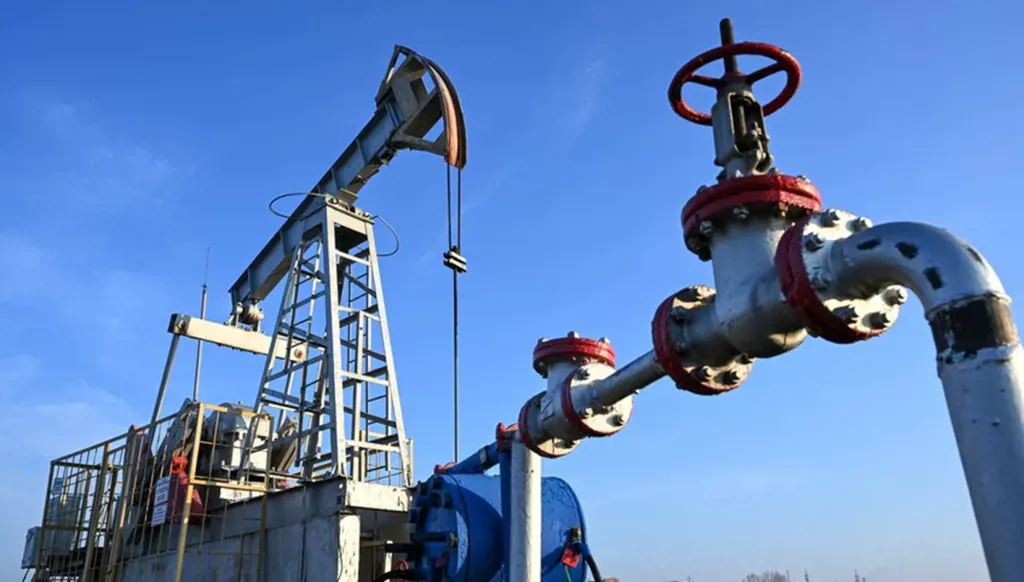
When a U.S. president announces a truce on Truth Social and oil prices fall by 15% overnight, it may appear that markets have stabilized. However, market reactions to breaking news often misinterpret the underlying economic fundamentals. In reality, seven interconnected and reinforcing factors suggest that oil prices are likely to remain higher than consumers would prefer, and possibly higher than major banks anticipate, in the months ahead.
The Strait of Hormuz has not reopened yet
More than 36 hours after the truce was announced, the Strait of Hormuz remains nearly closed. Shipping data shows that only 7 to 8 vessels are crossing daily, compared to more than 130 per day before the war began. This is not just a logistical detail—it means that roughly 93% of the operational capacity of the world’s most critical oil passage remains effectively out of service.
In this context, the truce signals only the possibility of Iranian negotiations over reopening the strait, not its actual reopening. As long as the Revolutionary Guards keep their missile systems deployed on both sides, maritime insurers will continue to classify the area as a “war zone,” which alone is enough to push many tankers toward the longer route around the Cape of Good Hope. Additionally, Iran appears intent on imposing transit fees of around one dollar per barrel and securing greater long-term control.
Infrastructure cannot be repaired with statements
Over the past weeks, Gulf oil facilities have sustained direct strikes, and supply chains have been significantly disrupted. Even if security conditions stabilize, restoring previous production capacity is not as simple as flipping a switch. It is a complex technical process that may take weeks or even months—from reinjecting essential materials and increasing reservoir pressures to restarting facilities that were shut down involuntarily—all of which depend on a secure operating environment.
Therefore, those expecting Gulf production to return to pre-war levels within two weeks are mistaking political statements for the realities of operational engineering.
Aramco has spoken until June
Spot oil prices may decline on the news, but the physical oil market operates differently. Days ago, Aramco announced its official May selling price with a record premium of $19.50 per barrel above the benchmark (the average of Dubai and Oman crude) for Asian buyers—the largest monthly increase in the company’s history. As is well known, Aramco’s pricing serves as a reference for other producers in the region.
Importantly, April and May cargoes have already been finalized, with contracts agreed at elevated levels. This means refinery prices are unlikely to decline before June at the earliest, regardless of how futures contracts move on trading screens.
Iran does not want cheap oil
A point missing from many analyses is that Iran, engaged in an expensive war, needs funding. Oil revenues remain a key financial lifeline for a state under heavy sanctions and an economy under significant pressure. From this perspective, a sharp drop in prices does not benefit Tehran; it weakens its negotiating position and reduces the resources available for reconstruction.
Hence the Revolutionary Guards’ insistence on the language of “conditional coordination” rather than a full, unconditional reopening of the strait.
Tankers say what the Truce does not
Shipping figures do not support the narrative of an actual reopening of the Strait of Hormuz. According to Kpler data, passage through the strait has fallen by 92% compared to the first week before the war. A broader impact is also visible within the Gulf, where Kpler estimates that more than 800 ships are effectively stranded, including 426 oil and product tankers, 34 LPG carriers, and 19 liquefied natural gas carriers, along with container and bulk cargo vessels. In addition, 187 fully loaded tankers carrying around 172 million barrels of crude oil and refined products are still awaiting safe passage within the strait or at its approaches.
The crisis is further complicated by ongoing security risks, following reports of three attacks on ships since last Saturday, the latest targeting the vessel Qingdao Star on Tuesday. Even if the strait were reopened immediately, Kpler estimates that clearing the shipping backlog would take more than two weeks before supplies return to normal routes. At the same time, maritime insurers continue to classify the area as a “war zone,” and elevated insurance premiums alone are enough to slow the return of regular navigation.
The forgotten Qatari factor: A slow disaster
Amid fast-paced news, a development from Doha warrants serious consideration. Iranian strikes on Ras Laffan facilities have reportedly taken 17% of Qatar’s gas export capacity out of service—equivalent to 12.8 million tonnes per year—for an estimated three to five years, according to the Qatari energy minister. QatarEnergy has declared force majeure on all its exports.
The impact is not confined to the gas market alone; Europe and Asia, which rely on Qatari supplies, will need to compensate for part of the shortfall with alternative energy sources, including liquid fuels such as oil and its derivatives. This creates new structural demand for oil, regardless of the truce’s fate.
Strategic reserves need to be refilled
During the peak of the crisis, major consuming countries resorted to drawing on their strategic reserves to contain the shock. The United States alone released millions of barrels from its Strategic Petroleum Reserve. However, these volumes will eventually need to be replenished, and refilling them will generate additional demand for oil at a time when supply has not yet fully recovered.
In other words, demand will emerge from two fronts simultaneously: natural consumption on one hand, and inventory rebuilding on the other.
Summarizing this situation, if we consider these seven factors together, it becomes clear that the truce has removed part of the “fear premium” that previously pushed prices above $110, but it has not eliminated the “scarcity premium” driven by a genuine structural imbalance between constrained supply and persistent demand. Unless negotiations in Islamabad lead to more than a temporary reprieve in the next two weeks, The Wall Street Journal’s projections of Brent returning to $80 appear, in light of these seven realities, to be more wishful thinking than analysis.





 Messenger
 Whatsapp
 Threads
 Email
Email
 Print
Print
 X
X
 Facebook