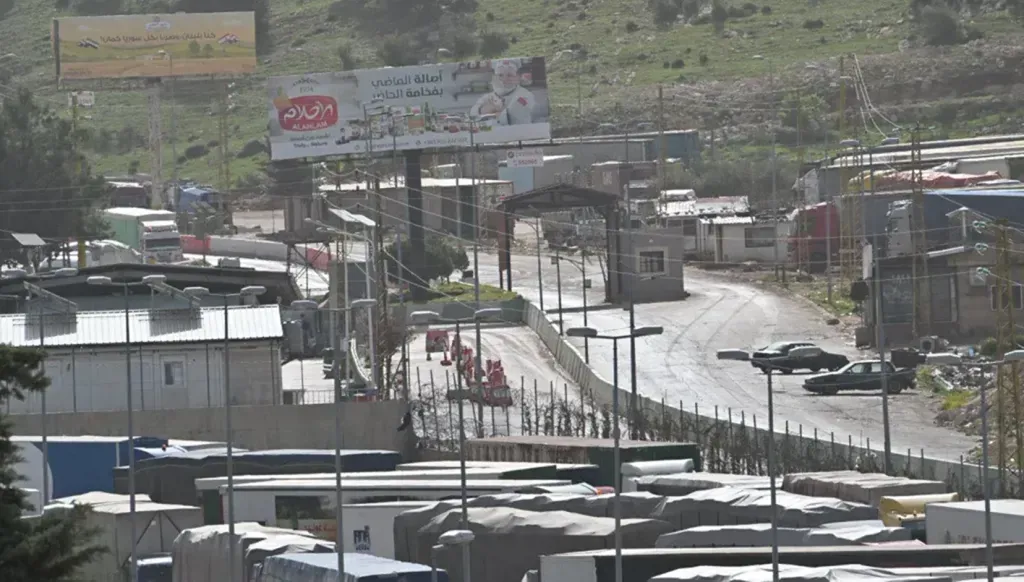
The announcement by Israel to close the Al-Masnaa Crossing was not merely a passing security measure, but a direct shock to a vital route considered the most consistently operating land artery between Lebanon and Syria. The crossing, which had remained relatively functional even after strikes hit other crossings during the last war, suddenly found itself out of service due to security accusations linked to “Hezbollah,” causing widespread confusion among both citizens and travelers.
In the hours following the announcement, the scene on both sides of the border appeared chaotic. Hundreds of people—Lebanese in Syria and Syrians in Lebanon—found themselves racing against time in search of alternative options, amid a lack of official clarity regarding the duration of the closure or how to deal with it. As pressure mounted, three main pathways emerged among the stranded, each carrying its own costs and risks.
The first option is to wait, which is currently the most widely chosen. This option is based on information about international interventions, particularly American ones, that have helped avert military targeting of the crossing, reinforcing the assumption that it may reopen soon. However, waiting is not without cost: forced residence in a second country, mounting financial burdens, and the daily anxiety that what is considered “temporary” may become prolonged.
The second option leads eastward to the Al-Jousiyeh Crossing, which remains operational but at a slower pace and with more complicated procedures. This crossing, not designed to handle the volume that Al-Masnaa did and not yet upgraded since the last war and subsequent strikes, is currently experiencing traffic beyond its capacity—resulting in long hours of waiting, burdensome logistical procedures, and additional transportation costs.
The third option is the most difficult, involving a complete rearrangement of travel routes—either through longer paths within Syria or indirect detours to reach less congested crossing points. While this option is theoretically available, it remains fraught with risks, especially given the volatile security landscape and damaged infrastructure.
However, what surpasses these options is the deeper implication of what is happening. The closure of Al-Masnaa Crossing appears less a technical measure than part of an undeclared reshaping of movement rules between Lebanon and Syria. Following previous strikes that disabled many crossings, Al-Masnaa had remained the “last functional outlet,” and its closure today raises serious questions about whether the aim is to gradually narrow this margin.
In this context, an additional dimension emerges that cannot be ignored: the use of crossings as a tool of pressure. Linking the closure to security considerations connected to “Hezbollah” places civilian movement entirely within the scope of military maneuvering, meaning that practically any development on the ground could immediately affect the lives of civilians and their ability to move.
On the other hand, the absence of any clear Lebanese plan to manage the crisis raises significant questions. There are no exceptional measures to support those stranded, nor any announced coordination to provide reassurance about the course of a solution, leaving individuals to face their fate amid rumors of an imminent reopening and on-the-ground realities suggesting otherwise.
Ultimately, a new reality is taking hold at the border: crossings are no longer mere transit points but have become tools within a broader conflict, with the stranded as the weakest link—caught between a security decision they cannot influence and borders harsher than ever before.





 Messenger
 Whatsapp
 Threads
 Email
Email
 Print
Print
 X
X
 Facebook