Syria’s $95 Billion vision: Connecting the Gulf to the Mediterranean
From high-speed trains to energy corridors and food security lines, Syria unveils five strategic initiatives poised to transform the country into a geo-economic hub connecting Asia, Europe, and the Gulf.
Syria has announced the launch of four major strategic projects to connect the Gulf with the Mediterranean Sea: the Gulf-Mediterranean high-speed train, the revival of the historical Hejaz Railway, energy pipelines from Qatar through Syria to Turkey and then to Europe, the rehabilitation of the Kirkuk–Baniyas line, and the rapid food security corridor linking the Saudi city of 'Arar' with Syrian cities via a railway.
Annahar highlights the details of each project, their importance, the investment cost of all five projects, the challenges they face, and the economic returns for both the Syrian economy and the Gulf economies.
1-The Saudi-Syrian high-speed train (Revival of the Hejaz Railway)
Dr. Salman Al-Hakim, an expert in Syrian economic affairs, accounting, and finance, told Annahar that the Gulf-Mediterranean high-speed train project involves the construction of a high-speed railway line with speeds ranging between 200 and 300 km/h. The line will link Saudi Arabia and Syria, passing through Jordan and reaching the Syrian port of Baniyas, thereby connecting the Gulf to the Mediterranean.
Hejaz High-Speed Train (Websites)
Preliminary estimates for the project’s cost, based on data from the International Union of Railways, put the cost per kilometer of the new railway line at 40 million euros. Consequently, the total project cost is expected to range between 8 and 12 billion euros, approximately 9.5 to 14 billion dollars.
According to Syrian economic affairs expert Abdel Razzaq Habza, who spoke to Annahar, the revival of the Hejaz Railway in Syria involves a trilateral understanding between Damascus, Ankara, and Amman. The first phase focuses on restarting the link between Damascus and the Jordanian border by completing approximately 30 kilometers of missing upper structure within Syrian territory with Turkish support, while Jordan evaluates locomotive maintenance and operations up to the Syrian capital.
According to announced projections, the route will initially focus on passenger transport between Damascus and Amman, with Jordanian officials discussing the possibility of launching the first journeys by the end of 2026 if the rehabilitation progresses as planned, before later expanding to freight transport following more extensive infrastructure upgrades.
So far, no final official cost or complete execution schedule has been published, making the plan more of a regional framework aimed at gradually reconnecting the historical route and transforming it from a heritage symbol into a new transport and trade corridor linking Syria to its southern and northern neighbors.
In the same context, Dr. Ziad Arabsh, a professor of economics at the University of Damascus, told Annahar that the strategic significance of the project goes beyond transportation, serving as a land artery that reshapes regional trade routes. Once completed, it will allow goods and passengers to travel from Riyadh to Latakia in hours and onward to Europe via the Mediterranean or through Turkey.
He adds that this project revives Syria's historical role as a bridge between Arabia and the Mediterranean, reducing reliance on maritime routes through the Strait of Hormuz. Ideally, creating branches to the ports of Tripoli and Beirut would be most beneficial.
Regarding the estimated investment costs, Arabsh sees them exceeding 10–15 billion dollars for creating new routes and upgrading existing ones. However, this requires high-level quadrilateral coordination among Saudi Arabia, Jordan, Syria, and Lebanon. It also necessitates ensuring security and stability along the route, particularly in Syrian areas that have experienced conflicts.
2-Laying the gas pipeline through Saudi Arabia, Jordan, Syria, Lebanon, and then Turkey
Dr. Ammar Yousef, a Syrian economic affairs expert, told Annahar that the project revives the concept of the “Qatari-Turkish gas line,” which had been stalled by regional disputes for years, albeit with some adjustments.
Dr. Ziad Arabsh believes that with the retreat of Iranian influence and Syria’s openness to Gulf countries, this gas line becomes feasible. For Europe, which seeks to reduce dependency on Russian gas, the project offers a new gateway to Qatari gas, one of the world’s largest gas reserves.
According to Arabsh, the gas pipeline project requires investments of 10–15 billion dollars to extend the pipelines over a distance of more than 1,500 kilometers.
The biggest challenge is the high cost and the long route, which requires Arab-Turkish cooperation, while also facing strong competition from Russian, Azerbaijani, American, and Algerian gas in the European market.
The Arab Gas Pipeline (Websites)
3-Rehabilitation of the Kirkuk-Baniyas Line
Economics expert on Syrian affairs, Ziad Arabsh, says that the project involves rehabilitating and extending the strategic line connecting oil fields in Kirkuk, northern Iraq, to the port of Baniyas on the Syrian coast, increasing capacity from 300,000 barrels per day to 1 million barrels per day using advanced technologies for greater efficiency. This project is the closest to implementation, as it partially relies on existing infrastructure.
For Iraq, particularly the Kurdistan region, this line provides an alternative export route to Gulf ports, reducing reliance on the Strait of Hormuz and offering broader options for Iraqi oil exports.
For Syria, this line restores its role as a transit country for energy and generates substantial revenue from transit fees.
Kirkuk - Baniyas Line (Websites)
Investment in the project is relatively modest, ranging between 1 and 2 billion dollars for rehabilitation and capacity enhancement.
The biggest challenge remains securing an agreement between the federal government in Baghdad and the Kurdistan region over oil wealth management. The project will also face security threats from remnants of ISIS and other armed groups in the areas it traverses.
4-Food security corridor – High-Speed rail from Arar to Syrian cities
Dr. Ziad Arabsh explains that the project is a railway dedicated to transporting fresh agricultural products and food goods within hours, incorporating modern refrigeration chains and dedicated production areas for export in Syria.
This project redefines the concept of regional “food security,” enabling Gulf countries to import fresh agricultural products from Syria and Jordan by land within hours, transforming Syria into a regional food basket and supporting the reconstruction of its war-damaged agricultural sector.
Investments in this project are relatively moderate, ranging from 2 to 4 billion dollars, compared to energy projects, and require the development of Syria’s agricultural sector along with the rehabilitation of land and irrigation infrastructure.
Ammar Yousef notes that these five projects are linked to proposals by Tom Barrack, the U.S. special envoy to Syria, presenting Syria as a geo-economic hub capable of repositioning itself within regional transport chains. The “Four Seas” project is proposed as a strategic vision to connect the Arabian Gulf to the Mediterranean through an integrated transport network.
Yousef adds that the five projects aim to provide a partial land and sea alternative to traditional routes such as the Strait of Hormuz, leveraging Syria’s strategic geographical location as a link between Asia and Europe.
If all five projects are implemented together, the total cost is estimated to range between 45 and 95 billion dollars, and could be higher if financing costs, land expropriation, security measures, and port and refinery expansions are included.
What challenges face the five Syrian projects?
Dr. Salman Al-Hakim says that the foremost challenge is funding, as these projects are very large and cannot be financed by a single state. The importa





 Messenger
 Whatsapp
 Threads
 Email
Email
 Print
Print
 X
X
 Facebook


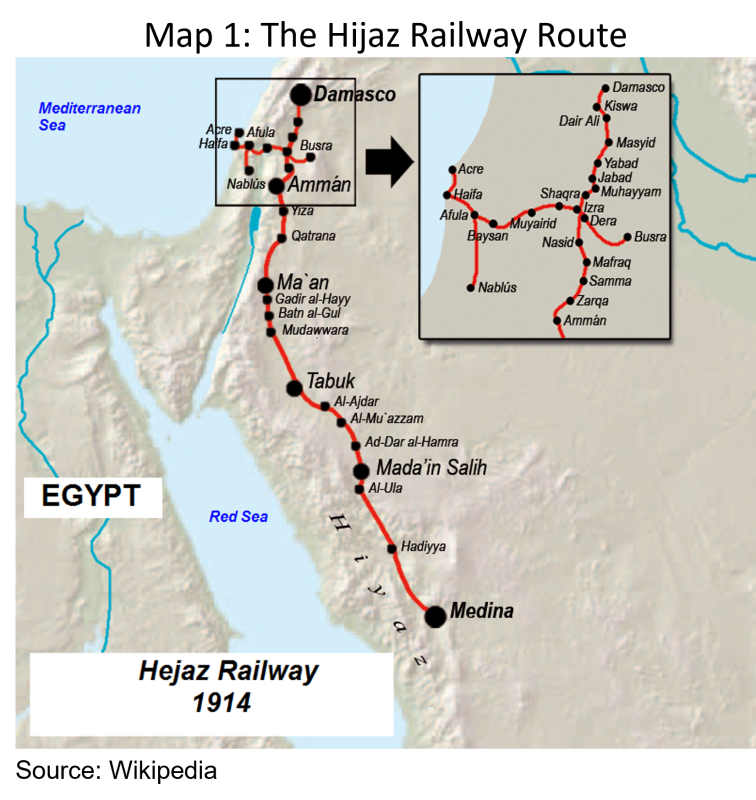 Hejaz High-Speed Train (Websites)
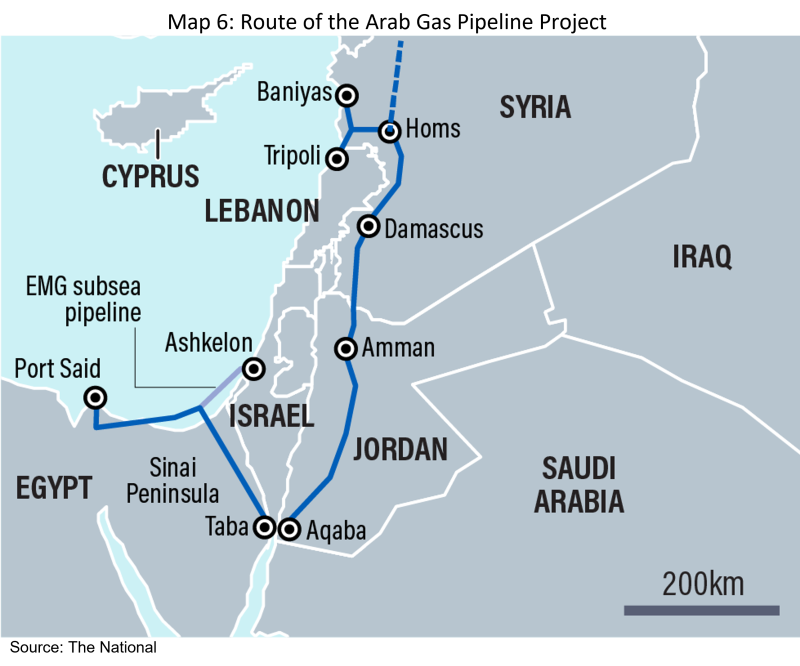 The Arab Gas Pipeline (Websites)
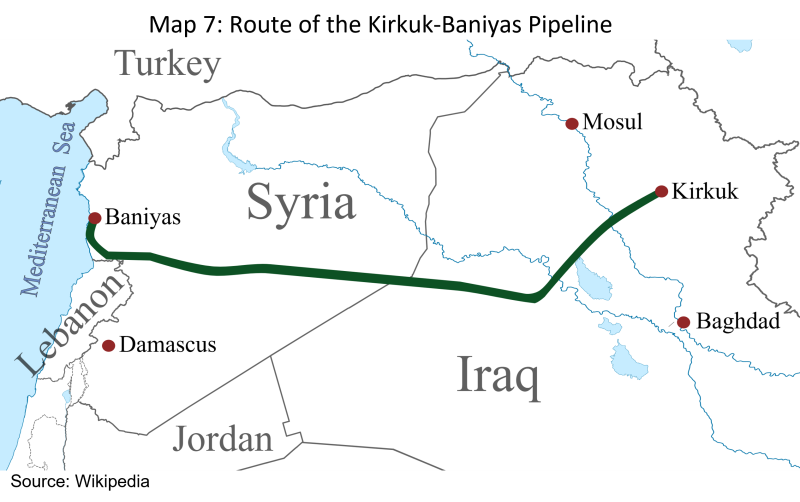 Kirkuk - Baniyas Line (Websites)