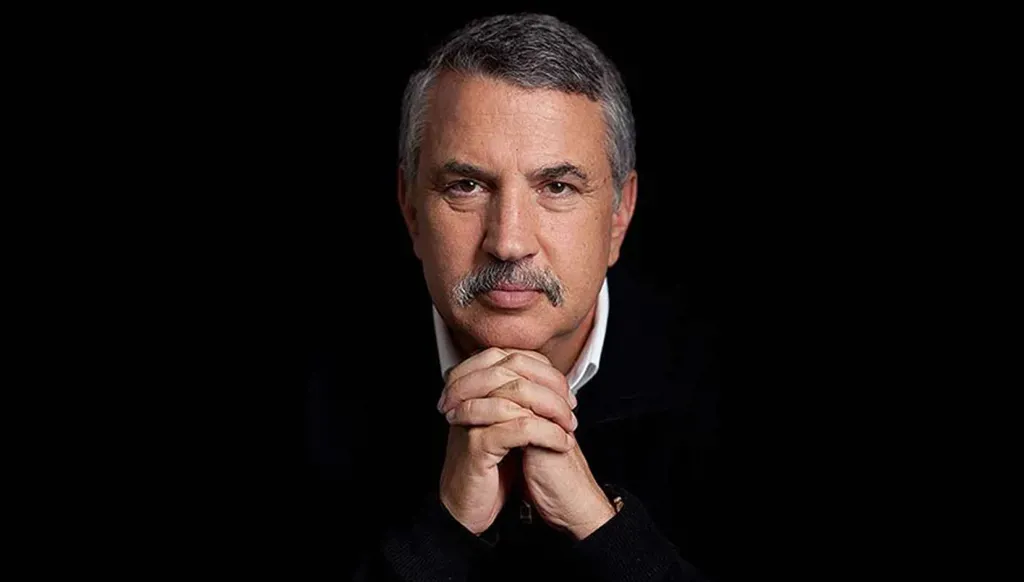
With the announcement that the Assembly of Experts in Iran has chosen a new Supreme Leader for the Islamic Republic following the assassination of Ali Khamenei, questions arise about a deeper transformation in the structure of the Iranian regime and its future, especially as the United States has declared regime change as an explicit goal of the war.
The writer for The New York Times, Thomas L. Friedman, observes that the ongoing war on Iran still lacks a clearly defined ultimate aim, despite repeated discussions of “nuclear disarmament.”
Thomas L. Friedman tells Annahar that what remains unchanged so far is the “fierceness of the joint U.S.-Israeli strikes,” which appear designed to destroy what remains of Iran’s capabilities for uranium enrichment and its missile programs.
“It is difficult to determine how successful these strikes have been in achieving their military objectives so far,” he believes, but he suggests that “when the smoke clears, Iran will have suffered a significant military setback.” Politically, however, the picture remains more ambiguous, as it is still unclear what form the Iranian regime might take once the confrontation is over.
In this context, Thomas L. Friedman points to the possibility of what he has previously described as “Islamic Republic 2.0,” a reconstituted regime in Iran that could negotiate with Washington after the war. He explains that this scenario rests on the assumption that the strikes might weaken the regime’s leadership while leaving behind remnants capable of managing a transitional phase.
“The question then will be: Can these remnants negotiate on behalf of Iran? And if not, who will speak for it?” Friedman asks, noting that Iran today lacks a government that clearly represents the people or a coherent opposition with a prominent leader.
He believes that the war could, at some point, reach a stage where the Americans and Israelis exhaust their list of military targets, raising a practical question: “What do we do now? There’s not much left to bomb, yet we want to end the war. Who do we talk to?” In his estimation, this moment could open a debate within the Iranian regime itself between reformist and hardline factions. He suggests that known reformist figures such as Hassan Rouhani or Mohammad Javad Zarif might then find themselves in a position to tell the hardliners that their policies have led the country into a strategic impasse that has cost it much of its military capabilities and regional influence.
Nevertheless, Thomas L. Friedman does not rule out a more dangerous scenario involving a shake-up of the power center in Iran. With a population of around 90 million and a diverse national composition—including roughly 60% Persians alongside Arab, Azeri, Kurdish, and Baluch minorities—the country could face risks of fragmentation if the political center weakens. He warns that such a collapse “would not be confined to Iran but would destabilize the entire Middle East.”
Economically, Thomas L. Friedman points out that one of Tehran’s bets in this war is to put pressure on the United States through energy markets. According to him, Iran is attempting to disrupt the flow of oil and raise prices, leading to inflation and economic pressure inside the United States, in the hope that this would force the American administration to back down. However, he notes that judging the success of this strategy is premature unless the crisis escalates into a complete disruption of the Strait of Hormuz, which could trigger a global energy crisis.
As for the Gulf Cooperation Council countries, Friedman argues that Tehran had hoped security and economic pressure would push them to urge Washington to stop the war, but the result has been the opposite: the attacks have alienated most of Iran’s neighbors in the Gulf, even those that previously maintained relatively good relations with it.
Regarding Lebanon, Thomas L. Friedman expresses hope in the current government’s success, considering that the country has its “best chance in a long time” under the leadership of Prime Minister Nawaf Salam and President Joseph Aoun. However, he also sees Lebanon as still being held hostage by Hezbollah, which he says has prioritized Iran’s interests over those of the Lebanese Shia community, noting that “the party no longer protects Lebanon from Israel as much as it invites Israeli attacks.”
He suggests that any change in this reality can only come from within the Shia community itself, as any direct confrontation between the Lebanese state and Hezbollah could pose significant risks to the cohesion of both the army and the state, according to Friedman.
Regarding Israel, Thomas L. Friedman acknowledges that the goals of Israeli operations are not entirely clear, even in the Lebanese theater at this stage. He notes that Prime Minister Benjamin Netanyahu acts according to his traditional approach of escalation and hardline stances amid increasing domestic political pressures. Friedman concludes that a quick ceasefire and elections in Israel might offer the best opportunities to reduce tension, expressing his belief that a change in leadership could be “better for the entire region.”





 Messenger
 Whatsapp
 Threads
 Email
Email
 Print
Print
 X
X
 Facebook