




 Messenger
 Whatsapp
 Threads
 Email
Email
 Print
Print
 X
X
 Facebook
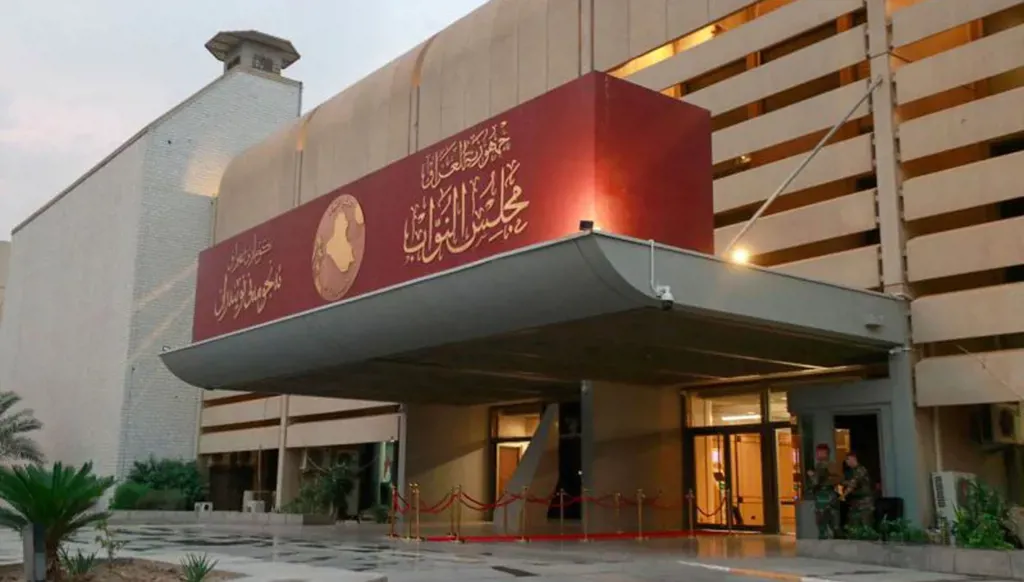


The Iraqi parliament postponed its session scheduled to elect the President of the Republic after the two main Kurdish parties failed to agree on a single candidate, at the request of the other Iraqi political forces, especially the two major political alliances in the country: the Coordination Framework “Shiite” and the Political Council “Sunni”.
These alliances were unwilling for this dispute to spill over into their own ranks and preferred to vote together for one candidate.
The Kurdish nomination crisis
Neither of the two Kurdish parties withdrew its candidate from the presidential race. The Patriotic Union of Kurdistan maintained the nomination of Nizar Amidi, a figure close to the party’s founding leader Jalal Talabani, while the current Foreign Minister Fuad Hussein remained the candidate of the Kurdistan Democratic Party, alongside seventeen other Kurdish candidates.
Negotiations between the two sides over forming the local government have been stalled for fifteen months due to their inability to agree on the distribution of positions and the strategy of government work. There are also sharp disagreements over coordination on joint political action in the capital Baghdad and within the federal government.
According to information obtained by Annahar, the Kurdistan Democratic Party presented a proposal to the Patriotic Union of Kurdistan under which the latter would receive all the main positions currently controlled by the Democratic Party, including the Deputy Speaker of Parliament and a sovereign ministry, most likely the Ministry of Foreign Affairs, in addition to a service ministry, in exchange for relinquishing the post of President of the Republic.
However, the Patriotic Union rejected the offer, relying on its political alliances with Iraqi political forces that hold the largest parliamentary blocs in the federal parliament.
The wavering of Iraqi alliances
However, figures close to the Kurdistan Democratic Party pointed to a fundamental shift in the traditional calculations of the Iraqi parliament. The Kurdistan Democratic Party is no longer in a confrontational relationship with the forces of the Coordination Framework, and it was among the first parties to welcome the nomination of Nouri al-Maliki for the post of the next prime minister.
It does not plan to form a political alliance opposed to the central Shiite alliance, as happened through the “Tripartite Alliance” in 2022, and its relationship with Iran is at its best. All these factors will prevent Iraqi forces and alliances from fully shifting toward the candidates of the Patriotic Union of Kurdistan, as happened more than once in previous experiences.
According to exclusive information obtained by Annahar, the Coordination Framework is divided over voting for either of the Kurdish candidates for the position of President of the Republic. The alliance, which holds 180 parliamentary seats, will mostly vote in favor of the Kurdistan Democratic Party’s candidate. The outgoing Prime Minister Mohammed Shia al-Sudani and the current candidate for prime minister Nouri al-Maliki have made commitments to the Kurdistan Democratic Party and secured at least 130 votes from Coordination Framework lawmakers in favor of its candidate. Meanwhile, the blocs of the Hikma Movement led by Ammar al-Hakim, Asaib Ahl al-Haq led by Qais al-Khazali (a Shiite armed-political group), and the Services Alliance led by Shibli al-Zaydi may vote for the Patriotic Union of Kurdistan’s candidate.
The same applies to the Political Council, as the forces within it - the Sovereignty Alliance, Taqaddum, the Resolve Alliance (Al-Hasm), and the National Masses Alliance (Al-Jamaheer Al-Wataniya) - are not united behind a single position. Taqaddum, led by former parliament speaker Mohammed al-Halbousi, is closer to the Patriotic Union of Kurdistan, while the Sovereignty Alliance is closer to the Kurdistan Democratic Party.
Political researcher and writer Amjad Saraya told Annahar that, in principle, the postponement serves the Coordination Framework because it relieves it of the embarrassment of clashing with the United States following the statement by US President Donald Trump regarding the nomination of al-Maliki for the post of prime minister.
However, the Kurdish dispute may affect fragile Shiite and Sunni understandings, as these alliances have held so far due to expectations of power-sharing within the structure of authority, and Kurdish polarization may trigger polarization from all sides.